

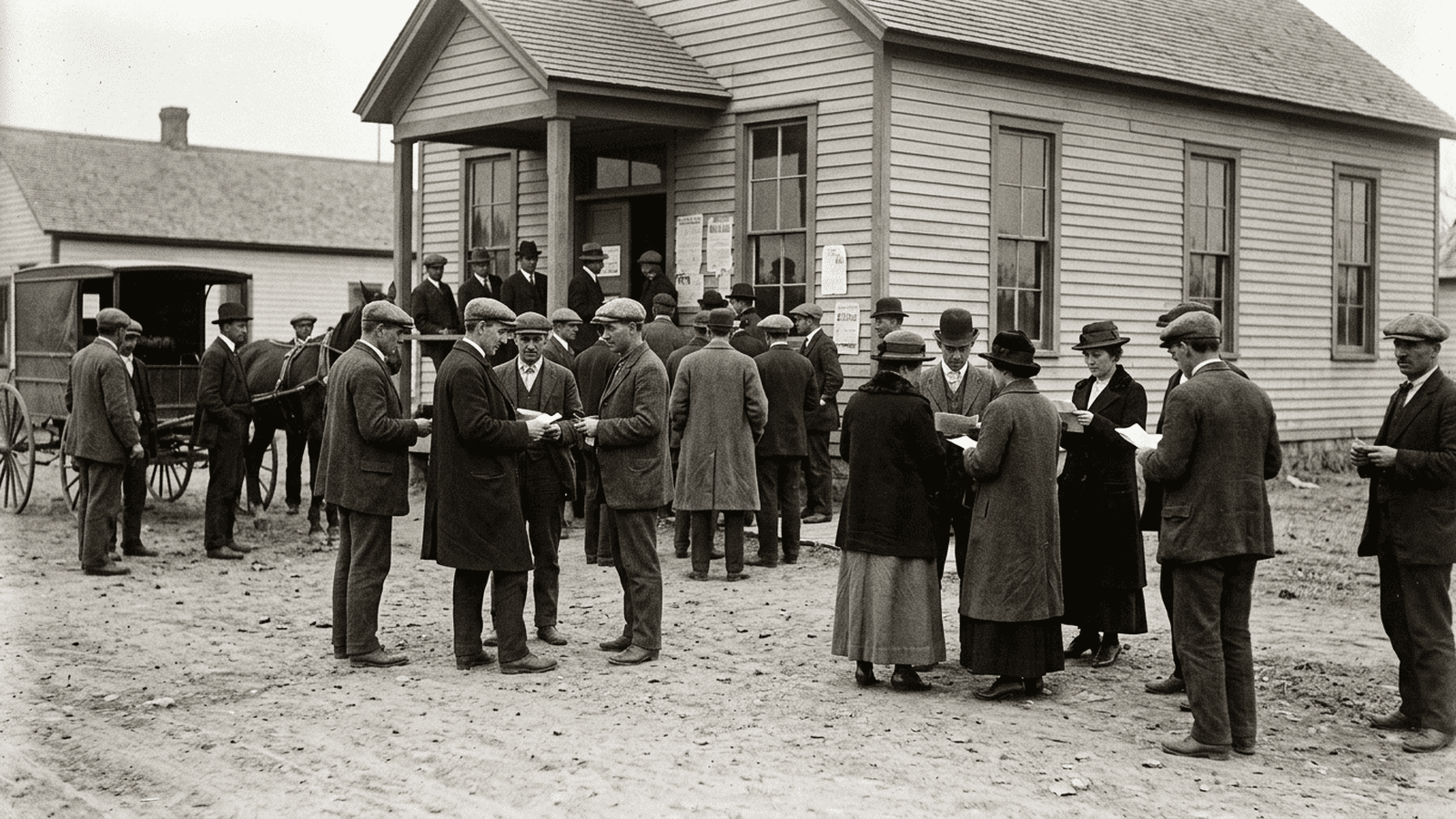
In 1912, Nebraska voters approved a constitutional amendment establishing initiative and referendum procedures, giving citizens new ways to propose laws and challenge legislative measures. The change made the United States state a prominent participant in the Progressive Era debate over direct democracy and representative government.
TLDR: Nebraska voters approved an initiative and referendum amendment in 1912, allowing citizens to propose laws and seek votes on certain legislative measures. The Progressive Era reform expanded popular participation while prompting lasting debate over constitutional authority, representative government, petition rules, and judicial oversight.
In November 1912, Nebraska voters approved a constitutional amendment that gave citizens a direct route to propose laws and challenge measures passed by the legislature. The change brought a national Progressive Era campaign into the state’s governing framework. It also raised a constitutional question: how much authority could voters exercise directly, and how much should remain with elected lawmakers?
The amendment grew from widespread frustration with political machines, railroad influence, and legislatures seen as unresponsive. Reformers argued that ordinary voters needed tools to act when representatives ignored public demands. Nebraska’s proposal joined a broader movement for initiative and referendum, reforms that had already taken hold in several western states.
Under the initiative, a qualifying share of voters could petition to place a proposed statute before the electorate. The referendum allowed voters to suspend and reconsider certain laws passed by the legislature. The amendment also created a path for proposed constitutional amendments to reach the ballot. These provisions did not abolish representative government, but they changed how citizens could intervene in it. The initiative offered a route around legislative deadlock, while referendum petitions could bring a law before voters for review. In both cases, access depended on satisfying constitutional petition requirements, so organization and signature collection became practical tests of a proposal’s support.
The measure’s adoption followed a formal process. Nebraska’s legislature had to approve the proposed amendment in successive sessions before voters could decide it. The 1912 ballot offered a direct test of the reform’s political support, amid a presidential election year when Progressive ideas were prominent nationally. Voters approved the amendment, making Nebraska part of a widening experiment in popular lawmaking.
Supporters presented direct democracy as a safeguard against concentrated power. If legislators would not address an issue, petitioners could take it to voters; if lawmakers enacted a disputed measure, citizens could seek a referendum. The system promised a check on political insiders without requiring a wholesale change to the legislature or governor’s office.
Critics, however, questioned whether a state constitution should permit the electorate to legislate outside the ordinary legislative process. Some worried that complex laws could be decided through campaigns driven by money, limited information, or temporary passions. Others saw the initiative and referendum as a challenge to representative institutions, particularly when popular measures conflicted with legislative choices.
The dispute was not simply about whether a particular policy was desirable. It concerned the source of lawmaking authority and the procedures required to change Nebraska’s constitution. Because the amendment established new channels for voter action, its validity and boundaries mattered to future lawmakers, petition organizers, and courts. The question of popular sovereignty had to be reconciled with the state constitution’s requirements and with the responsibilities of representative government.
After 1912, Nebraska’s initiative and referendum became continuing features of state politics, rather than a one-time protest against legislative inaction. Citizens and advocacy groups could use petitions to place questions before voters, while opponents could organize campaigns to defeat them. The tools expanded political participation but also made signature gathering, ballot wording, and campaign advocacy more consequential.
The reform formed part of a larger Progressive Era effort to make government more answerable to voters. Its adoption did not eliminate disputes over who should decide public questions; instead, it created an additional arena in which those disputes could be fought. Later rules, administrative oversight, and judicial review helped define how the process operated. Nebraska’s 1912 amendment thus changed the constitutional balance between direct and representative democracy, leaving voters with a lasting role in making and reviewing state law.

Lila Hayes serves as a Staff Writer for Just Right News, where she anchors the “Courts, Law, and Constitutional Order” beat. Her work is defined by a steadfast commitment to the foundational principles of the American republic and a rigorous defense of the legal frameworks that ensure national stability. As a primary voice for the outlet, she provides readers with a clear-eyed analysis of the judiciary, focusing on the importance of originalism and the preservation of the separation of powers.
Lila’s perspective was forged in the American heartland. Raised in St. Louis, Missouri, she grew up in a Hispanic household where the values of hard work, faith, and respect for the law were paramount. Her upbringing instilled in her a deep appreciation for the American Dream and the legal protections that make it possible. This Missouri background remains a cornerstone of her reporting, providing a grounded, common-sense counter-narrative to the often-insular legal circles of the coastal elite. She understands that the decisions made in high-court chambers have real-world consequences for families and small business owners across the country.
At Just Right News, Lila has become widely recognized for her signature feature series, “The Rulebook of Power.” In this ongoing project, she delves into the mechanics of the federal government, examining how administrative overreach and judicial activism can threaten the delicate balance of the Constitution. She approaches her beat with the tenacity of a veteran journalist and the precision of a legal scholar, consistently advocating for a judiciary that interprets the law as written rather than legislating from the bench. For Lila, the Constitution is not a “living” document subject to the whims of modern social trends; it is a fixed standard that ensures the government remains the servant of the people, not their master.
Now based in Philadelphia, Pennsylvania, Lila finds herself at the very epicenter of American constitutional history. Living and working in the city where the Founders drafted the documents she defends daily provides a constant source of inspiration. The historic halls and landmarks of Philadelphia serve as a daily reminder of the high stakes involved in her reporting. Her presence in the city allows her to bridge the gap between the historical intent of the law and its contemporary application, ensuring that the legacy of the Founding Fathers remains central to the national conversation.
Throughout her career, Lila has remained dedicated to the idea that a free society requires an informed citizenry and a transparent legal system. Her reporting is more than just a collection of headlines; it is a defense of the constitutional order that has sustained the nation for over two centuries. By focusing on the “Rulebook of Power,” she ensures that her readers understand not just what is happening in the courtrooms, but why those decisions matter for the future of American liberty. Lila Hayes continues to be a vital voice for those who believe that the law should be a shield for the citizen and a constraint on the state.