

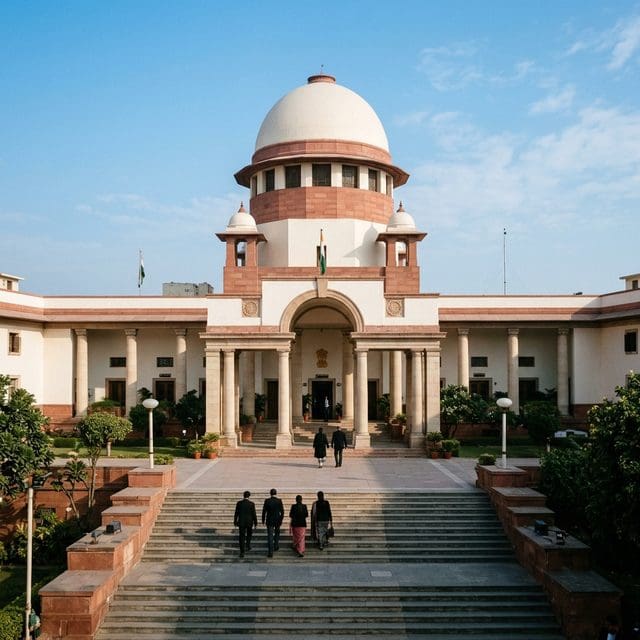
Three separate proceedings in India show the difference between an urgent challenge to an investigation, a ruling on school assemblies and a trial court’s bail decision.
India’s courts took up three distinct matters on October 6, each with a different procedural consequence: the Supreme Court agreed to hear Punjab’s challenge to a Central Bureau of Investigation probe, dismissed a petition seeking mandatory Preamble recitation in schools, and a Delhi trial court granted regular bail to Swatantra Bhardwaj in an assault case.
The Supreme Court’s agreement to hear Punjab’s plea is not a ruling on the merits of the corruption allegations or on the ultimate authority of the CBI to investigate. Punjab is challenging a Punjab and Haryana High Court order directing the agency to register a first information report and submit a report within two months. The Supreme Court said it would try to hear the state’s petition on Wednesday or Thursday after declining same-day listing, according to reports by The Hindu and other Indian outlets.
Punjab argues that the High Court’s intervention raises concerns about the federal structure and comes ahead of state Assembly elections. The dispute follows communications from the Enforcement Directorate alleging wrongdoing involving public servants and private individuals linked to Chief Minister Bhagwant Mann’s office. The reported allegations include improper influence over transfers and postings, policy decisions and tenders. Those claims remain allegations, not findings of guilt.
The High Court said the material before it prima facie warranted an FIR and criticized the state police’s handling of a preliminary inquiry. That threshold determination is not a conviction and does not settle whether any accused person committed an offense. The Supreme Court’s next step is to consider Punjab’s challenge; the available reports do not establish that it has stayed the High Court’s direction.
In a separate matter, the Supreme Court dismissed a public-interest petition asking for a nationwide policy requiring students to recite the Constitution’s Preamble during morning assemblies. The petitioner sought directions to the Union Education Ministry and the Central Board of Secondary Education. The Court’s reported observation that the Preamble is already covered in classroom instruction helps explain its decision, but the dismissal does not amount to a general prohibition on schools choosing to include a recitation.
The distinction is practical: the petition asked the Court to require a uniform national practice, while the reported decision rejected that request. It does not, on the information available, invalidate local initiatives or settle every question about how schools may teach constitutional values. Nor should this ruling be confused with a separate Supreme Court decision reported in older coverage concerning the words “socialist” and “secular” in the Preamble. That earlier constitutional question is not what the school-assembly petition asked the Court to decide.
In Delhi, Additional Sessions Judge Saurabh Pratap Singh Laler granted regular bail to Bhardwaj in the Jantar Mantar assault case, The Hindu reported. The judge had earlier granted him interim bail for three weeks and considered his conduct during that period before issuing the regular-bail order. The available report does not provide the detailed terms of the final order, so the conditions attached to interim release should not be treated as the final bail conditions.
Bail governs a person’s release while a case proceeds; it is not a determination of innocence or guilt. The reported case concerns an alleged assault on a member of the Scheduled Caste community. No finding on the underlying allegation follows from the bail decision itself.
Taken together, the proceedings illustrate why court actions should be read at the stage they occupy. An agreement to hear a challenge opens review, a dismissal denies a requested remedy, and bail addresses detention pending proceedings. None, by itself, resolves the factual allegations at the heart of a criminal investigation or trial.

Lila Hayes serves as a Staff Writer for Just Right News, where she anchors the “Courts, Law, and Constitutional Order” beat. Her work is defined by a steadfast commitment to the foundational principles of the American republic and a rigorous defense of the legal frameworks that ensure national stability. As a primary voice for the outlet, she provides readers with a clear-eyed analysis of the judiciary, focusing on the importance of originalism and the preservation of the separation of powers.
Lila’s perspective was forged in the American heartland. Raised in St. Louis, Missouri, she grew up in a Hispanic household where the values of hard work, faith, and respect for the law were paramount. Her upbringing instilled in her a deep appreciation for the American Dream and the legal protections that make it possible. This Missouri background remains a cornerstone of her reporting, providing a grounded, common-sense counter-narrative to the often-insular legal circles of the coastal elite. She understands that the decisions made in high-court chambers have real-world consequences for families and small business owners across the country.
At Just Right News, Lila has become widely recognized for her signature feature series, “The Rulebook of Power.” In this ongoing project, she delves into the mechanics of the federal government, examining how administrative overreach and judicial activism can threaten the delicate balance of the Constitution. She approaches her beat with the tenacity of a veteran journalist and the precision of a legal scholar, consistently advocating for a judiciary that interprets the law as written rather than legislating from the bench. For Lila, the Constitution is not a “living” document subject to the whims of modern social trends; it is a fixed standard that ensures the government remains the servant of the people, not their master.
Now based in Philadelphia, Pennsylvania, Lila finds herself at the very epicenter of American constitutional history. Living and working in the city where the Founders drafted the documents she defends daily provides a constant source of inspiration. The historic halls and landmarks of Philadelphia serve as a daily reminder of the high stakes involved in her reporting. Her presence in the city allows her to bridge the gap between the historical intent of the law and its contemporary application, ensuring that the legacy of the Founding Fathers remains central to the national conversation.
Throughout her career, Lila has remained dedicated to the idea that a free society requires an informed citizenry and a transparent legal system. Her reporting is more than just a collection of headlines; it is a defense of the constitutional order that has sustained the nation for over two centuries. By focusing on the “Rulebook of Power,” she ensures that her readers understand not just what is happening in the courtrooms, but why those decisions matter for the future of American liberty. Lila Hayes continues to be a vital voice for those who believe that the law should be a shield for the citizen and a constraint on the state.