

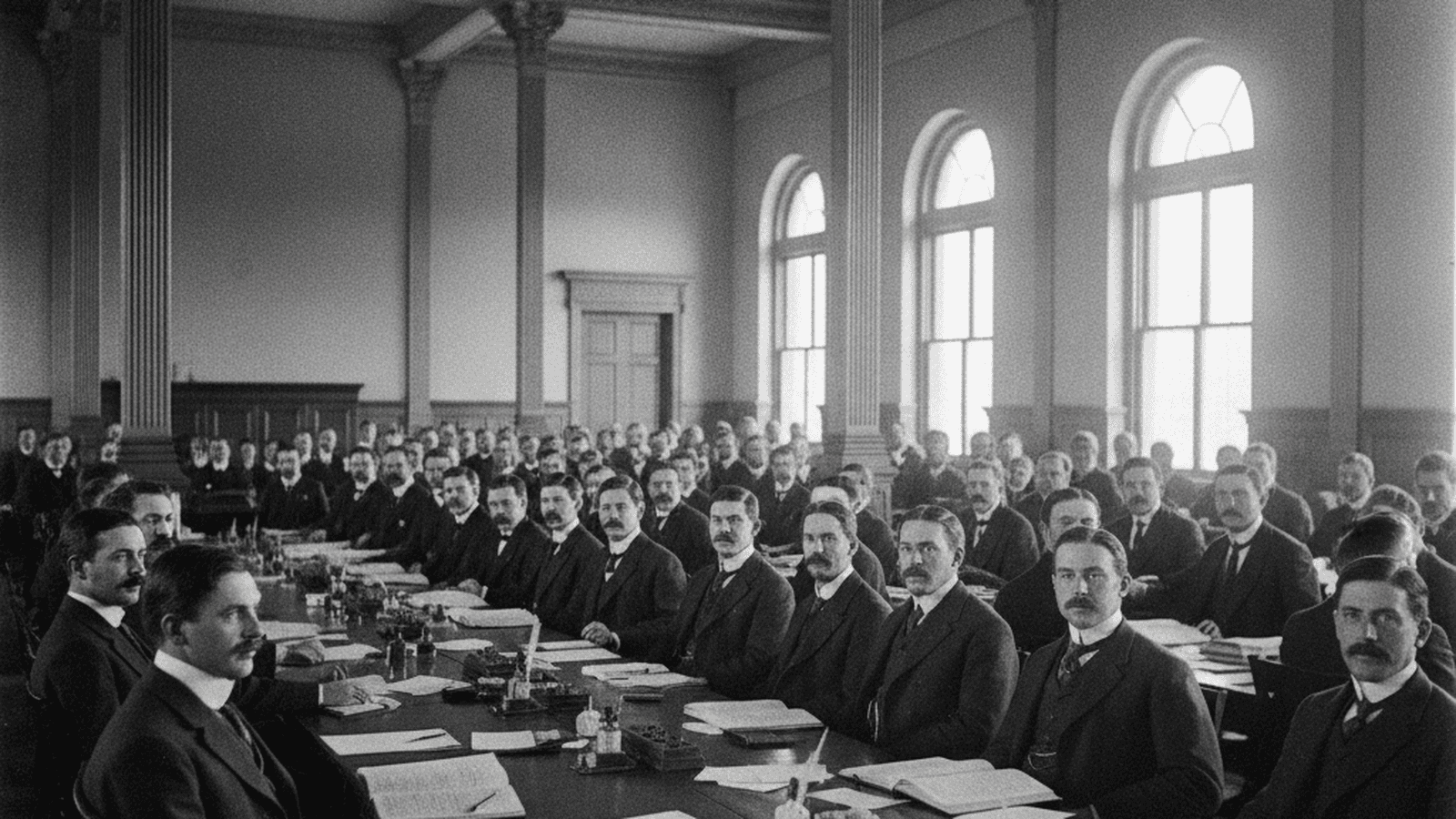
In 1910, delegates at the New Mexico Constitutional Convention established Ironclad Clauses to protect the civil rights of the state’s Hispanic population. These provisions ensured that the right to vote and access to education could not be restricted based on language or ancestry in the United States.
TLDR: During the 1910 New Mexico Constitutional Convention, Hispano delegates led by Solomon Luna secured unprecedented legal protections for Spanish-speaking citizens. These Ironclad Clauses prevented disenfranchisement and educational discrimination, requiring nearly impossible majorities to repeal. The move ensured New Mexico entered the United States with robust civil rights safeguards.
As the United States expanded into the Southwest during the early 20th century, the push for New Mexico’s statehood forced a confrontation between traditional Hispanic political power and the rising influence of Anglo-American settlers. In 1910, delegates gathered in Santa Fe to draft a constitution that would finally allow the territory to join the Union. The central tension of the convention revolved around the civil rights of the Hispano population, who had lived in the region for centuries under Spanish and Mexican rule.
The political landscape of New Mexico was unique compared to other Western territories. Unlike many areas where Spanish-speaking populations were quickly marginalized, New Mexico’s Hispanic elite maintained significant land holdings and political influence. However, the implementation of Jim Crow laws in the American South and the disenfranchisement of minorities in other states created a sense of urgency among Hispano leaders. They feared that once New Mexico became a state, a new legislative majority might use literacy tests or language requirements to strip them of their political voice.
Solomon Luna, a wealthy sheep rancher and the most powerful Republican in the territory, emerged as the primary architect of the Hispanic defense. Luna chaired the convention’s Committee on Committees, giving him the power to place his allies in key positions. He led a caucus of Spanish-American delegates who were determined to bake civil rights protections directly into the foundational law of the state. Their goal was to create Ironclad Clauses that would be virtually impossible for future legislatures to overturn.
The resulting document included Article VII and Article XII, which provided unprecedented protections. Article VII stipulated that the right of any citizen to vote or hold office could never be restricted on account of religion, race, language, or color. It specifically protected those who were unable to speak, read, or write the English or Spanish languages. Article XII guaranteed that children of Spanish descent would never be denied admission to public schools and prohibited the establishment of separate schools for Hispanic students.
To ensure these protections were not merely symbolic, the delegates implemented a rigorous amendment process. Changing these specific clauses required a three-fourths majority of the total vote in the state and a two-thirds majority in every single county. This high bar was designed to prevent a simple majority of new settlers from eroding the rights of the established population. The convention’s success in passing these measures reflected a sophisticated understanding of constitutional law and a proactive approach to civil rights.
The 1910 convention was not without controversy. Some Anglo delegates argued that such rigid protections were unnecessary or that they would hinder the Americanization of the state. However, the Hispano caucus remained unified, leveraging their voting bloc to ensure the clauses remained intact. When New Mexico was officially admitted to the United States in 1912, it possessed one of the most progressive constitutions in the country regarding the protection of a linguistic and ethnic minority.
The legacy of the Ironclad Clauses continues to define New Mexico’s political identity. While other states in the Mountain West struggled with the legacy of exclusion, New Mexico’s constitutional framework provided a legal shield that preserved Hispanic political participation. These protections were tested in later decades but largely remained a cornerstone of the state’s governance. The 1910 convention serves as a reminder of how institutional design can be used to safeguard the rights of vulnerable populations against the shifting tides of demographic change. Subsequent legal challenges and modern voting rights discussions in the United States often reference the New Mexico model as an early example of proactive constitutional protection.

Lila Hayes serves as a Staff Writer for Just Right News, where she anchors the “Courts, Law, and Constitutional Order” beat. Her work is defined by a steadfast commitment to the foundational principles of the American republic and a rigorous defense of the legal frameworks that ensure national stability. As a primary voice for the outlet, she provides readers with a clear-eyed analysis of the judiciary, focusing on the importance of originalism and the preservation of the separation of powers.
Lila’s perspective was forged in the American heartland. Raised in St. Louis, Missouri, she grew up in a Hispanic household where the values of hard work, faith, and respect for the law were paramount. Her upbringing instilled in her a deep appreciation for the American Dream and the legal protections that make it possible. This Missouri background remains a cornerstone of her reporting, providing a grounded, common-sense counter-narrative to the often-insular legal circles of the coastal elite. She understands that the decisions made in high-court chambers have real-world consequences for families and small business owners across the country.
At Just Right News, Lila has become widely recognized for her signature feature series, “The Rulebook of Power.” In this ongoing project, she delves into the mechanics of the federal government, examining how administrative overreach and judicial activism can threaten the delicate balance of the Constitution. She approaches her beat with the tenacity of a veteran journalist and the precision of a legal scholar, consistently advocating for a judiciary that interprets the law as written rather than legislating from the bench. For Lila, the Constitution is not a “living” document subject to the whims of modern social trends; it is a fixed standard that ensures the government remains the servant of the people, not their master.
Now based in Philadelphia, Pennsylvania, Lila finds herself at the very epicenter of American constitutional history. Living and working in the city where the Founders drafted the documents she defends daily provides a constant source of inspiration. The historic halls and landmarks of Philadelphia serve as a daily reminder of the high stakes involved in her reporting. Her presence in the city allows her to bridge the gap between the historical intent of the law and its contemporary application, ensuring that the legacy of the Founding Fathers remains central to the national conversation.
Throughout her career, Lila has remained dedicated to the idea that a free society requires an informed citizenry and a transparent legal system. Her reporting is more than just a collection of headlines; it is a defense of the constitutional order that has sustained the nation for over two centuries. By focusing on the “Rulebook of Power,” she ensures that her readers understand not just what is happening in the courtrooms, but why those decisions matter for the future of American liberty. Lila Hayes continues to be a vital voice for those who believe that the law should be a shield for the citizen and a constraint on the state.