

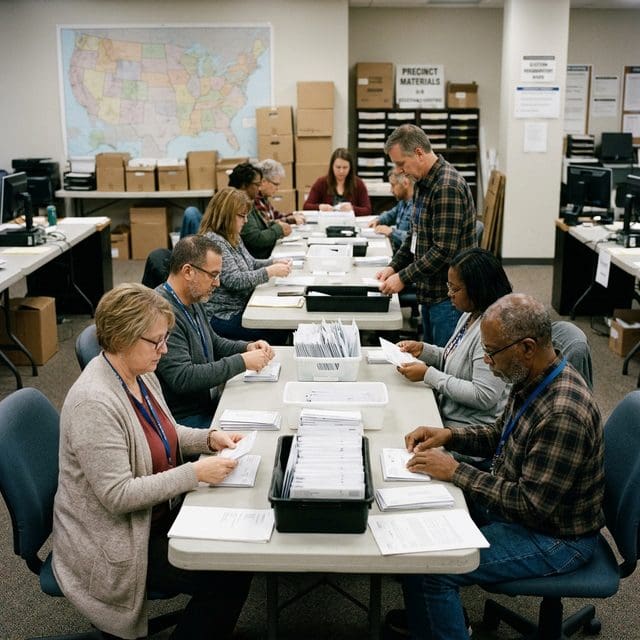
Turnout is sharply higher in Texas and North Carolina, while county-level political signals and election disputes highlight the local institutions shaping a national midterm contest.
With the Nov. 3 midterms days away, state and county election systems are producing a varied picture: turnout is surging in Texas and North Carolina, bellwether counties are sending mixed political signals, and disputes over election administration remain active in California and Alaska. National contests are conducted through local institutions, with state and county officials responsible for much of the work of processing and reporting votes.
More than 6.3 million Texans had voted early by Wednesday, 50% above the comparable point in 2022, according to the Associated Press. Harris County reported 862,700 votes, compared with 564,500 at the same point four years earlier. In North Carolina, more than 2 million people had voted by Wednesday evening, over 35% above the comparable 2022 period, ABC News reported. Black early-vote turnout there was up more than 50%.
The figures measure participation, not how voters will choose, and do not establish why turnout has risen. They do put local election operations in focus as officials process ballots and prepare to report results. In Texas, the AP expects most counties to release nearly all early and absentee results in their first update, often before reporting Election Day in-person votes. That timing may shape the first public impression of the outcome, though later returns will add to the picture.
County-level political signals are less uniform. In Wisconsin, voters in Sauk County described dissatisfaction and uncertainty about the governor’s race, the Milwaukee Journal Sentinel reported. The county has backed the statewide presidential winner in eight consecutive elections, making it a point of interest—but not a guarantee of how the state will vote.
In Michigan, analysts identified Saginaw as a current bellwether and said Macomb remains important for Republican Senate candidate Mike Rogers. Kent County, meanwhile, has moved left over the past decade, according to WWMT. Bellwether status reflects past patterns; it does not settle a race or erase differences among communities.
President Donald Trump is not on the ballot, but voters in bellwether counties are largely treating the midterms as a referendum on him, the Daily Mail reported after visiting five such areas. The Republican National Committee said Trump would participate in tele-rallies across 19 states after in-person events in Iowa and Kansas were canceled. Trump has said he would respect the 2026 midterm results if the elections were honest. These national efforts unfold alongside local contests with distinct candidates and issues.
California’s ballot dispute underscores questions about who may review election records and how voter privacy is protected. Another judge ordered the administration to share a disputed voter list with voting-rights groups for review, the AP reported. Election officials said processed ballots cannot be matched back to individual voters. The order keeps the list under scrutiny, but the available reporting does not resolve the dispute or establish the administration’s next steps.
In Alaska, Gov. Mike Dunleavy ordered an investigation into allegations that Mary Peltola’s Senate campaign recruited spoiler candidates to draw votes from Sen. Dan Sullivan. The House Oversight Committee also opened an investigation. Peltola’s campaign and national Democrats denied the allegations reported by The New York Times. Dunleavy said the state’s election-certification process could be stopped or changed because of the investigation. The allegations remain contested; the investigations are not findings that the campaign violated state law.
The reports do not establish that one state is copying another’s approach, or that higher turnout will benefit either party. They do show that election administration is not a single national operation. State rules, county reporting and court decisions intersect with federal involvement, while voters encounter the system through local offices. Comparisons among returns will need to account for those differences rather than treating every early count or county trend as interchangeable.

Dylan Brooks serves as the Senior Correspondent for Statehouses and Local Governance at Just Right News, where he brings a principled, constitutionalist lens to the often-overlooked machinery of state-level politics. As the lead voice behind the acclaimed feature series “Fifty Laboratories of Power,” Dylan has dedicated his career to the idea that the most impactful governance happens closest to home. His reporting consistently champions the Tenth Amendment, exploring how individual states can serve as testing grounds for innovative, conservative policy solutions that prioritize personal liberty and fiscal responsibility.
A native of Des Moines, Iowa, Dylan’s journalistic philosophy was forged in the heart of the American Midwest. Growing up in a community where local school board meetings and town halls were the bedrock of civic life, he developed a deep appreciation for the “retail politics” of the heartland. This upbringing instilled in him a fundamental belief that the American experiment is best preserved when power is decentralized. He carries the values of his Iowa roots into every assignment, maintaining a healthy skepticism of federal overreach and a steadfast commitment to the concerns of everyday citizens over the interests of the administrative state.
Now based in Madison, Wisconsin, Dylan operates from one of the nation’s most pivotal political battlegrounds. His location in a state capital known for its rigorous policy debates allows him to provide Just Right News readers with a front-row seat to the legislative process. From Madison, he tracks the ripple effects of statehouse decisions on local municipalities, ensuring that the connection between high-level policy and community impact is never lost. His work often highlights the success of conservative governors and legislatures in fostering economic growth, protecting parental rights, and securing the integrity of local institutions.
As an African American man in the conservative media landscape, Dylan offers a vital perspective on how limited government and free-market principles empower individuals and families. He frequently reports on how deregulation and school choice initiatives provide new avenues for success in underserved communities, challenging the monolithic narratives often presented by legacy media outlets. Dylan’s work is characterized by a commitment to the facts and a refusal to shy away from the complex realities of modern governance.
Throughout his tenure at Just Right News, Dylan has become a trusted authority for readers who value a rigorous, principled approach to the news. Whether he is dissecting a complex state budget or profiling a local grassroots movement, his goal remains the same: to provide the American public with the information they need to hold their local leaders accountable. By focusing on the “Fifty Laboratories of Power,” Dylan Brooks ensures that the vital work being done in statehouses across the country receives the national attention it deserves, always through a lens that respects the traditions and sovereignty of the American people.