

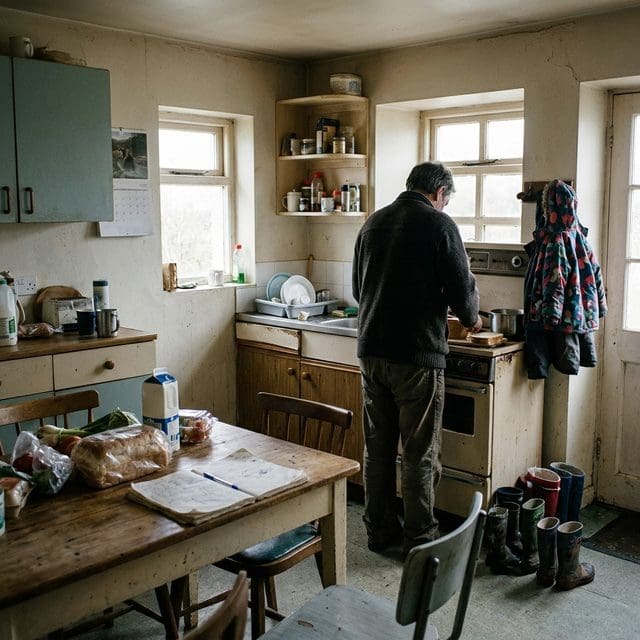
An Irish project manager’s account of housing instability and careful budgeting shows how routine costs can strain a family without a stable home.
A family’s housing trouble can begin with a decision made elsewhere. In a Money Diaries account published by TheJournal.ie, a project manager in a rural village in western Ireland says a landlord sold the family’s previous home. The diarist gave away most of their belongings and spent two years staying in other people’s spare rooms with a teenage son.
The diarist describes being among Ireland’s “hidden homeless”: without a stable home, but not necessarily visible in the way people often picture homelessness. Having somewhere to sleep, the account suggests, is not the same as having a secure place to live. For two years, the family’s possessions and routines had to fit around other people’s homes.
TheJournal.ie’s Money Diaries series follows household spending over a week. Here, its details show the work of keeping family life going after housing disruption. The diarist cooks from scratch, reuses leftovers, freezes bread and makes compote, while avoiding takeaways. Good food for the children is described as non-negotiable, not an area where further cuts are easy.
Planning does not prevent every loss. The diarist says they had to compost fruit bought only a few days earlier because it had gone bad. That small waste sits alongside deliberate efforts to make food last. The diary shows both the discipline involved in budgeting and the limits of what planning can control.
Work travel presents another strain. The diarist says they pay diesel and public-transport costs upfront, then wait a month for reimbursement. Extra travel spending in the previous month “totally wiped” them out. The costs may eventually be repaid, but the household has to cover them in the meantime. When money is tight, the timing of a bill can matter as much as its final cost.
The weekly account also includes second-hand waterproof shoes, a winter coat and a transport-card top-up for the children. These are practical needs, not obvious luxuries, but they still compete with rent and household bills. The diarist says moving expenses, household items, school uniforms and school fees have so far prevented saving. They also describe helping older children who are on low wages.
The list of recurring pressures extends beyond rent and groceries: electricity, diesel, car maintenance, heating oil, clothing and doctors. Moving into a home also means replacing basic household items. Costs that might be spread across years for a settled household can arrive together after a move.
The material available does not provide verified figures for the diarist’s budget, so exact amounts cannot be responsibly repeated. Nor does one diary establish how common this experience is across Ireland. It is an individual account, published by TheJournal.ie, not a representative survey or a basis for direct comparison with American households.
Its value is in the specifics. A working household can plan meals, limit discretionary spending and still struggle to save or absorb an unexpected expense. A month’s wait for travel reimbursement, spoiled fruit or a child’s winter coat matters more when there is little room in the budget.
The diarist says there were no further meaningful cuts to make. Free podcasts, library books, homemade toiletries and sewing clothes from existing materials help keep discretionary spending down. The account offers no policy blueprint; it records the strain of trying to rebuild ordinary stability after losing a home. Resourcefulness helps the family manage, but it has not yet made saving possible.

Ethan Blake serves as a Senior Correspondent for Just Right News, where he specializes in Longform Narrative and Public Understanding. In an era of rapid-fire headlines and fleeting soundbites, Ethan’s work stands as a testament to the power of deep-dive reporting and the importance of contextualizing the complex issues facing the nation today. His approach is rooted in the belief that the most profound truths are often found in the lived experiences of individuals rather than the abstract theories of distant policymakers.
Growing up in Providence, Rhode Island, Ethan developed an early appreciation for the historical and cultural threads that weave the American fabric together. Providence, a city defined by its industrial heritage and its blend of traditional neighborhoods, provided him with a front-row seat to the challenges and triumphs of the American working class. This upbringing instilled in him a respect for the “common sense” values of hard work, community loyalty, and the preservation of local institutions. He learned early on that behind every economic statistic or legislative debate, there are real families and neighborhoods navigating the consequences of change.
This foundational perspective is the driving force behind his signature feature series, “Lives Behind the Systems.” Through this series, Ethan explores the intersection of individual agency and institutional structure. Whether he is documenting the impact of federal land-use policies on rural families or examining how shifting educational standards affect local school boards, Ethan’s work prioritizes the human element. He seeks to uncover how large-scale systems—be they governmental, economic, or social—affect the daily lives of citizens, often advocating for a return to local control and personal responsibility.
Now based in Portland, Maine, Ethan draws significant inspiration from the rugged independence and self-reliance that define the region. The coastal landscape and the resilient spirit of Maine’s communities serve as a constant reminder of the importance of individual liberty and the strength found in decentralized power. Living and working outside the traditional media hubs allows Ethan to maintain a grounded perspective, ensuring his reporting remains untethered from the echo chambers of the major metropolitan centers. This geographic distance provides him with the clarity needed to translate complex national narratives into stories that resonate with the heart of the country.
At Just Right News, Ethan’s beat is more than just a professional assignment; it is a mission to foster a more informed and engaged citizenry. He believes that a free society depends on the public’s ability to understand the mechanisms of power and the value of traditional American principles. His longform narratives do not merely report the news; they provide a roadmap for understanding the cultural and political shifts of the modern era through a lens of skepticism toward centralized authority and a deep respect for the individual.
Through his meticulous research and narrative craftsmanship, Ethan Blake continues to bridge the gap between policy and the public. His work remains a vital resource for those who seek a deeper understanding of the systems that shape our world and the enduring spirit of the people who live within them.