

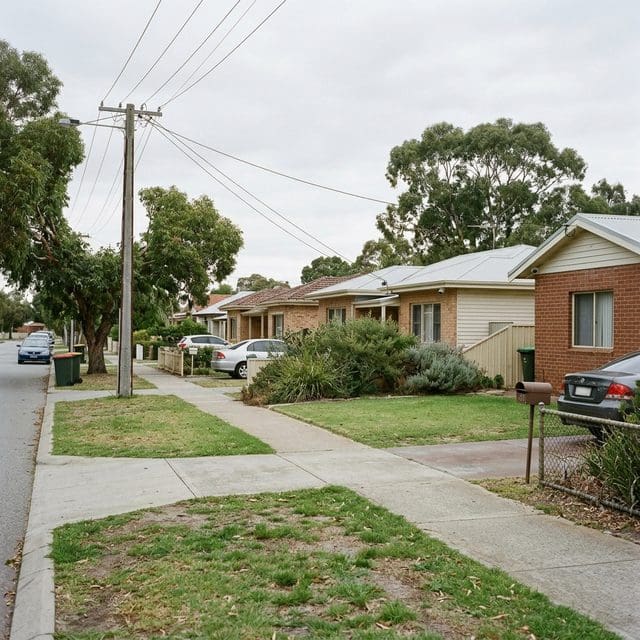
A public-housing dispute in Cloverdale highlights how complaint procedures and tenancy law shape residents’ options when neighbours say persistent disruption is driving them from home.
A dispute on a public-housing street in Cloverdale, a suburb of Perth, raises a basic question about housing security: what protection does a tenancy provide when residents say their home no longer feels safe?
Megan, a tenant with a disability who previously stayed in a women’s refuge after leaving an abusive relationship, told The Age that problems at the neighbouring property have continued for about four years. The newspaper reported allegations of open drug use, threats, suspected break-ins, concerns about children’s safety and frequent visitors. Megan has installed security cameras and sometimes stays with a friend because of the disruption.
The allegations have not been established as findings by a court or an investigation. But two nearby residents described a prolonged effort to obtain a response. Neighbour Brent told The Age he contacted the Department of Housing’s disruptive-behaviour team “four or five” times and is now planning to move and sell his home. Megan said she had also complained repeatedly but had “given up a little bit.” One neighbour reported that four children lived in a two-bedroom house.
For tenants with limited alternatives, leaving can mean trading one set of problems for the uncertainty and expense of finding another home. The Age did not report the residents’ housing options or the costs of moving.
Western Australian guidance, last updated Feb. 23, 2026, divides disruptive conduct into three categories: dangerous, serious and disruptive. The Department of Housing and Works can act when behaviour breaches a tenancy agreement or the Residential Tenancies Act 1987. It is not a general enforcement agency for every conflict between neighbours.
Minister John Carey told The Age that complaints must be made through the department’s disruptive-behaviour reporting line before conduct can be investigated. The department said it works with tenants and support agencies and will act when behaviour is serious or ongoing. Carey said eviction requires a Magistrates Court order confirming a tenancy breach and a failure to rectify it. Criminal behaviour, he said, should be reported to police.
That division of responsibility reflects a tension in public-housing policy. Agencies must address serious disruption while following tenancy law; they cannot take the place of police or courts. Requiring formal complaints and evidence of a breach may protect due process. To residents who say they have reported problems repeatedly, the same process may feel like a slow route to relief.
The available reporting does not establish whether officials failed to act, whether the allegations meet the legal threshold for intervention or what steps the department has taken. The Age reported the department’s general position but not a detailed account of the investigation or its outcome. The central question—how quickly the system can respond when residents say disruption makes their homes unlivable—remains unanswered.
In Ireland, a separate information gap has complicated debate over housing need. The Journal reported that the housing minister expressed frustration after monthly homelessness figures were not released because of ongoing industrial action. The report did not provide the missing figures. Without current data, policymakers and the public have a less complete picture of homelessness.
Neither report measures the wider performance of its housing system. But both point to the stakes of administration: residents need a process capable of responding to serious problems, and the public needs reliable information to assess policy. For people who cannot easily move, a functioning complaint system is part of the security a home is meant to provide.

Deborah Cole serves as a Senior Correspondent for Just Right News, where she spearheads the network’s coverage of Housing, Infrastructure, and Mobility. With a career defined by a commitment to rigorous reporting and a focus on the fundamental pillars of American community life, Deborah brings a principled perspective to the complex issues that dictate how and where we live. Her work is grounded in the belief that sound policy, fiscal responsibility, and respect for private property are the essential foundations of a prosperous society.
Originally from Boston, Massachusetts, Deborah’s upbringing in one of the nation’s oldest and most historically significant cities deeply influenced her professional trajectory. Growing up amidst the architectural legacy and dense urban planning of New England, she developed an early appreciation for the importance of durable infrastructure and the role of local tradition in shaping neighborhoods. Her perspective is informed by the classic American values of her hometown—hard work, community cohesion, and a healthy skepticism of top-down bureaucratic mandates that often overlook the unique needs of individual citizens.
Today, Deborah operates from her base in Austin, Texas, a city that serves as a primary laboratory for her reporting. Austin’s rapid expansion and its status as a hub for innovation and migration provide her with a front-row seat to the most pressing challenges in modern infrastructure and housing. From the Lone Star State, she chronicles the tensions between rapid growth and the preservation of the American Dream, often highlighting how market-driven solutions and deregulation can address the housing shortages that plague many of the country’s metropolitan areas.
At Just Right News, Deborah is perhaps best known for her signature feature series, “Where We Live.” Through this platform, she explores the intersection of public policy and private life, moving beyond mere statistics to tell the stories of families, small business owners, and local developers. Her reporting frequently highlights the importance of mobility—not just in terms of transportation and transit, but as a vehicle for economic opportunity and social stability. She remains a staunch advocate for the taxpayer, consistently scrutinizing government spending on large-scale projects and advocating for transparency in how infrastructure dollars are allocated.
Deborah’s beat is more than just a collection of policy topics; it is an investigation into the physical and legal structures that allow families to flourish. Whether she is reporting on the impact of zoning laws on suburban development or the necessity of maintaining the nation’s highway systems, her work is characterized by a dedication to the facts and a respect for the constitutional principles that protect the rights of homeowners.
As a Senior Correspondent, Deborah Cole continues to be a vital voice for Just Right News, providing the audience with the clarity and context needed to navigate an ever-changing landscape. Her reporting ensures that the values of individual liberty and local sovereignty remain at the forefront of the national conversation regarding the future of our cities and towns. Through her tireless efforts, she remains committed to informing the public on the issues that hit closest to home.