

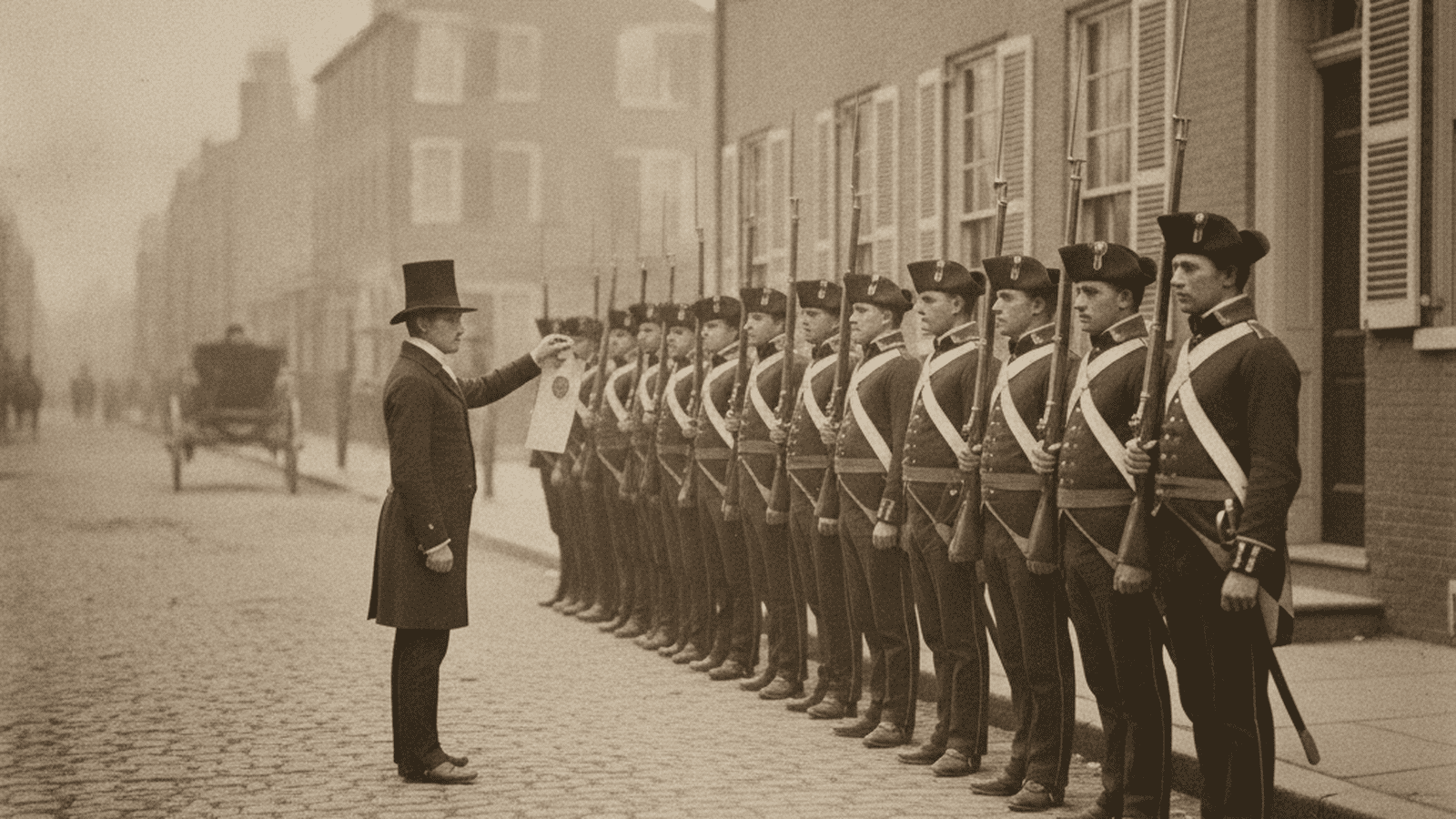
In 1809, the United States faced a constitutional standoff when Pennsylvania used its state militia to defy a federal court order regarding Revolutionary War prize money. The Supreme Court ruling in United States v. Peters ultimately forced the state to yield, asserting the supremacy of federal judicial authority over state legislatures.
TLDR: The 1809 Olmstead crisis saw Pennsylvania’s militia block federal marshals from enforcing a Supreme Court ruling. President James Madison’s refusal to support the state’s defiance cemented the principle that federal law supersedes state legislative acts, preventing a collapse of the national judicial system during the Early Republic.
In 1809, the fragile stability of the American legal system was pushed to the brink in the streets of Philadelphia. The Olmstead Crisis, culminating in the Supreme Court case United States v. Peters, represented the first major test of whether a state could unilaterally nullify a federal court order. The roots of the conflict stretched back to the American Revolution, involving a dispute over maritime prize money that would eventually force a choice between the rule of law and the specter of civil war.
The saga began in 1778 when Gideon Olmstead, a Connecticut sailor, was captured by the British and forced into service aboard the sloop Active. In a daring act of rebellion, Olmstead and three fellow prisoners seized control of the vessel. As they steered toward a friendly port, they were intercepted by the Convention, a privateer commissioned by the state of Pennsylvania. When the case reached a Pennsylvania admiralty court, the jury awarded only one-fourth of the prize money to Olmstead and his crew, granting the remainder to the Commonwealth and the owners of the Convention. Olmstead appealed to the Continental Congress’s Committee of Appeals, which overturned the state court’s decision and awarded him the full amount. However, Pennsylvania authorities, operating under the loose framework of the Articles of Confederation, refused to recognize the federal decree.
For decades, the case languished as the United States transitioned from the Articles of Confederation to the Constitution. By 1803, the dispute reached a boiling point. The Pennsylvania legislature, asserting its sovereign rights, passed an act declaring that the federal court lacked jurisdiction over the matter. They authorized the governor to protect the state’s interests—and the disputed funds—against any federal encroachment. This was a direct challenge to the newly established federal judiciary. When Judge Richard Peters of the U.S. District Court finally attempted to enforce the payment in 1808, he was met with a formal protest from the state.
The matter ascended to the Supreme Court, where Chief Justice John Marshall issued a landmark opinion in February 1809. Marshall’s ruling was a stinging rebuke to state-level defiance. He argued that if a state legislature could at will annul the judgments of the federal courts and destroy the rights acquired under those judgments, the Constitution itself would become a “solemn mockery.” Marshall asserted that the federal judiciary was the final arbiter of the law, a principle essential to the survival of the Union.
Despite the Supreme Court’s mandate, Pennsylvania Governor Simon Snyder refused to back down. He ordered the state militia, under the command of General Michael Bright, to surround the Philadelphia home of the daughters of the late state treasurer, where the disputed funds were held. For several weeks, a tense military standoff ensued. Armed state troops stood with bayonets fixed, physically blocking U.S. Marshal John Smith from serving a warrant. The spectacle of a state army defying federal law threatened to trigger a broader insurrection.
Governor Snyder appealed to President James Madison, expecting support from a fellow Democratic-Republican who had previously championed state rights. However, Madison, a primary architect of the Constitution, recognized that allowing Pennsylvania to succeed would dismantle the federal government’s authority. He firmly rejected Snyder’s plea, stating that the President was “not only unauthorized to prevent the execution of a decree of the Supreme Court, but is specially enjoined… to carry the same into effect.”
Left without executive support and facing the prospect of federal intervention, the Pennsylvania legislature finally relented and appropriated the funds to pay Olmstead. General Bright and his men were arrested and convicted of obstructing federal law, though Madison later pardoned them to ease political tensions. The resolution of the Olmstead Crisis cemented the supremacy of federal judicial authority, establishing a precedent that would safeguard the American legal order against future attempts at state nullification.

Lila Hayes serves as a Staff Writer for Just Right News, where she anchors the “Courts, Law, and Constitutional Order” beat. Her work is defined by a steadfast commitment to the foundational principles of the American republic and a rigorous defense of the legal frameworks that ensure national stability. As a primary voice for the outlet, she provides readers with a clear-eyed analysis of the judiciary, focusing on the importance of originalism and the preservation of the separation of powers.
Lila’s perspective was forged in the American heartland. Raised in St. Louis, Missouri, she grew up in a Hispanic household where the values of hard work, faith, and respect for the law were paramount. Her upbringing instilled in her a deep appreciation for the American Dream and the legal protections that make it possible. This Missouri background remains a cornerstone of her reporting, providing a grounded, common-sense counter-narrative to the often-insular legal circles of the coastal elite. She understands that the decisions made in high-court chambers have real-world consequences for families and small business owners across the country.
At Just Right News, Lila has become widely recognized for her signature feature series, “The Rulebook of Power.” In this ongoing project, she delves into the mechanics of the federal government, examining how administrative overreach and judicial activism can threaten the delicate balance of the Constitution. She approaches her beat with the tenacity of a veteran journalist and the precision of a legal scholar, consistently advocating for a judiciary that interprets the law as written rather than legislating from the bench. For Lila, the Constitution is not a “living” document subject to the whims of modern social trends; it is a fixed standard that ensures the government remains the servant of the people, not their master.
Now based in Philadelphia, Pennsylvania, Lila finds herself at the very epicenter of American constitutional history. Living and working in the city where the Founders drafted the documents she defends daily provides a constant source of inspiration. The historic halls and landmarks of Philadelphia serve as a daily reminder of the high stakes involved in her reporting. Her presence in the city allows her to bridge the gap between the historical intent of the law and its contemporary application, ensuring that the legacy of the Founding Fathers remains central to the national conversation.
Throughout her career, Lila has remained dedicated to the idea that a free society requires an informed citizenry and a transparent legal system. Her reporting is more than just a collection of headlines; it is a defense of the constitutional order that has sustained the nation for over two centuries. By focusing on the “Rulebook of Power,” she ensures that her readers understand not just what is happening in the courtrooms, but why those decisions matter for the future of American liberty. Lila Hayes continues to be a vital voice for those who believe that the law should be a shield for the citizen and a constraint on the state.