

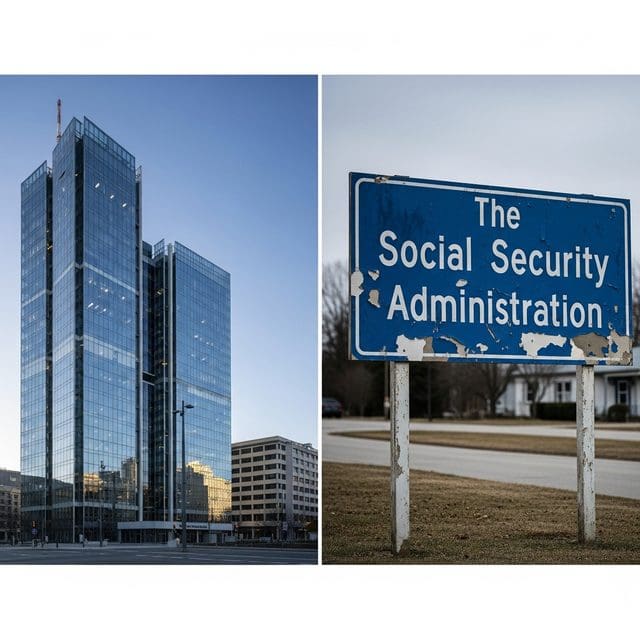
As international health agencies lobby for climate adaptation funding, looming domestic fiscal pressures and private sector AI disruptions are reshaping the American appetite for expansive foreign aid commitments.
The global health landscape is increasingly colliding with a sobering reality: the American taxpayer’s capacity for open-ended international development is being tested by domestic fiscal constraints. As the World Health Organization and various United Nations affiliates push for integrated climate and health adaptation strategies, the economic indicators at home suggest a tightening of the proverbial belt. With Social Security trust funds now projected for insolvency by the fourth quarter of 2032, the debate over foreign aid is shifting from moral imperatives to hard-nosed accounting. The automatic 22% benefit cut triggered by that insolvency looms as a primary concern for a domestic electorate already grappling with the rising cost of living.
Recent projections indicate a 2027 Social Security Cost-of-Living Adjustment (COLA) of approximately 3.8%, which would raise the average monthly benefit to $2,011.15. While this appears to be a gain, it is a temporary reprieve against a backdrop of systemic instability. Legislative efforts like the Social Security 2100 Act, which proposes lifting the payroll tax cap on wages above $400,000 and switching to a CPI-E calculation, currently face a 0% chance of passage according to GovTrack. This political gridlock ensures that every dollar allocated to global health initiatives, such as pandemic preparedness in Africa or climate-resilient infrastructure in Southeast Asia, will be scrutinized against the backdrop of a potential $73 monthly increase for American retirees that may eventually be wiped out by trust fund exhaustion.
Simultaneously, the private sector is undergoing a radical transformation that complicates the funding model for global initiatives. Market analysts and innovators like Mark Cuban have warned that the current AI boom is not merely a technological shift but a survival-of-the-fittest event for the corporate world. Cuban’s recent warnings regarding Nvidia’s aggressive AI financing and revenue-sharing deals suggest that the very tech-driven economic growth often relied upon to fund global development may be built on a fragile foundation. If the AI ecosystem faces a correction similar to the dot-com era, the surplus capital available for international health grants will likely evaporate. Cuban’s “Innovator’s AI Dilemma” highlights that even incumbent firms face litigation risks whether they adapt or fail, creating a volatile tax base for the U.S. government.
This economic backdrop necessitates a market-driven approach to global health. Rather than relying on the traditional model of indefinite subsidies, development policy must pivot toward fostering self-sufficiency and private-sector solutions within emerging markets. The “cardinal sin” of investing, as noted by Warren Buffett, is the failure to promptly correct acknowledged mistakes. For U.S. foreign policy, this means recognizing that the era of unchecked funding for centralized global health bureaucracies may no longer be sustainable. Decisive action is required to review international holdings and commitments, ensuring they align with the current reality of a constrained American budget.
As the U.S. navigates complex geopolitical shifts—including the April 2026 ceasefire between Israel and Lebanon and the subsequent reopening of the Strait of Hormuz—the focus must remain on initiatives that offer tangible returns for national security and economic stability. The American stake in global health is real, particularly regarding infectious disease containment, but it must be balanced against the reality of “retail deserts” in rural America where pharmacies and local stores are closing at alarming rates. A principled foreign policy requires acknowledging that global resilience begins with domestic solvency. The focus should remain on evidence-based, market-led solutions that respect national sovereignty while ensuring that the American social safety net remains the priority for the nation’s resources.

Rachel Vaughn serves as a Senior Correspondent for Just Right News, where she leads the network’s coverage of Global Health, Climate, and Development. With a career defined by intellectual rigor and a commitment to principled reporting, Rachel provides a vital conservative perspective on some of the most complex and high-stakes issues facing the world today. Her work is characterized by a refusal to accept bureaucratic narratives at face value, focusing instead on how international policies impact national sovereignty, individual liberty, and the American taxpayer.
Raised in New Haven, Connecticut, Rachel grew up in an environment dominated by elite academic discourse. This upbringing provided her with a front-row seat to the inner workings of the American establishment, but it also instilled in her a healthy skepticism of the “ivory tower” consensus. She learned early on that while academic theories may sound promising in a lecture hall, they often fail to account for the practical realities of the working class. This background drives her to bridge the gap between high-level policy discussions and the common-sense concerns of everyday citizens, ensuring that her reporting remains grounded and accessible.
Now based in Burlington, Vermont, Rachel operates from a unique vantage point within one of the nation’s most progressive political landscapes. Living and working in a region that often serves as a testing ground for radical social and environmental experiments allows her to witness the real-world consequences of these policies firsthand. From her base in the Green Mountain State, she provides Just Right News readers with essential “boots on the ground” reporting, documenting the friction between local mandates and the constitutional freedoms of the individual. Her presence in Burlington ensures that her critiques of globalist agendas are informed by a direct understanding of how those ideologies manifest at the local level.
In her acclaimed feature series, “Planetary Stakes,” Rachel explores the intersection of international development and environmental stewardship. She rejects the alarmism often found in mainstream media, opting instead for a sober analysis of the economic and geopolitical costs of global climate agreements. Her reporting frequently highlights the importance of market-driven innovation and the role of American leadership in fostering global health without ceding authority to unelected international bodies. Through “Planetary Stakes,” she has become a leading voice for those who believe that true conservation and public health are best achieved through transparency, accountability, and the protection of private property rights.
Throughout her tenure at Just Right News, Rachel has distinguished herself as a journalist who is unafraid to ask difficult questions of global institutions. Whether she is investigating the influence of non-governmental organizations on domestic policy or analyzing the fiscal transparency of international health initiatives, her goal remains the same: to provide her audience with the facts necessary to navigate an increasingly interconnected world. Her blend of East Coast intellectual heritage and her current immersion in the political heart of the Northeast makes her an indispensable asset to the newsroom and a trusted source for readers seeking a principled, conservative take on the issues that define our era.