

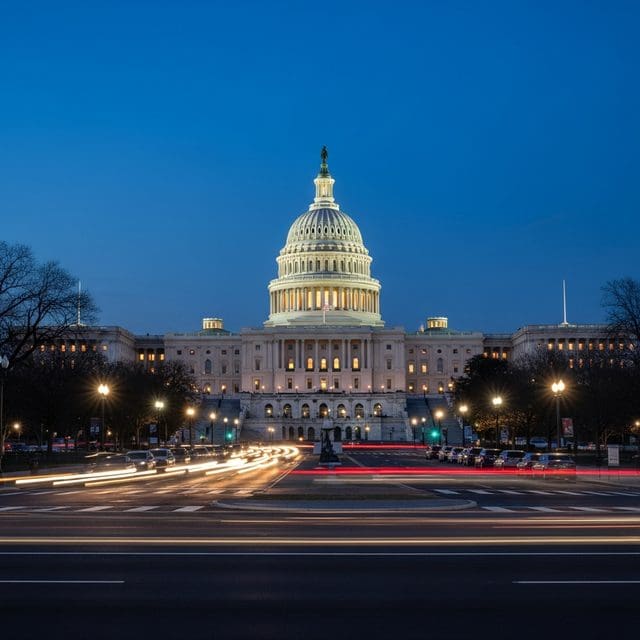
The Senate confirmed a new Attorney General and CDC Director while the White House issued a controversial vaccine order and pivoted to sanctions amid a six-month conflict with Iran.
In a series of high-stakes maneuvers ahead of the midterm elections, the United States Senate has finalized two critical executive appointments, providing the Trump administration with permanent leadership at the Department of Justice and the Centers for Disease Control and Prevention. The Senate narrowly confirmed Todd Blanche as Attorney General in an overnight vote that underscored the thin margins of the current majority. The confirmation was largely secured after Senator Bill Cassidy (R-LA) provided critical support, a move that observers suggest paved the necessary path for Blanche to take the helm of the nation’s top law enforcement agency. This appointment is particularly significant as the administration navigates complex legal challenges and intensifies its focus on federal law enforcement priorities.
Simultaneously, the Senate confirmed Dr. Erica Schwartz as the Director of the CDC. Her appointment is intended to bring fresh leadership to an agency that has faced years of institutional controversy and public scrutiny. This personnel shift occurs as the White House asserts greater control over public health policy through direct executive action. President Trump recently signed an executive order calling for the spacing out of childhood vaccines, specifically directing the separation of the combined measles-mumps-rubella (MMR) vaccine into individual doses and elongating the standard vaccination schedule. While the administration frames this as a matter of parental choice and caution, the order runs contrary to the established guidance of major medical groups, which warn that elongating the vaccination schedule could lower on-time immunization rates and increase the risk of preventable infections across the country.
On the international stage, the administration is grappling with a strategic stalemate in the Middle East that has drawn criticism from within the traditional defense establishment. Former Defense Secretary Mark Esper noted on August 11 that the administration appears to be on its “back foot” regarding the nearly six-month war with Iran. Despite the heavy damage inflicted by U.S. military strikes, the conflict has not reached a definitive conclusion, and the strategic initiative appears to have stalled. Iran recently announced it is nearing an agreement with Oman regarding control of the Strait of Hormuz, though it has conditioned any reopening of the vital waterway on U.S. compensation for damages. In response to these faltering strategies, President Trump has pivoted back to a policy of heavy economic sanctions, seeking to use financial leverage where military kinetic action has yet to yield a diplomatic breakthrough.
Domestically, the Department of Homeland Security (DHS) has intensified its pursuit of noncitizens on voter rolls, a move that has raised immediate legal and civil-rights questions. This initiative involves identifying individuals who may have registered to vote inadvertently or who have never cast a ballot, as part of a broader effort to address concerns regarding election integrity. This push coincides with a report from the State Department confirming the revocation of more than 175,000 visas during this administration, citing public safety and criminal accusations. These actions, combined with the nomination of Project 2025 co-author Dennis Kirk to serve as Inspector General for the Interior Department, signal a robust effort to install loyalist oversight across the administrative state. Kirk’s office would notably oversee reviews of major federal projects, such as the Lincoln Memorial Reflecting Pool renovation.
To ensure stability during these transitions, the Senate approved a stopgap funding bill to avoid a government shutdown before the election. This legislative action provides the necessary funding to maintain federal operations while the administration continues its personnel overhaul. However, internal friction remains evident; the Pentagon recently revoked former Air Force Secretary Frank Kendall’s access to classified information, citing unauthorized disclosures regarding the capabilities of Air Force One. Furthermore, the political landscape remains volatile as Montana Democratic Senate nominee Alani Bankhead refused to exit her race ahead of a key deadline, and Arizona Governor Katie Hobbs selected former Mesa Mayor John Giles as her running mate. As the administration navigates these personnel and policy shifts, the focus remains on whether these changes will consolidate executive power or invite further constitutional scrutiny from a divided Congress.

Miles Harrington serves as the Senior Correspondent for Federal Systems & Executive Power at Just Right News, where he brings a disciplined, constitutionalist lens to the inner workings of the American government. With a focus on the mechanics of the federal bureaucracy and the limits of executive authority, Harrington has established himself as a vital voice for readers who value transparency, accountability, and the preservation of the separation of powers.
A native of Richmond, Virginia, Harrington’s perspective is deeply rooted in the traditions of the Old Dominion. Growing up in a city defined by its historical significance and its role as a center of American jurisprudence, he developed an early appreciation for the foundational principles of the Republic. His upbringing in Richmond—a place where the legacy of the Founding Fathers is woven into the landscape—instilled in him a belief that the federal government should remain within its constitutional bounds. This background informs his skepticism of centralized overreach and his commitment to reporting on the ways in which the administrative state impacts the lives of everyday citizens.
In his current role, Harrington specializes in the complexities of federal systems. He doesn’t just report on the headlines of the day; he digs into the structural shifts within the executive branch that often go unnoticed by the mainstream press. Whether he is analyzing the implications of a new federal regulation or investigating the expansion of agency jurisdiction, his work is characterized by a rigorous adherence to the facts and a dedication to the rule of law.
Harrington is perhaps best known for his signature feature series, “How Washington Works.” Through this ongoing project, he demystifies the often-opaque processes of the nation’s capital, pulling back the curtain on the “Deep State” and the unelected officials who wield significant influence over national policy. By breaking down complex legislative maneuvers and executive orders, he empowers Just Right News readers to understand the true levers of power in Washington. His reporting serves as a necessary check on the federal government, ensuring that the actions of those in power are held up to the light of public scrutiny.
Now based in Washington, D.C., Harrington operates at the epicenter of the political world, yet he remains intentionally distanced from the “Beltway bubble.” His proximity to the halls of power allows him to maintain a robust network of sources across the federal landscape, but his heart remains in the principled conservatism of his Virginia roots. He views his role not merely as a reporter, but as a steward of the public trust, dedicated to providing the clarity and context that conservative voters need to navigate an increasingly complex political environment.
Through his sharp analysis and unwavering commitment to the truth, Miles Harrington continues to be a cornerstone of the Just Right News team. His work ensures that the principles of limited government and executive restraint remain at the forefront of the national conversation, providing a crucial service to those who believe in a government that is truly of, by, and for the people.