

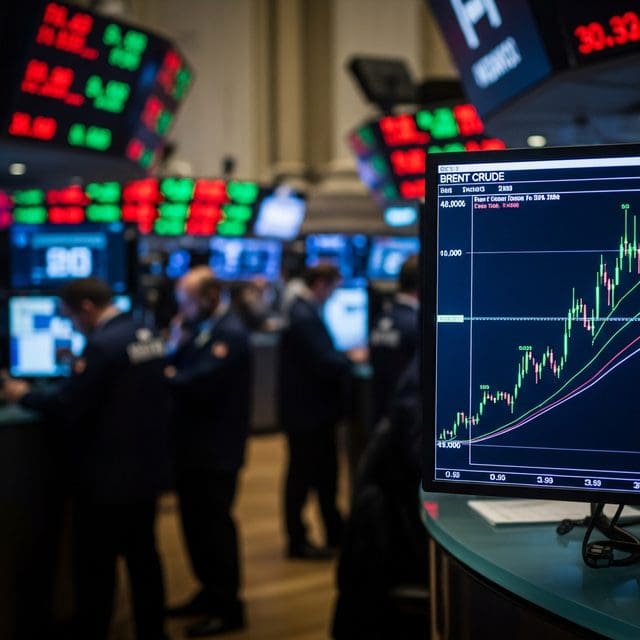
The SPY dipped 0.32% as investors weighed rising Brent crude prices and geopolitical threats against upcoming U.S. inflation data, while Asian tech shares provided a rare bright spot in global markets.
The American taxpayer is once again caught in the crosshairs of global volatility as the S&P 500 (SPY) retreated 0.32% during the session. This downward drift reflects a market paralyzed by two primary forces: the looming July Consumer Price Index (CPI) report and a dangerous escalation of geopolitical tensions in the Middle East that threatens to reignite energy inflation. For the working household, these macro shifts represent a direct threat to purchasing power and the stability of the domestic economy.
Brent crude futures rose 0.9% to reach $89.69 a barrel following fresh attacks on shipping in critical waterways. With Iran-aligned Houthi rebels continuing strikes and Iranian officials threatening to close the Strait of Hormuz unless frozen assets are released, the specter of $90 oil is no longer a distant concern. This geopolitical friction is further evidenced by the record-breaking heat of July 2026, which saw temperatures 3.3°F above the 20th-century average, placing additional strain on the nation’s energy grid and agricultural output. For those on Main Street, these are not just numbers on a screen; they represent a direct tax on mobility and a potential reversal of recent cooling in headline inflation.
In the currency markets, the U.S. Dollar Index (DXY) nudged higher to 99.88. This strength in the greenback came at the expense of the Euro, which slipped to $1.1534, and the Yen, which weakened to 159.44 per dollar. This persistent weakness in the Yen persists despite previous interventions, signaling that global capital still favors the relative safety and higher yields of the U.S. financial system. The market is currently pricing in a July headline CPI of 3.4% year-over-year, a figure that will dictate whether the Federal Reserve continues its restrictive stance or offers relief to debt-burdened citizens. The pre-CPI positioning suggests a market that is hedging its bets rather than making a decisive risk-on move.
While the domestic outlook remains cautious, Asian markets provided a stark contrast. South Korea’s KOSPI surged 4.0%, and Japan’s Nikkei rose 0.8%, driven largely by an insatiable demand for the hardware required for artificial intelligence. This divergence highlights a bifurcated global economy: a booming technological arms race fueled by massive capital expenditures on Nvidia chips—which SpaceX CEO Elon Musk recently committed to exclusively for AI development—and computer memory. This tech-heavy growth is so significant that CME Group and Silicon Data are planning to launch Compute futures contracts in October to help firms hedge the risks associated with AI infrastructure.
On the corporate front, the movement toward centralized digital finance and institutional expansion continues. Zaria Systems has filed with the OCC to charter Zaria National Trust Bank, while Blue Ridge Associates has appointed Adam Studdard as CTO to lead its enterprise AI strategy. Even the housing market shows signs of international concentration, with buyers pouring $4 billion into Texas homes over the past year. Meanwhile, Industrial Control Solutions’ acquisition of Modern Instrument Company underscores the ongoing consolidation within the aerospace and calibration sectors.
For the principled defender of the free market, these developments serve as a reminder that the ‘Invisible Economy’ is increasingly driven by centralized technological control and geopolitical maneuvering. While companies like Koppers Holdings Inc. continue to provide steady quarterly dividends of $0.09 per share, the broader market remains tethered to the whims of central bank data releases and foreign conflicts. True economic sovereignty for the American worker requires a stable monetary foundation that is not perpetually at the mercy of shipping lane disruptions or the next core inflation print.

Jordan Lee serves as the Senior Correspondent for Wall Street, Finance, and Monetary Systems at Just Right News. Based in the heart of the world’s financial capital, New York City, Lee brings a sharp, principled eye to the complex mechanisms that drive the global economy. His reporting is defined by a commitment to fiscal responsibility, the defense of the free market, and a deep-seated belief that a transparent monetary system is the bedrock of a free society.
Raised in Portland, Oregon, Lee’s perspective was forged in a city that has undergone significant cultural and economic shifts. His upbringing in the Pacific Northwest instilled in him a profound appreciation for the industriousness of small business owners and the importance of local economic stability. Watching the evolution of his hometown’s landscape sparked an early interest in how federal fiscal policy and large-scale financial trends eventually trickle down to the average citizen. This background provides him with a unique vantage point; he understands the growing disconnect between the policy-making elite and the reality of Main Street, a theme that frequently resonates throughout his work.
Now operating from his base in New York City, Lee bridges the gap between the high-stakes trading floors of Manhattan and the households of everyday Americans. He views the financial sector not merely as a collection of numbers and tickers, but as a vital engine of American prosperity that requires constant vigilance and accountability. His reporting often highlights the dangers of centralized financial control and the necessity of maintaining a system that rewards merit, risk-taking, and innovation.
As the creator and lead of the featured series, “The Invisible Economy,” Lee pulls back the curtain on the often-opaque world of monetary systems. He specializes in translating the dense jargon of central banking and international finance into actionable insights for the Just Right News audience. His work explores the “invisible” forces—such as inflationary pressures, regulatory creep, and the expansion of the administrative state—that erode the purchasing power of American families. By focusing on these systemic issues, Lee empowers readers to understand the hidden forces shaping their financial independence.
Lee’s journalistic philosophy is rooted in a steadfast commitment to traditional American values. As an Asian American professional who has navigated the competitive corridors of the financial world, he is a vocal advocate for meritocracy and the preservation of the American Dream. He believes that a stable currency and a predictable regulatory environment are essential for national sovereignty and individual liberty. His reporting frequently warns against the risks of government overreach in the private sector, arguing that the most effective solutions to economic challenges arise from competition and individual enterprise rather than bureaucratic mandates.
At Just Right News, Jordan Lee remains dedicated to providing a clear-eyed defense of the taxpayer. Whether he is analyzing market volatility or investigating the long-term implications of national debt, his mission is to provide the truth about where the money is going and what it means for the future of the country. Through his rigorous analysis and principled stance, Lee has become a trusted voice for those who value a strong, sovereign, and fiscally sound America.