

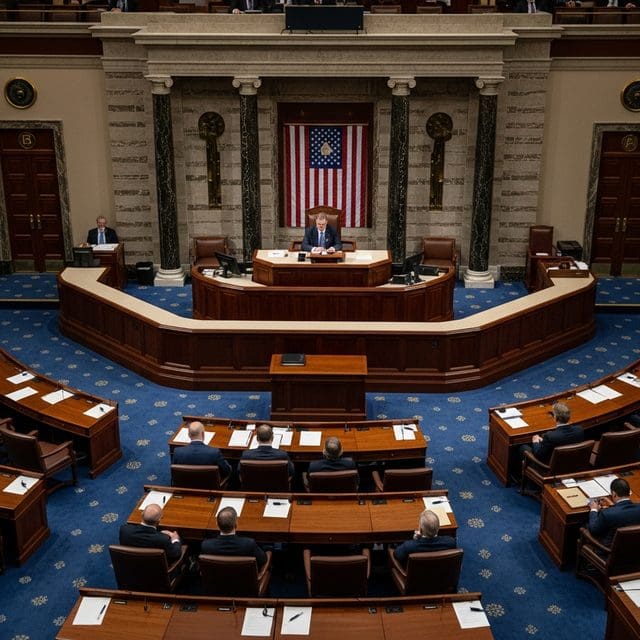
The Senate averted a federal shutdown with a 90-6 vote on a stopgap bill while narrowly confirming Todd Blanche as Attorney General following high-stakes negotiations over executive spending and DOJ independence.
In an exhaustive overnight session concluding early August 8, 2026, the United States Senate moved to stabilize federal operations while simultaneously reshaping the executive branch. By a commanding 90-6 margin, the chamber passed a continuing resolution to fund the government through December 11, 2026. Senate Majority Leader John Thune framed the early action as a necessary step to avoid a fiscal cliff during the height of the midterm election season, aiming to provide a measure of certainty to federal agencies and the public alike. The vote was part of a broader exit strategy designed to clear the deck before a five-week August recess, though it leaves several legislative flashpoints unresolved for the autumn.
However, the Senate’s version of the funding bill sets up a direct confrontation with the House of Representatives. While the Senate measure maintains current spending levels, it includes specific policy riders that challenge the Trump administration’s executive reach. The bill explicitly blocks the reallocation of funds to the Border Patrol and temporarily halts a proposed rule that would grant political appointees greater authority over federal grants. These provisions contrast sharply with the House-passed version, which lacks these “anomalies” and features a different expiration date. This discrepancy necessitates intense bicameral negotiations in September, as House leaders face pressure to reconcile the Senate’s constraints with the President’s priorities. The White House must now decide whether to sign a final compromise that includes these limits on redirecting border funds and constraining the perceived politicization of federal grants.
The session also marked a significant milestone for the Department of Justice. Todd Blanche, formerly a personal defense attorney for President Trump, was confirmed as the permanent Attorney General in a narrow 50-49 vote. The confirmation followed intense deliberations within the Senate Judiciary Committee, where Blanche had previously advanced on a strict 12-10 party-line vote. To secure the full Senate’s approval, Blanche was forced to navigate deep-seated concerns regarding the independence of the Justice Department. Senator Bill Cassidy provided a critical swing vote after Blanche offered written assurances narrowing controversial settlements, including those involving the IRS and the January 6 compensation fund.
To win over Republican skeptics, Blanche agreed to rescind a proposed $1.8 billion “anti-weaponization” fund, which critics had characterized as a partisan slush fund. He also offered to scale back a broad tax-immunity package for the Trump family. These concessions were pivotal in securing the narrow majority, highlighting a persistent unease among some constitutionalists regarding the potential for executive overreach within federal law enforcement. Despite these agreements, opposition remains vocal, with critics arguing that the appointment of a former personal lawyer to lead the DOJ represents a fundamental shift in the department’s traditional role as an independent arbiter of the law.
Beyond fiscal and personnel matters, the Senate floor saw the rejection of a federal voter ID measure, signaling a lack of appetite for new federal voting restrictions in the immediate pre-midterm window. The session also took place against a backdrop of broader administrative activity, including the Trump administration’s launch of “The Fraud Ledger,” a website designed to track crackdowns by Vice President Vance’s task force. Additionally, President Trump spent the week defending Defense Secretary Pete Hegseth following reported internal disagreements over the depletion of military munition stockpiles, further illustrating the friction between the White House and the established military bureaucracy.
As lawmakers depart for the August recess, the focus shifts to the looming September deadline. The House must decide whether to accept the Senate’s funding limits or risk a shutdown. Furthermore, the Senate has teed up future debates on a major Russia sanctions package and is bracing for the fallout of a White House ballroom oversight ruling. For now, the stopgap measure provides a temporary reprieve, but the fundamental disagreements over executive power and the “politicization” of the administrative state remain unresolved, ensuring a contentious return to the Capitol as the nation moves toward the 2026 midterms.

Miles Harrington serves as the Senior Correspondent for Federal Systems & Executive Power at Just Right News, where he brings a disciplined, constitutionalist lens to the inner workings of the American government. With a focus on the mechanics of the federal bureaucracy and the limits of executive authority, Harrington has established himself as a vital voice for readers who value transparency, accountability, and the preservation of the separation of powers.
A native of Richmond, Virginia, Harrington’s perspective is deeply rooted in the traditions of the Old Dominion. Growing up in a city defined by its historical significance and its role as a center of American jurisprudence, he developed an early appreciation for the foundational principles of the Republic. His upbringing in Richmond—a place where the legacy of the Founding Fathers is woven into the landscape—instilled in him a belief that the federal government should remain within its constitutional bounds. This background informs his skepticism of centralized overreach and his commitment to reporting on the ways in which the administrative state impacts the lives of everyday citizens.
In his current role, Harrington specializes in the complexities of federal systems. He doesn’t just report on the headlines of the day; he digs into the structural shifts within the executive branch that often go unnoticed by the mainstream press. Whether he is analyzing the implications of a new federal regulation or investigating the expansion of agency jurisdiction, his work is characterized by a rigorous adherence to the facts and a dedication to the rule of law.
Harrington is perhaps best known for his signature feature series, “How Washington Works.” Through this ongoing project, he demystifies the often-opaque processes of the nation’s capital, pulling back the curtain on the “Deep State” and the unelected officials who wield significant influence over national policy. By breaking down complex legislative maneuvers and executive orders, he empowers Just Right News readers to understand the true levers of power in Washington. His reporting serves as a necessary check on the federal government, ensuring that the actions of those in power are held up to the light of public scrutiny.
Now based in Washington, D.C., Harrington operates at the epicenter of the political world, yet he remains intentionally distanced from the “Beltway bubble.” His proximity to the halls of power allows him to maintain a robust network of sources across the federal landscape, but his heart remains in the principled conservatism of his Virginia roots. He views his role not merely as a reporter, but as a steward of the public trust, dedicated to providing the clarity and context that conservative voters need to navigate an increasingly complex political environment.
Through his sharp analysis and unwavering commitment to the truth, Miles Harrington continues to be a cornerstone of the Just Right News team. His work ensures that the principles of limited government and executive restraint remain at the forefront of the national conversation, providing a crucial service to those who believe in a government that is truly of, by, and for the people.