

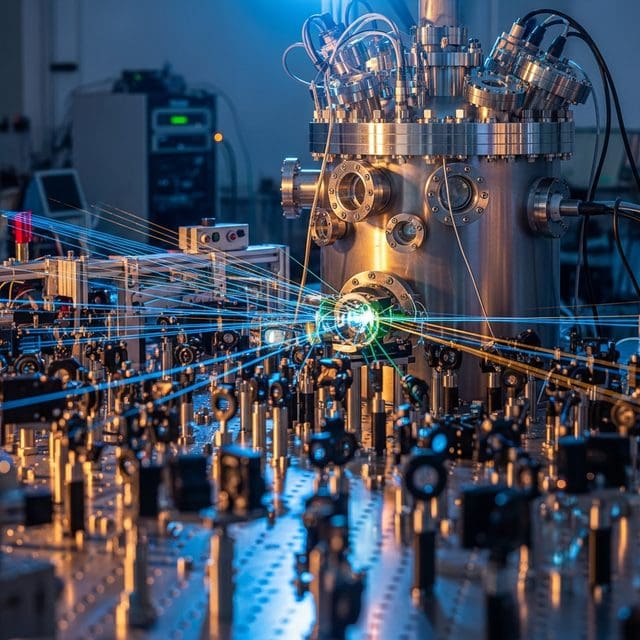
Researchers from Ghent, Cambridge, and Oxford have demonstrated that particles passing through a ‘duality defect’ transform into nonlocal excitations, potentially resolving long-standing paradoxes in quantum field theory.
A collaborative effort between Ghent University, the University of Cambridge, and the University of Oxford has unveiled a fundamental discovery in quantum field theory that challenges traditional understanding of particle behavior. Published this week in Nature Physics, the research demonstrates that when a quantum wave packet encounters a ‘duality defect’—an interface connecting two mathematically equivalent but physically distinct descriptions of a system—it is never reflected. Instead, it transmits with 100% probability, undergoing a radical transformation in the process. This specific construction, utilizing matrix-product-operator (MPO) representations, provides a systematic way to study how these interfaces function in quantum spin systems.
According to the findings, the particle does not emerge on the other side as a localized point of matter. Rather, it becomes a nonlocal excitation, described by researchers as a ‘wisp of fog’ or a particle attached to an invisible string that remains tethered to the defect. This transition provides an operational look at field-theoretic dualities, which are often treated as abstract mathematical symmetries rather than observable physical transitions. The authors argue this sheds light on the magnetic monopole paradox, demonstrating how electric and magnetic descriptions can be dual without double-counting degrees of freedom by showing how ‘particle vs. string’ interpretations are simply two sides of the same physics. This theoretical laboratory for studying topological defects is highly relevant to high-energy theory and condensed matter, particularly regarding the dualities between vortices and charges.
Beyond theoretical physics, the work has practical applications for the burgeoning field of quantum simulation. The researchers have provided experimentally testable predictions for engineered impurities in quantum simulators. Such advancements could lead to more robust quantum computers and sensors that leverage these nonlocal states for information processing. This is particularly relevant as institutions like Rice University develop precise temperature tuning methods for trapped-ion quantum simulators to match real-world conditions, further bridging the gap between theory and application. Furthermore, Caltech has recently achieved a fourfold resolution improvement in quantum microscopy using entangled photons, suggesting that our ability to observe these quantum phenomena is accelerating alongside our theoretical understanding.
In a separate but related development in particle physics, a global network of neutrino detectors, including the SNO+ facility in Canada, has begun mapping the Earth’s interior using geoneutrinos. These ‘ghost particles,’ emitted by radioactive decay within the planet, are providing the first direct evidence of how heat-producing elements like uranium, thorium, and potassium are distributed throughout the mantle. While current data from KamLAND and Borexino suggests the mantle may not be uniform, researchers at SNO+ note that significant work remains to separate crustal interference from deeper mantle signals. This planetary-scale tomography represents a new tool for Earth science, depending entirely on high-energy physics infrastructure to constrain the radiogenic heating power that drives plate tectonics and volcanism.
Complementing these high-energy findings, researchers have also demonstrated that sunlight can be used as an input to generate entangled photon pairs. This breakthrough, which confirms a Bell inequality violation using solar photons, offers a potential alternative to energy-intensive lasers currently required for quantum communication. By reducing the energy footprint of entanglement, this discovery aligns with a decentralized vision of innovation that respects resource constraints while advancing national technological sovereignty. It proves that quantum networks could potentially operate on passive, natural energy sources rather than centralized, power-hungry infrastructure.
These breakthroughs—exploring the smallest strings of quantum reality, using subatomic particles to peer into the heart of the Earth, and harnessing the sun for quantum information—underscore a pivotal moment for scientific interests. As Silicon Valley continues to push for centralized AI and quantum dominance, these foundational discoveries remind us that true innovation often stems from a deeper, principled understanding of the natural laws that govern our world. The ability to measure the behavior of empty space, as recently seen in NASA’s IXPE observations of a magnetar supporting a 90-year-old theoretical prediction, further confirms that the frontiers of physics are finally within our reach to prove and utilize for the benefit of individual liberty and national security.

Mason Reed serves as a Staff Writer for Just Right News, where he spearheads the Future Frontiers & Special Projects desk. In an era defined by rapid technological shifts and evolving social landscapes, Mason provides a steady, principled voice, examining the innovations of tomorrow through the lens of traditional American values. His work is most prominently featured in his signature series, “The Next Horizon,” where he explores the intersection of emerging technology, national sovereignty, and the preservation of individual liberty.
A native of San Diego, California, Mason’s worldview was shaped by the unique culture of his hometown. Growing up in a region defined by its strong military presence and its history of maritime industry, he developed a deep-seated respect for the institutions that provide national stability and the entrepreneurial spirit that drives the American economy. This upbringing instilled in him a belief that true progress is not found in discarding the past, but in building upon a foundation of proven principles. His reporting often reflects this San Diego influence, emphasizing the importance of a robust national defense and the necessity of maintaining a competitive edge in the global marketplace.
Now based in San Francisco, Mason operates from the heart of the world’s technological engine. Living and working in the Bay Area provides him with a front-row seat to the advancements—and the ideological challenges—emanating from Silicon Valley. While many in the region embrace a “move fast and break things” mentality, Mason’s reporting serves as a vital counterweight. He offers Just Right News readers a “boots on the ground” perspective, documenting how radical local policies and the concentration of tech power impact the everyday lives of citizens. His proximity to the industry allows him to cut through the marketing jargon of big tech to uncover the real-world implications for privacy, free speech, and the nuclear family.
In his “Future Frontiers” beat, Mason tackles complex subjects ranging from the ethics of artificial intelligence to the burgeoning private space race. He approaches these topics with a healthy skepticism toward centralized bureaucracy, championing instead the decentralized innovations that empower individuals. Through “The Next Horizon,” he highlights the pioneers and thinkers who are working to ensure that the future remains a place where human dignity and constitutional rights are protected. He believes that the rapid pace of change requires more than just technical expertise; it requires a moral compass rooted in the Western tradition.
Throughout his tenure at Just Right News, Mason has remained committed to the idea that the future is something to be shaped, not merely accepted. His writing is characterized by a rigorous defense of American exceptionalism and a belief that the country’s best days lie ahead, provided it remains true to its founding ideals. Whether he is investigating the impact of automation on the American workforce or profiling the next generation of aerospace engineers, Mason Reed ensures that his readers are equipped with the insights they need to navigate a changing world with confidence and clarity.