

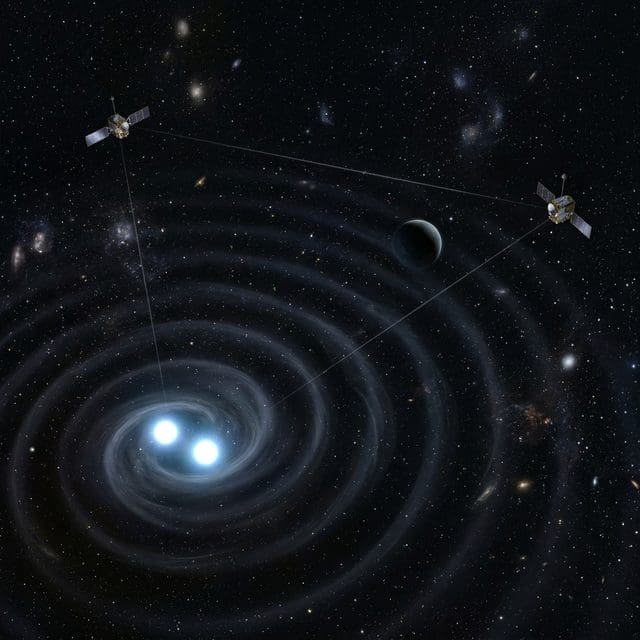
Two studies show how a future gravitational-wave observatory could find planets orbiting tightly paired white dwarfs, opening a new route to worlds difficult to see in starlight.
Some planets are hard to spot because their stars shine too brightly. Two recent studies point to another way to search: detect how a planet’s gravity alters ripples in space-time from two dead stars orbiting one another.
The proposed observatory is LISA, the Laser Interferometer Space Antenna, planned for launch in the mid-2030s. Its three spacecraft will form a triangle, with about 1.6 million miles between each pair. NASA reported Nov. 10 that the studies examine how LISA could identify planets orbiting tightly paired white dwarfs—dense remnants of stars whose motion generates gravitational waves.
The method depends on a subtle shift in those waves. As the white dwarfs circle one another, they produce a regular signal. A planet orbiting the pair would make the system wobble slightly, changing the waves’ observed frequency in a repeating pattern. Researchers call these variations Doppler-modulated sidebands: a faint rhythm within the larger rhythm of the stellar pair.
The studies model whether LISA could distinguish that pattern from the expected signals. Under ideal conditions, the observatory could detect a planet smaller than Jupiter, NASA says. For a more massive planet—about five times Jupiter’s mass—the signal could be strong enough for the James Webb Space Telescope to follow up at a distance of roughly 500 light-years.
LISA would not take a picture. It would register the gravitational effect of the system’s motion; a telescope such as Webb could then seek confirming evidence in light. The technique would complement conventional searches that look for a planet dimming its star or shifting its position. It could help investigate systems where planets are difficult to distinguish from the glare of their host stars.
The potential search field is large, but the expected sample is more limited. Astronomers estimate the Milky Way contains about 10 million double-white-dwarf systems with orbital periods under an hour. LISA is expected to resolve roughly 10,000 individual systems, including about 100 mixed binaries. The studies explore whether some detectable systems may have planets; they do not establish how many such planets exist.
This is a forecast, not a discovery announcement. LISA is years from launch, and the proposed detections depend on the observatory’s eventual sensitivity and the strength of signals from individual systems. Researchers will continue refining predictions; once the mission operates, they can test whether the predicted sidebands appear in actual data.
A separate advance reported by NASA shows how astronomers can extract more from existing observations. Northwestern researchers developed Physics-based Learning for Imaging Planets, or FLIP, which uses a digital model of Webb’s Near-Infrared Camera to account for optical imperfections and subtract starlight. In tests involving observations of three stars, it improved sensitivity to faint planets by two to 15 times.
FLIP recovered the already-known planet 51 Eridani b in two-year-old Webb data where conventional processing could not separate it from residual glare. The result is a recovery from previously unusable data, not the discovery of a new planet. That distinction matters: the technique gives researchers another way to examine the telescope’s archive, but its demonstrated result is improved recovery of a known world.
Meanwhile, construction has begun on the far-detector cryostats for the Deep Underground Neutrino Experiment at South Dakota’s Sanford Underground Research Facility. Each of two modules is designed to hold about 17,000 tons of liquid argon nearly a mile underground. DUNE will compare neutrinos measured near Fermilab with those detected after traveling about 800 miles through Earth. The experiment is designed to study how neutrinos change along the way, a question tied to the behavior of fundamental particles.
The schedule underscores how much work remains: underground space is planned for completion by 2029, detector equipment by 2030, and the neutrino beam’s arrival in South Dakota is expected by 2031. As with LISA, the scientific promise depends on building instruments capable of measuring signals that are otherwise out of reach.
Together, these efforts show how physics is expanding its toolkit. LISA may let astronomers search for planets through gravity rather than light; FLIP can recover faint signals from observations already in hand; and DUNE will track neutrinos across a continent. For LISA, the models come first. The decisive test will come when the observatory begins collecting data.

Ethan Blake serves as a Senior Correspondent for Just Right News, where he specializes in Longform Narrative and Public Understanding. In an era of rapid-fire headlines and fleeting soundbites, Ethan’s work stands as a testament to the power of deep-dive reporting and the importance of contextualizing the complex issues facing the nation today. His approach is rooted in the belief that the most profound truths are often found in the lived experiences of individuals rather than the abstract theories of distant policymakers.
Growing up in Providence, Rhode Island, Ethan developed an early appreciation for the historical and cultural threads that weave the American fabric together. Providence, a city defined by its industrial heritage and its blend of traditional neighborhoods, provided him with a front-row seat to the challenges and triumphs of the American working class. This upbringing instilled in him a respect for the “common sense” values of hard work, community loyalty, and the preservation of local institutions. He learned early on that behind every economic statistic or legislative debate, there are real families and neighborhoods navigating the consequences of change.
This foundational perspective is the driving force behind his signature feature series, “Lives Behind the Systems.” Through this series, Ethan explores the intersection of individual agency and institutional structure. Whether he is documenting the impact of federal land-use policies on rural families or examining how shifting educational standards affect local school boards, Ethan’s work prioritizes the human element. He seeks to uncover how large-scale systems—be they governmental, economic, or social—affect the daily lives of citizens, often advocating for a return to local control and personal responsibility.
Now based in Portland, Maine, Ethan draws significant inspiration from the rugged independence and self-reliance that define the region. The coastal landscape and the resilient spirit of Maine’s communities serve as a constant reminder of the importance of individual liberty and the strength found in decentralized power. Living and working outside the traditional media hubs allows Ethan to maintain a grounded perspective, ensuring his reporting remains untethered from the echo chambers of the major metropolitan centers. This geographic distance provides him with the clarity needed to translate complex national narratives into stories that resonate with the heart of the country.
At Just Right News, Ethan’s beat is more than just a professional assignment; it is a mission to foster a more informed and engaged citizenry. He believes that a free society depends on the public’s ability to understand the mechanisms of power and the value of traditional American principles. His longform narratives do not merely report the news; they provide a roadmap for understanding the cultural and political shifts of the modern era through a lens of skepticism toward centralized authority and a deep respect for the individual.
Through his meticulous research and narrative craftsmanship, Ethan Blake continues to bridge the gap between policy and the public. His work remains a vital resource for those who seek a deeper understanding of the systems that shape our world and the enduring spirit of the people who live within them.