

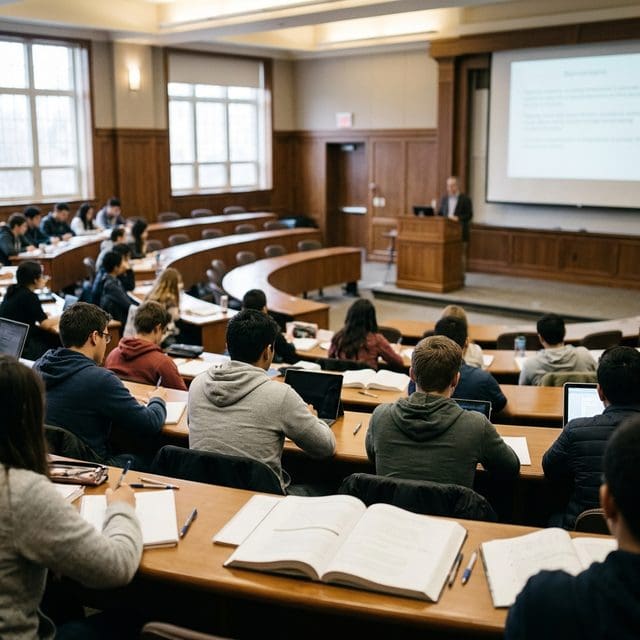
A French education strike puts staffing and university capacity in focus, while Princeton’s public events show another part of higher education’s mission: developing and sharing ideas.
Education is often judged by the skills and credentials it gives students for work. But institutions that build human capital also depend on staffing, adequate facilities and opportunities to think, write and exchange ideas. Developments on November 10 showed both sides: a nationwide education strike in France and a slate of public literary events at Princeton University.
Across France, teachers from preschool through university, support staff, university employees, researchers and students were called to strike. In Paris, an authorized march from the Panthéon to Place d’Italie began at 2 p.m., according to the day’s reported schedule. Franceinfo reported that the mobilization was expected to be uneven and could be less extensive than the action on November 5, citing union leader Sophie Vénétitay. The available reporting did not provide a final national count.
The strike coalition’s demands, summarized by Morocco World News in a November 7 report, included an unfrozen public-sector salary index, more school staff and investment in buildings. For higher education and research, it called for 150,000 additional places and 15,000 permanent jobs. Those are coalition demands, not confirmed government commitments.
The proposals raise a practical question: whether institutions have enough people and capacity to serve students. More university places can widen access, but the number of places alone says little about what students will learn or what support they will receive. Additional permanent jobs could address continuity in teaching and research, but the reporting does not specify where the requested positions would go, how they would be funded, or how extensive current staffing and building problems are.
Princeton’s November 10 events offered a different view of education’s work. Cultural historian and author Isaac Butler discussed his new book, “The Perfect Moment: God, Sex, Art, and the Birth of America’s Culture Wars,” with Associate Professor Brian Herrera. Princeton described the book as a New Yorker Best Book of 2026 So Far. The conversation brought a current cultural argument into a university setting, with an author and faculty scholar in dialogue.
At a separate event, poet and memoirist Brittany Perham read alongside creative writing seniors at the C.K. Williams Reading. Princeton also scheduled a public lecture by Mexican author and essayist Valeria Luiselli, whose work spans fiction, nonfiction and soundscapes. The listings establish that these programs were scheduled; they do not report attendance, student outcomes or whether the events led to further academic or professional opportunities.
Such programming is not a substitute for career preparation, and its value is not captured solely by immediate job placement. Reading and writing require students to interpret material, make arguments and communicate—abilities relevant across occupations. But the event descriptions do not measure those skills or prove a workforce impact. The listings show opportunities to encounter ideas and writers, not evidence of particular learning outcomes.
The contrast is useful without implying that one priority cancels out the other. Students need institutions capable of delivering instruction and support, and they can also benefit from exposure to ideas beyond a narrow technical curriculum. Policymakers and universities must make both possible with available staff, facilities and funding. Access to a seat is only one part of a worthwhile education; what happens in the classroom and the support available to students shape what that access can become.
The reports offer no evidence about whether France’s strike will change policy, and Princeton’s listings do not show what students gained by attending. They do underscore that education’s human-capital role has more than one measure. Access and institutional capacity matter, as does the academic work that helps students develop knowledge and judgment. Claims of success, however, require outcome data—not just demands or event calendars.
Daniel Owens serves as a Senior Correspondent for Just Right News, where he leads the newsroom’s coverage of Education, Workforce, and Upward Mobility. In an era where the national conversation often overlooks the practical foundations of success, Owens brings a principled perspective to the forefront of the media landscape. His work is defined by a commitment to the idea that a strong society is built on the pillars of quality education, a robust work ethic, and the removal of bureaucratic barriers to individual achievement.
Born and raised in Cleveland, Ohio, Owens’s worldview was shaped by the industrial landscape of the Midwest. Growing up in a city known for its grit and resilience, he witnessed firsthand the transformative power of steady employment and the devastating effects of economic stagnation. This background instilled in him a deep respect for the American worker and a healthy skepticism toward top-down government solutions that often fail to reach the communities they intend to help. As an African American man who has navigated the path to professional success, Owens approaches his beat with a nuanced understanding of how meritocracy and personal responsibility intersect with opportunity. He frequently draws on his roots to highlight the importance of family stability and community-led initiatives in fostering the next generation of leaders.
At Just Right News, Owens is the architect of the acclaimed feature series, “The Learning Curve.” Through this platform, he explores the evolving landscape of American schooling, from the rise of the school choice movement to the revitalization of trade schools and vocational training. He frequently challenges the status quo of higher education, advocating for a return to academic rigor and the practical alignment of degrees with market demands. For Owens, education is not merely about obtaining credentials; it is about equipping young people with the tools necessary to lead self-sufficient, meaningful lives. His reporting on “The Learning Curve” has become essential reading for parents and policymakers who believe that educational competition and parental rights are the keys to a brighter future.
Now based in Raleigh, North Carolina, Owens finds himself at the heart of one of the nation’s most dynamic regions for innovation and growth. Raleigh’s unique blend of traditional values and a fast-paced economy provides the perfect backdrop for his reporting on the modern workforce. From the tech hubs of the Research Triangle to the rural communities of the South, he tracks how shifts in the economy are impacting families and local industries. His reporting often highlights the success stories of entrepreneurs and workers who are thriving by embracing the values of hard work and innovation.
Throughout his career, Daniel Owens has remained a steadfast voice for the student seeking a better path and the worker striving for a better life. His reporting for Just Right News serves as a vital resource for readers who value common-sense solutions to the challenges of the 21st-century economy. By focusing on the intersection of policy and the human spirit, Owens continues to provide a roadmap for how individuals and communities can achieve lasting upward mobility.