

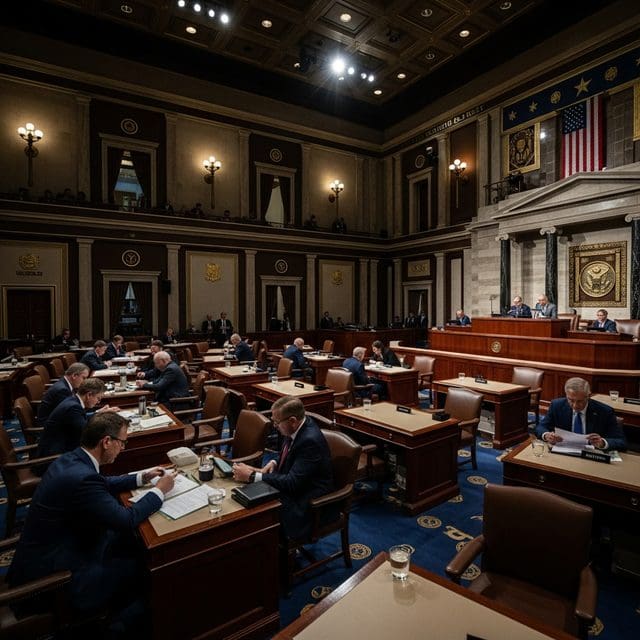
The Senate narrowly confirmed Todd Blanche as Attorney General in a 50-49 vote while passing a stopgap funding bill to avert a pre-election government shutdown through December.
In a flurry of early-morning activity on August 8, 2026, the United States Senate fundamentally altered the leadership of the Department of Justice and secured a temporary reprieve for the federal treasury. At approximately 4:31 a.m. ET, the chamber narrowly confirmed Todd Blanche as the next U.S. Attorney General in a 50-49 vote, placing a close legal confidant of the President at the helm of the administrative state’s law enforcement apparatus. The confirmation represents a significant consolidation of executive influence, as Blanche previously served as President Trump’s personal defense counsel. The vote largely followed party lines, with Republican Senators Susan Collins and Lisa Murkowski defecting to join Democrats in opposition. Senator Bill Cassidy, who had previously signaled hesitation, ultimately provided a critical ‘yes’ vote, while Minority Leader Mitch McConnell did not cast a vote.
Minority Leader Chuck Schumer characterized the appointment as a threat to institutional integrity, citing concerns over Blanche’s prior representation of the President and allegations regarding a $1.8 billion slush fund that surfaced during the confirmation process. As Attorney General, Blanche now assumes control over the Department of Justice, including federal prosecutions, civil rights enforcement, and investigations involving the Trump administration itself. The narrow margin of his victory underscores the deep partisan divide regarding the independence of the nation’s top law enforcement official and suggests a period of intense scrutiny for the Department in the months ahead.
Parallel to the personnel shift, the Senate moved to stabilize federal operations by passing a stopgap spending bill with a decisive 90-6-1 margin. This continuing resolution extends government funding through December 11, effectively pushing the next fiscal cliff past the upcoming midterm elections. The measure now moves to the House, where its reception remains the final hurdle to preventing a September 30 shutdown. A close reading of the funding legislation reveals a strategic compromise; to secure Democratic support, the bill includes specific language prohibiting the Trump administration from shifting funds into certain Border Patrol and grant-approval initiatives. This represents a rare legislative check on executive discretion, though the White House secured its primary objective of avoiding a politically volatile shutdown during the campaign season.
Beyond the halls of Congress, the executive branch remains entangled in complex geopolitical and administrative maneuvers. President Trump indicated on August 5 that a resolution regarding the Strait of Hormuz could be reached within days, even as Iran signaled that any reopening of the waterway would require U.S. compensation. Simultaneously, the Pentagon took the extraordinary step of revoking former Air Force Secretary Frank Kendall’s security clearance, citing unauthorized disclosures concerning Air Force One’s capabilities. On the domestic front, the administration terminated Temporary Protected Status for migrants from Myanmar and South Sudan, effective August 7, signaling a continued tightening of immigration policy.
Labor and regulatory developments also marked the week’s end. Teamsters at Open Kitchens ratified a three-year contract following a six-week strike, while over 2,000 Teamsters in Contra Costa County announced a strike date for August 19. In the healthcare sector, the FDA granted IND clearance for the first circular RNA-based CAR-T therapy, RXIM002, and issued emergency authorization for Elanco’s CLiK Extra to combat New World screwworm in livestock. As the Senate enters its summer recess, the administrative landscape is marked by a Department of Justice under new management and a federal budget held together by a temporary, conditional agreement. The focus now shifts to the House of Representatives, where the timing of the funding vote will determine if the threat of a shutdown is truly extinguished or merely delayed.

Miles Harrington serves as the Senior Correspondent for Federal Systems & Executive Power at Just Right News, where he brings a disciplined, constitutionalist lens to the inner workings of the American government. With a focus on the mechanics of the federal bureaucracy and the limits of executive authority, Harrington has established himself as a vital voice for readers who value transparency, accountability, and the preservation of the separation of powers.
A native of Richmond, Virginia, Harrington’s perspective is deeply rooted in the traditions of the Old Dominion. Growing up in a city defined by its historical significance and its role as a center of American jurisprudence, he developed an early appreciation for the foundational principles of the Republic. His upbringing in Richmond—a place where the legacy of the Founding Fathers is woven into the landscape—instilled in him a belief that the federal government should remain within its constitutional bounds. This background informs his skepticism of centralized overreach and his commitment to reporting on the ways in which the administrative state impacts the lives of everyday citizens.
In his current role, Harrington specializes in the complexities of federal systems. He doesn’t just report on the headlines of the day; he digs into the structural shifts within the executive branch that often go unnoticed by the mainstream press. Whether he is analyzing the implications of a new federal regulation or investigating the expansion of agency jurisdiction, his work is characterized by a rigorous adherence to the facts and a dedication to the rule of law.
Harrington is perhaps best known for his signature feature series, “How Washington Works.” Through this ongoing project, he demystifies the often-opaque processes of the nation’s capital, pulling back the curtain on the “Deep State” and the unelected officials who wield significant influence over national policy. By breaking down complex legislative maneuvers and executive orders, he empowers Just Right News readers to understand the true levers of power in Washington. His reporting serves as a necessary check on the federal government, ensuring that the actions of those in power are held up to the light of public scrutiny.
Now based in Washington, D.C., Harrington operates at the epicenter of the political world, yet he remains intentionally distanced from the “Beltway bubble.” His proximity to the halls of power allows him to maintain a robust network of sources across the federal landscape, but his heart remains in the principled conservatism of his Virginia roots. He views his role not merely as a reporter, but as a steward of the public trust, dedicated to providing the clarity and context that conservative voters need to navigate an increasingly complex political environment.
Through his sharp analysis and unwavering commitment to the truth, Miles Harrington continues to be a cornerstone of the Just Right News team. His work ensures that the principles of limited government and executive restraint remain at the forefront of the national conversation, providing a crucial service to those who believe in a government that is truly of, by, and for the people.