

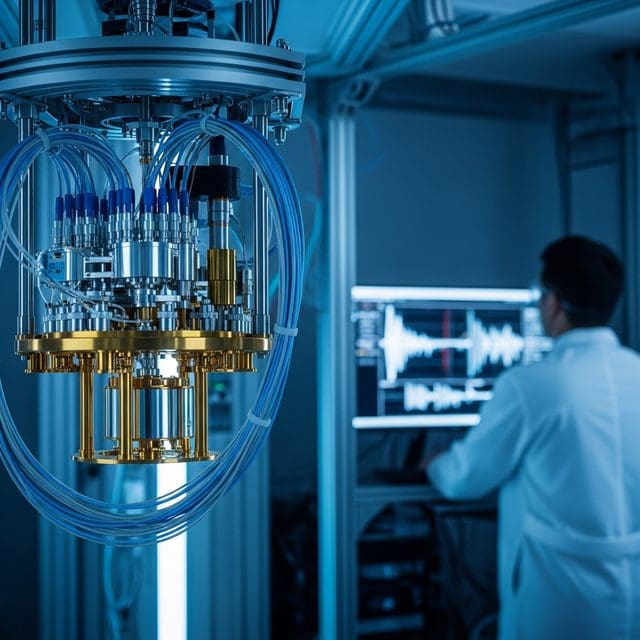
Researchers have demonstrated a new ‘doped Clifford sampling’ method that allows quantum processors to certify their own accuracy while reducing hardware gate errors tenfold.
The persistent challenge of quantum computing has long been a paradox of trust: as these machines become powerful enough to outperform classical supercomputers, they simultaneously become impossible to verify using traditional methods. This week, researchers at IBM, in collaboration with the University of Chicago, announced a potential resolution to this verification gap. Using a technique dubbed “doped Clifford sampling” (DCS), the team demonstrated that a quantum processor can effectively certify its own results while significantly suppressing the hardware noise that typically plagues such sensitive systems.
Reported by Arman Aisultan of the Qazinform News Agency, the experiment utilized the IBM Heron processor to execute circuits involving 70 logical qubits and 468 non-Clifford “T gates.” These gates are the essential components that make a quantum calculation difficult for a classical computer to mimic. By embedding the computation within spacetime error-detecting codes, the system was able to identify and discard runs where errors occurred. This post-selection process resulted in a tenfold reduction in effective gate error rates, providing a much-needed shield against the atmospheric and systemic interference that often derails quantum operations.
The demonstration required approximately 3.5 million “shots” or runs to obtain 2,051 accepted samples, reflecting an acceptance rate of about 0.059%. While this may seem low, the entire process was completed in roughly 16 minutes of processor time. The significance of this development lies in its integrated approach to reliability. Rather than relying on external cross-entropy benchmarking, the DCS method produces a built-in fidelity certificate. In the recent demonstration, the system established a 95% confidence lower bound of 0.284 for the accuracy of the final quantum state. This statistical foundation is critical for industries eyeing quantum applications in chemistry and cryptography, where a single bit of corrupted data can render an entire simulation useless.
While IBM pushes the boundaries of computation, the broader physics community continues to probe the limits of the Standard Model at the subatomic level. At the 43rd International Conference on High Energy Physics in Brazil, the LHCb collaboration at CERN announced the discovery of a new “beauty-strange” resonance, the Bs0*(5700)0 particle. This discovery, confirmed with a statistical significance of seven standard deviations—well above the five-sigma threshold required for a formal discovery—exhibits a mass and width that defy current theoretical expectations. Much like the IBM breakthrough, the LHCb findings suggest that as measurement tools become more refined, the physical world reveals complexities that challenge established scientific models.
For proponents of decentralized innovation and national sovereignty, these advancements in quantum verification are particularly noteworthy. The ability to verify complex computations locally, without tethering results to massive, centralized classical verification clusters, aligns with a vision of technological independence. As IBM moves toward fault-tolerant schemes, the focus remains on ensuring that the next generation of computing is not only faster but fundamentally more accountable to its human operators. This shift toward “trusted quantum advantage” ensures that we are not merely building faster black boxes, but reliable tools that can be audited and verified within a framework of rigorous physical evidence.
Looking ahead, the integration of these error-detecting protocols into commercial workflows could redefine the landscape of private 5G networks and AI-assisted security. As companies like Cato Networks and Coalfire race to protect digital infrastructure from AI-assisted attacks, the underlying hardware must be beyond reproach. The IBM experiment proves that we are entering an era where the machine can finally answer for its own mistakes, providing a principled path forward for American innovation in an increasingly complex digital frontier.

Mason Reed serves as a Staff Writer for Just Right News, where he spearheads the Future Frontiers & Special Projects desk. In an era defined by rapid technological shifts and evolving social landscapes, Mason provides a steady, principled voice, examining the innovations of tomorrow through the lens of traditional American values. His work is most prominently featured in his signature series, “The Next Horizon,” where he explores the intersection of emerging technology, national sovereignty, and the preservation of individual liberty.
A native of San Diego, California, Mason’s worldview was shaped by the unique culture of his hometown. Growing up in a region defined by its strong military presence and its history of maritime industry, he developed a deep-seated respect for the institutions that provide national stability and the entrepreneurial spirit that drives the American economy. This upbringing instilled in him a belief that true progress is not found in discarding the past, but in building upon a foundation of proven principles. His reporting often reflects this San Diego influence, emphasizing the importance of a robust national defense and the necessity of maintaining a competitive edge in the global marketplace.
Now based in San Francisco, Mason operates from the heart of the world’s technological engine. Living and working in the Bay Area provides him with a front-row seat to the advancements—and the ideological challenges—emanating from Silicon Valley. While many in the region embrace a “move fast and break things” mentality, Mason’s reporting serves as a vital counterweight. He offers Just Right News readers a “boots on the ground” perspective, documenting how radical local policies and the concentration of tech power impact the everyday lives of citizens. His proximity to the industry allows him to cut through the marketing jargon of big tech to uncover the real-world implications for privacy, free speech, and the nuclear family.
In his “Future Frontiers” beat, Mason tackles complex subjects ranging from the ethics of artificial intelligence to the burgeoning private space race. He approaches these topics with a healthy skepticism toward centralized bureaucracy, championing instead the decentralized innovations that empower individuals. Through “The Next Horizon,” he highlights the pioneers and thinkers who are working to ensure that the future remains a place where human dignity and constitutional rights are protected. He believes that the rapid pace of change requires more than just technical expertise; it requires a moral compass rooted in the Western tradition.
Throughout his tenure at Just Right News, Mason has remained committed to the idea that the future is something to be shaped, not merely accepted. His writing is characterized by a rigorous defense of American exceptionalism and a belief that the country’s best days lie ahead, provided it remains true to its founding ideals. Whether he is investigating the impact of automation on the American workforce or profiling the next generation of aerospace engineers, Mason Reed ensures that his readers are equipped with the insights they need to navigate a changing world with confidence and clarity.