

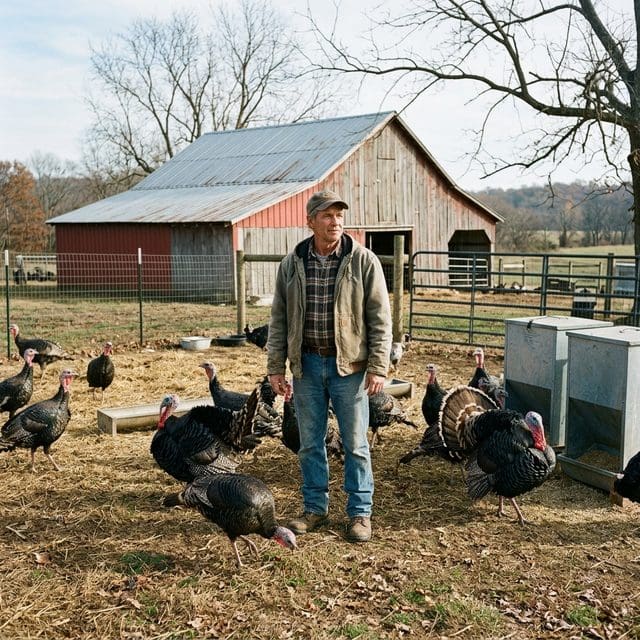
Nationwide wholesale turkey prices are up 12% this year, while DiPaola Turkey Farms says higher corn and soybean costs helped prompt a 30-cent-per-pound price increase.
Thanksgiving turkey is costing more this year as higher feed and other production expenses put pressure on farms. Nationwide wholesale turkey prices are up 12% this year, Fox Business reported Nov. 11, while Artie DiPaola, owner of DiPaola Turkey Farms, said corn and soybean feed costs have climbed 10% to 12%.
DiPaola said his farm raised prices by 30 cents per pound in response to higher feed and other production costs. He also said increased sales are helping the business offset its daily expenses, according to Fox Business. The report describes a farm-level pricing decision amid rising costs, not a uniform increase at grocery stores or a prediction of what every household will pay.
The figures offer a practical glimpse of how crop costs can reach the holiday table. Corn and soybeans are used in animal feed, and a farm facing higher feed bills may adjust what it charges for its products. But the available reporting does not break down the farm’s full cost structure, specify what portion of its price increase reflects feed, or compare its prices with those of other producers. The 12% wholesale increase is a nationwide figure; it does not establish the retail price consumers will see.
DiPaola Turkey Farms’ online shop listed Wednesday, Nov. 18, as the Thanksgiving order deadline as of Nov. 11. The farm scheduled pickup in Hamilton for Nov. 23 and 24. Those dates provide a limited, farm-specific ordering window for customers. They do not indicate how much turkey the farm has available, whether orders are filling up, or what prices other sellers are charging. The reported deadline and pickup schedule are useful logistics, but they are not evidence of broader supply conditions.
The farm owner’s comments also leave the reasons for higher feed costs largely unexplained. The reporting provides no corn or soybean price series, no detailed comparison of the farm’s expenses with last year beyond DiPaola’s estimate, and no breakdown of other production costs. It therefore supports the farm’s account of its expenses, but not a broader conclusion about what is driving input prices across the agricultural sector. Nor does it establish whether the farm’s price change is typical among turkey producers.
For food-safety watchers, the report leaves another set of questions unanswered. It contains no information about inspections, disease testing, processing practices, pesticide exposure, water use, or environmental impacts at the farm. Higher feed costs are an agricultural business concern, but they do not by themselves indicate a food-safety problem or a regulatory failure. The news item is about prices and farm expenses, not a safety alert or an inspection finding.
That distinction matters in a season when price pressures can easily be conflated with claims about food quality or safety. The available account supports a narrower conclusion: a turkey producer says feed and other production costs rose, and the farm responded with a price increase. It does not establish whether the increase is temporary, whether other farms are making similar changes, or whether public policy or environmental regulation contributed. Increased sales, DiPaola said, are helping offset daily expenses, but the report gives no sales figures or measure of how much relief that provides.
The report also provides no basis for judging whether federal agencies are doing enough to protect food, water, or air. Assessing those responsibilities would require separate, attributable information about inspection schedules, test results, farm practices, and enforcement. None is included in the available material. That absence should not be mistaken for evidence that regulators have failed—or that every relevant risk has been resolved.
For now, the clearest measures are the nationwide wholesale increase reported by Fox Business, DiPaola’s account of rising costs, the farm’s 30-cent-per-pound price adjustment, and its posted order deadline and pickup dates. Consumers comparing holiday options may find those details relevant, but the source does not provide a verified price list or a comparison with grocery stores and other farms. How widely producers are passing costs along, and what shoppers will ultimately pay, remain uncertain from the reporting at hand.

Eric Nolan serves as the Senior Correspondent for Food, Water, and Environmental Health at Just Right News, where he brings a principled, common-sense perspective to the most fundamental issues facing the American public. With a career dedicated to uncovering the truth behind the policies that govern our natural resources, Eric has become a trusted voice for readers who value traditional stewardship over bureaucratic overreach. His reporting is defined by a commitment to the idea that true environmentalism is rooted in the protection of the American family and the preservation of the nation’s agricultural heritage.
Raised in Fresno, California, Eric’s worldview was shaped in the heart of the San Joaquin Valley. Growing up in one of the world’s most productive agricultural hubs, he witnessed firsthand the vital connection between the land, the water, and the dinner table. In Fresno, he saw the resilience of farmers and the devastating impact that distant, top-down regulations can have on local communities. This upbringing instilled in him a deep respect for the producers who feed the country and a lifelong skepticism toward the alarmist narratives often pushed by mainstream media. For Eric, environmental health is not an abstract political talking point; it is a matter of ensuring that the people who work the land have the freedom and the resources to do so effectively.
Now based in Eugene, Oregon, Eric operates from a unique vantage point in the Pacific Northwest. Living in a region often defined by intense environmental debate, he provides a necessary counter-narrative to the prevailing trends of the area. From his base in Eugene, he monitors the shifting tides of federal and state policies, ensuring that the voices of rural citizens and property owners are not drowned out by urban activism. His reporting often bridges the gap between the rugged realities of the outdoors and the legislative halls where decisions are made, offering a grounded perspective that prioritizes local sovereignty and practical solutions.
As the lead for the acclaimed feature series “Earth on the Table,” Eric explores the intricate journey of the American food supply. He tackles critical issues such as water rights, soil health, and food security through a lens of national stability and individual liberty. He believes that a healthy environment and a thriving economy are not mutually exclusive, but rather two sides of the same coin of national prosperity. His work consistently highlights how innovation and private-sector ingenuity are the most effective tools for ensuring clean water and a safe food supply, rather than the expansion of the administrative state.
At Just Right News, Eric’s reporting serves as a vital resource for those who seek accountability and transparency. Whether he is investigating the impact of federal land management on local economies or examining the safety of the national food infrastructure, his work remains anchored in the values of heritage and hard work. Eric Nolan continues to be a leading voice in environmental journalism, championing the belief that the best way to protect our natural resources is to empower the people who live and work closest to them.