

Spain’s protests, a UAW labor dispute and new union organizing in baseball show workers pressing for leverage as economic anxiety remains elevated.
Workers in Spain took to the streets Wednesday over housing costs and the high cost of living, while labor disputes in the United States underscored how pay, job security and bargaining power are again pressing concerns across very different industries.
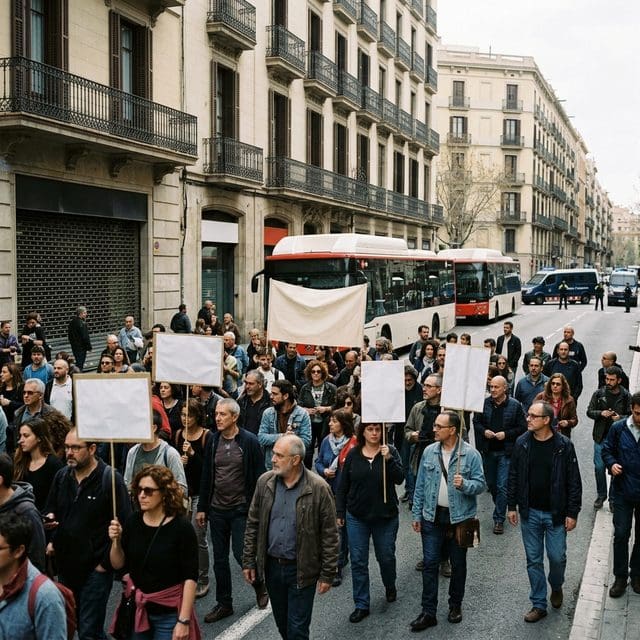
In Barcelona, more than 50,000 people demonstrated, according to BBC reporting. Masked protesters reportedly set rubbish bins alight and smashed shop windows; police used tear gas. Public transit was largely halted from 9:30 a.m. to 4:30 p.m. local time, an interruption that carried the dispute well beyond the march itself.
The disruption also reached industrial workplaces. Spanish unions UGT and CCOO reported 90% participation in the automotive and port sectors, including total stoppages at Volkswagen’s Navarre factory and SEAT’s Barcelona plant, according to Al Jazeera and Independent.ie. The reported participation figures come from the unions; they are not an independent measure of how many workers joined.
The immediate demands center on housing affordability, wages and public services. Those issues are tightly connected for workers: when living costs rise faster than household income, a wage increase can offer less relief than its headline figure suggests. The available reports provide no detailed wage series or estimate of how much workers’ purchasing power has changed, so the scale of that pressure cannot be measured from the strike figures alone.
In the United States, UAW Local 405 members were scheduled to begin an unfair-labor-practice strike at Triumph Engine Control Systems at 5 a.m. on November 2. The union cited alleged unfair labor practices and the company’s refusal to present what it considers a fair economic proposal. The UAW’s November 10 update describes the planned action, but the material does not establish whether the strike remained underway or report its effect on production.
That distinction matters. A strike announcement can signal a breakdown in negotiations, but it does not by itself establish the merits of either side’s claims or the eventual outcome for workers. No company response or contract terms were included in the available reporting.
Labor uncertainty is also showing up in broader public sentiment. The New York Fed reported that the perceived probability of U.S. unemployment rising over the next year reached 45.3% in October, the highest level since April 2020. That is a measure of expectations, not the unemployment rate itself, and it does not prove that job losses are imminent. Still, it points to anxiety about job security at a time when workers are weighing the cost of living against the stability of their paychecks.
In professional baseball, the bargaining deadline is drawing nearer. Major League Baseball’s collective-bargaining agreement expires December 1, and owners are pressing for a salary cap that the players’ union rejects. A lockout is expected if the sides fail to reach a deal, according to the Los Angeles Times. A shutdown would affect more than players: team and league operations depend on a wider workforce, though the available reporting does not quantify the potential effects on those jobs.
At the same time, 127 MLB Advanced Media content employees voted November 11 to unionize with the Writers Guild of America East. The group produces content in English, Spanish and Japanese. Their vote adds digital-media workers to the labor story surrounding baseball, where the dispute over player compensation has dominated attention.
Together, these cases show different forms of worker leverage: mass demonstrations, a strike rooted in alleged labor-law violations, and a union vote. None guarantees higher real wages or greater job security. Those outcomes will depend on negotiations and on whether employers, unions and public officials can address the underlying pressures without shifting the costs onto workers and families.

Tom Blake serves as the Senior Correspondent for Labor, Wages, and Automation at Just Right News, where he brings a grounded, principled perspective to the most pressing economic issues facing the American heartland. As the lead voice behind the acclaimed feature series “The Price of Work,” Tom focuses his reporting on the intersection of traditional industry and the rapidly evolving technological landscape, always prioritizing the dignity of the individual worker and the health of the American family.
Tom’s deep understanding of the labor market is not merely academic; it is rooted in his upbringing in Detroit, Michigan. Growing up in the shadow of the automotive industry, he witnessed firsthand the triumphs and tribulations of the American blue-collar workforce. He saw how the stability of a manufacturing job could build a community and, conversely, how the erosion of those industries could tear the social fabric apart. This background instilled in him a lifelong respect for the trades and a healthy skepticism toward economic policies that prioritize globalist interests over the well-being of local communities.
Now based in Pittsburgh, Pennsylvania, Tom continues to report from the front lines of the shifting economy. Pittsburgh, a city that has reinvented itself while maintaining its gritty, industrious spirit, provides the perfect vantage point for his beat. From the steel mills that remain to the high-tech robotics labs reshaping the city’s future, Tom explores how automation is changing the nature of employment. His reporting often highlights the tension between innovation and tradition, arguing that while progress is inevitable, it must not come at the expense of the American worker’s ability to provide for their family through honest, meaningful labor.
In his role at Just Right News, Tom has become a vital voice for those who feel overlooked by mainstream economic coverage. He rejects the notion that the decline of American manufacturing is an unavoidable casualty of the modern era. Instead, his work often examines how regulatory overreach, rising energy costs, and the unchecked rise of automation impact the take-home pay of everyday citizens. Through “The Price of Work,” Tom delves into the true cost of economic shifts, looking beyond the raw data to tell the stories of the people behind the statistics.
Tom’s reporting is characterized by a commitment to the conservative values of self-reliance, fiscal responsibility, and the preservation of the American dream. He believes that a strong nation is built on a foundation of stable jobs and fair wages, and his work seeks to hold both government and corporate entities accountable to that standard. Whether he is interviewing a shop floor manager about the implementation of new AI technology or analyzing the impact of wage inflation on small businesses, Tom provides a clear-eyed analysis that resonates with readers who value hard work and common sense.
Through his dedicated coverage, Tom Blake remains a steadfast advocate for the American workforce, ensuring that the voices of those in the industrial heartland are heard loud and clear in the national conversation. His perspective is essential for anyone seeking to understand the complex realities of labor and automation in the twenty-first century.