

President Trump signed S. 1003 into law as a Senate Judiciary Committee deadlock continues over Todd Blanche’s nomination for Attorney General and a disputed $1.8 billion anti-weaponization fund.
The executive and legislative branches remain locked in a high-stakes tug-of-war as President Donald Trump signed new legislation into law while his top priority for the Department of Justice remains in procedural limbo. According to official White House briefings, the President signed S. 1003 on July 30, 2026. While the administration has yet to release the full line-item policy details, its enactment creates a fresh statutory framework that will influence ongoing negotiations over broader reconciliation packages and federal spending. This signature represents a concrete exercise of executive power, yet it stands in contrast to the gridlock paralyzing the upper echelons of the federal law enforcement apparatus.
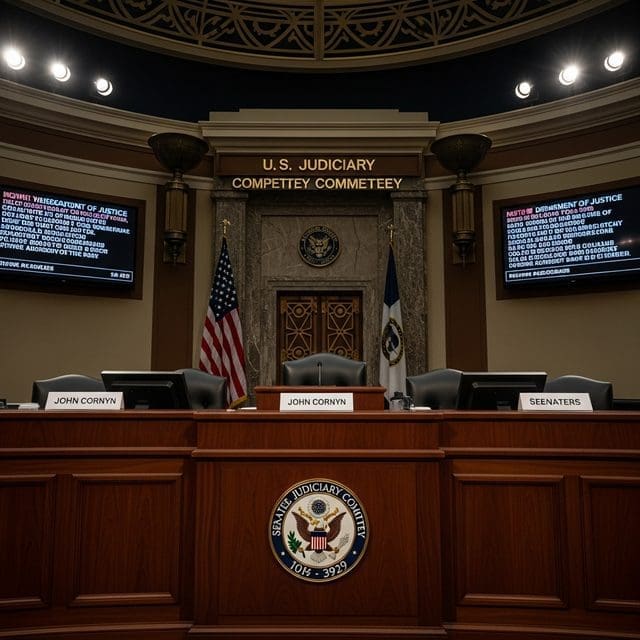
Simultaneously, the Senate Judiciary Committee has postponed a scheduled vote on Todd Blanche, the President’s nominee for Attorney General. The nomination has become a focal point for internal Republican friction, specifically regarding the President’s demand for a $1.8 billion “anti-weaponization fund.” Despite the President’s public defense of the fund, reports indicate that Blanche himself suggested earlier this month that the proposal is not moving forward, creating a significant disconnect between the nominee and the Oval Office. This friction has led some observers to characterize the President’s current posture as one of political retribution, potentially sacrificing his own nominee’s confirmation to exert pressure on congressional holdouts.
Senator John Cornyn of Texas has emerged as a central figure in this administrative standoff. As the President publicly needles Cornyn over the lack of progress on the Blanche nomination, Cornyn has reportedly delivered a new settlement proposal to the Department of Justice. The Senator’s posture suggests a demand for concessions, stating that the administration must decide if they want the current impasse resolved. This internal party struggle is playing out against a ticking clock, as Senate Majority Leader John Thune attempts to manage a complex legislative calendar with only eight days remaining to show progress on major reconciliation packages before the scheduled summer recess.
This vacancy at the head of the Justice Department comes at a volatile moment for federal policy and international relations. The administration is currently navigating the fallout of July 30 airstrikes against Iran, conducted in retaliation for an attack on a U.S. base in Jordan. Furthermore, the President has publicly broken with preliminary official assessments regarding recent cyberattacks on Minnesota water systems, attributing the failures to local incompetence rather than Iranian state actors. This divergence from intelligence community assessments underscores the tension between the White House and the permanent administrative state during a period of heightened geopolitical risk.
On the domestic front, the financial implications of executive actions continue to ripple through the economy. Amazon recently received $600 million in tariff refunds following a Supreme Court decision that struck down several Trump administration trade penalties. Meanwhile, the Department of War has issued an $820 million conditional loan to PDW Holdings to bolster domestic drone manufacturing, highlighting a shift toward industrial policy aimed at national security. These fiscal maneuvers, combined with the ongoing dispute over the $1.8 billion anti-weaponization fund, illustrate the administration’s aggressive use of the federal purse to achieve policy ends.
As the Senate grapples with “Senate math” and the President’s penchant for leverage, the broader legislative agenda remains in flux. From Ukrainian President Zelensky’s requests for intervention regarding Starlink drone strikes to the refusal of Democratic Senate candidates in Montana and South Dakota to step aside for independents, the political landscape is increasingly fractured. The coming days will determine whether the administration can bridge the gap with the Senate Judiciary Committee or if the Department of Justice will continue to operate without a confirmed leader during a complex period of the current term.

Miles Harrington serves as the Senior Correspondent for Federal Systems & Executive Power at Just Right News, where he brings a disciplined, constitutionalist lens to the inner workings of the American government. With a focus on the mechanics of the federal bureaucracy and the limits of executive authority, Harrington has established himself as a vital voice for readers who value transparency, accountability, and the preservation of the separation of powers.
A native of Richmond, Virginia, Harrington’s perspective is deeply rooted in the traditions of the Old Dominion. Growing up in a city defined by its historical significance and its role as a center of American jurisprudence, he developed an early appreciation for the foundational principles of the Republic. His upbringing in Richmond—a place where the legacy of the Founding Fathers is woven into the landscape—instilled in him a belief that the federal government should remain within its constitutional bounds. This background informs his skepticism of centralized overreach and his commitment to reporting on the ways in which the administrative state impacts the lives of everyday citizens.
In his current role, Harrington specializes in the complexities of federal systems. He doesn’t just report on the headlines of the day; he digs into the structural shifts within the executive branch that often go unnoticed by the mainstream press. Whether he is analyzing the implications of a new federal regulation or investigating the expansion of agency jurisdiction, his work is characterized by a rigorous adherence to the facts and a dedication to the rule of law.
Harrington is perhaps best known for his signature feature series, “How Washington Works.” Through this ongoing project, he demystifies the often-opaque processes of the nation’s capital, pulling back the curtain on the “Deep State” and the unelected officials who wield significant influence over national policy. By breaking down complex legislative maneuvers and executive orders, he empowers Just Right News readers to understand the true levers of power in Washington. His reporting serves as a necessary check on the federal government, ensuring that the actions of those in power are held up to the light of public scrutiny.
Now based in Washington, D.C., Harrington operates at the epicenter of the political world, yet he remains intentionally distanced from the “Beltway bubble.” His proximity to the halls of power allows him to maintain a robust network of sources across the federal landscape, but his heart remains in the principled conservatism of his Virginia roots. He views his role not merely as a reporter, but as a steward of the public trust, dedicated to providing the clarity and context that conservative voters need to navigate an increasingly complex political environment.
Through his sharp analysis and unwavering commitment to the truth, Miles Harrington continues to be a cornerstone of the Just Right News team. His work ensures that the principles of limited government and executive restraint remain at the forefront of the national conversation, providing a crucial service to those who believe in a government that is truly of, by, and for the people.