

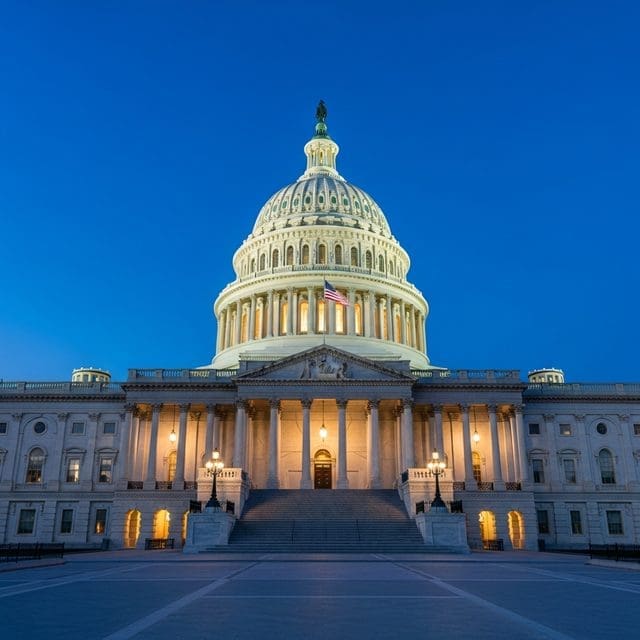
House Republicans passed a stopgap funding bill to extend government operations through December 4, attempting to bypass fiscal brinkmanship before the November midterms while facing criticism over partisan policy priorities.
The House of Representatives moved with uncharacteristic haste on July 21, 2026, passing a continuing resolution to fund the federal government through December 4. The 220–205 vote, breaking almost entirely along party lines, represents a calculated strategic attempt by House leadership to remove the threat of a fiscal cliff just weeks before the November midterm elections. With the current funding authority set to expire at midnight on September 30, the early maneuver seeks to insulate the legislature from the political volatility typically associated with shutdown brinkmanship, which Republicans fear could benefit the opposition at the polls.
Speaker Mike Johnson framed the legislation as a necessary step to ensure administrative stability, challenging his colleagues across the aisle to support the measure or “own the chaos” of a potential closure. By pushing the deadline into December, the House GOP aims to clear the legislative calendar for a separate, more contentious $95 billion spending package. That secondary package is expected to include significant funding for military operations against Iran following the July 30 airstrikes, agricultural aid for struggling farmers, and grants for states to implement stricter voter ID requirements—a central policy pillar for President Donald Trump.
However, the fiscal path forward remains obscured by internal friction and procedural complaints. The passed resolution notably excludes the “Save America Act,” a comprehensive election overhaul favored by the party’s most conservative members. This omission suggests a calculated decision by Speaker Johnson to keep the stopgap bill “clean” enough to pass the House, even as it draws fire from the left for its lack of bipartisan input. Representative Tom Cole, chairman of the House Appropriations Committee, defended the move, noting that the country had already endured two major shutdowns in this Congress and that leadership was not willing to risk a third.
Ranking Member Rosa DeLauro lead the Democratic opposition, criticizing the bill as a one-sided product drafted without meaningful committee negotiation. DeLauro raised specific alarms regarding the absence of prior language limiting Border Patrol and Customs and Border Protection funding. She argued that the current text creates a loophole that could allow the executive branch to redirect resources toward expanded immigration raids and voter-access restrictions. Furthermore, DeLauro expressed concern that the bill fails to block a proposed federal rule that would allow agency heads to terminate grants they claim do not align with the president’s specific policy priorities.
The legislative focus now shifts to the Senate, where the bill’s prospects are far from certain. Senate Majority Leader John Thune indicated that Senate Appropriations Chair Susan Collins is seeking a bipartisan path, but the upper chamber is expected to demand revisions before the August recess. This tension is mirrored in the broader political landscape, where Democratic Senate candidates like Alani Bankhead in Montana and Julian Beaudion in South Dakota are resisting party pressure to step aside for independents, further complicating the electoral math that this funding bill seeks to stabilize.
Beyond the immediate funding fight, the administrative state continues to navigate a complex geopolitical and legal landscape. While Congress debates the budget, the Department of War recently issued an $820 million conditional loan to PDW Holdings to bolster domestic drone manufacturing. Simultaneously, President Trump has injected new uncertainty into the executive branch’s stance on foreign interference, publicly stating he does not believe Iran was behind the recent cyberattacks on Minnesota water systems, despite preliminary official assessments to the contrary. These overlapping crises ensure that while the funding bill may temporarily delay a shutdown, the broader debate over federal overreach and executive priorities will remain at the forefront of the national discourse.

Miles Harrington serves as the Senior Correspondent for Federal Systems & Executive Power at Just Right News, where he brings a disciplined, constitutionalist lens to the inner workings of the American government. With a focus on the mechanics of the federal bureaucracy and the limits of executive authority, Harrington has established himself as a vital voice for readers who value transparency, accountability, and the preservation of the separation of powers.
A native of Richmond, Virginia, Harrington’s perspective is deeply rooted in the traditions of the Old Dominion. Growing up in a city defined by its historical significance and its role as a center of American jurisprudence, he developed an early appreciation for the foundational principles of the Republic. His upbringing in Richmond—a place where the legacy of the Founding Fathers is woven into the landscape—instilled in him a belief that the federal government should remain within its constitutional bounds. This background informs his skepticism of centralized overreach and his commitment to reporting on the ways in which the administrative state impacts the lives of everyday citizens.
In his current role, Harrington specializes in the complexities of federal systems. He doesn’t just report on the headlines of the day; he digs into the structural shifts within the executive branch that often go unnoticed by the mainstream press. Whether he is analyzing the implications of a new federal regulation or investigating the expansion of agency jurisdiction, his work is characterized by a rigorous adherence to the facts and a dedication to the rule of law.
Harrington is perhaps best known for his signature feature series, “How Washington Works.” Through this ongoing project, he demystifies the often-opaque processes of the nation’s capital, pulling back the curtain on the “Deep State” and the unelected officials who wield significant influence over national policy. By breaking down complex legislative maneuvers and executive orders, he empowers Just Right News readers to understand the true levers of power in Washington. His reporting serves as a necessary check on the federal government, ensuring that the actions of those in power are held up to the light of public scrutiny.
Now based in Washington, D.C., Harrington operates at the epicenter of the political world, yet he remains intentionally distanced from the “Beltway bubble.” His proximity to the halls of power allows him to maintain a robust network of sources across the federal landscape, but his heart remains in the principled conservatism of his Virginia roots. He views his role not merely as a reporter, but as a steward of the public trust, dedicated to providing the clarity and context that conservative voters need to navigate an increasingly complex political environment.
Through his sharp analysis and unwavering commitment to the truth, Miles Harrington continues to be a cornerstone of the Just Right News team. His work ensures that the principles of limited government and executive restraint remain at the forefront of the national conversation, providing a crucial service to those who believe in a government that is truly of, by, and for the people.