

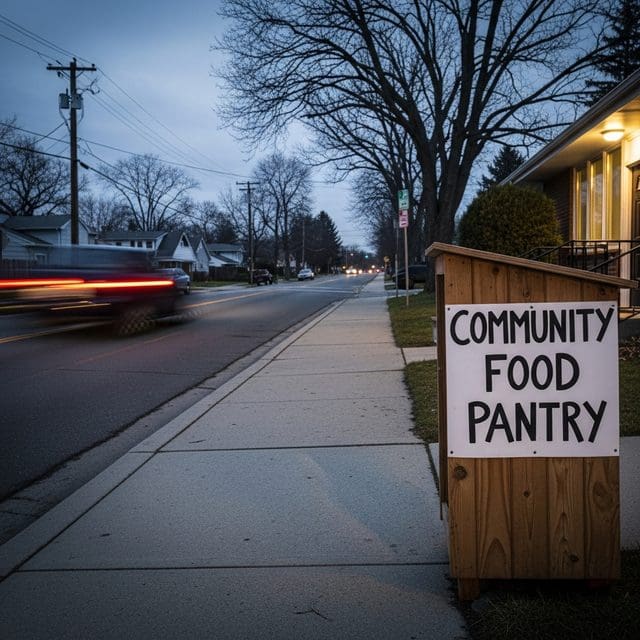
Data reveals a sharp decline in SNAP participation and record homelessness as low-income Americans face real income erosion despite headline economic growth and corporate earnings strength.
The American economy is currently a tale of two realities. While headline GDP and corporate earnings suggest a resilient financial core, the social safety net reveals a growing fissure for the nation’s most vulnerable. Data indicates that the primary springboard for economic mobility—the ability for a family to rise through work—is being tested by policy shifts and persistent inflation.
According to USAFacts, the United States is grappling with a paradox: the poverty rate remains near historic lows, yet homelessness has reached a record high. This disconnect is visible in the Supplemental Nutrition Assistance Program (SNAP). In fiscal year 2025, 42.1 million people received benefits. However, the Food Research & Action Center reports a sharp 8% national decline in participation over the last year, with states like Arizona and Florida seeing drops as high as 33% and 15%. This contraction precedes a planned $187 billion reduction in SNAP funding over the next decade.
This retrenchment comes as the bottom 40% of the income distribution—roughly 100 million Americans—face real income erosion. While top earners and AI-adjacent workers have seen wealth swell, many citizens struggle with gasoline prices that doubled in early 2026. Even as oil prices dropped 10% following the reopening of the Strait of Hormuz in April, the weight of high interest rates presses on the middle class. PennyMac Mortgage Investment Trust reported $78.5 million in Q2 net income, yet management flagged that its low-to-moderate income borrowers remain vulnerable to labor-market shocks.
The restorative power of work is also under scrutiny. Research from the Brookings Institution suggests that SNAP work requirements frequently lead to program exits without corresponding increases in stable employment. For many, exiting assistance signals a descent into housing instability rather than a transition to the middle class. This is compounded by a wealth gap resistant to traditional mobility. Equitable Growth research indicates that a child’s future income is heavily dictated by their parents’ financial standing, a correlation that is strongest among low-income families where parental income explains two-thirds of a child’s mobility.
For Black households, the disparity is pronounced; median wealth for top-tier Black families stands at $283,000, compared to over $1.5 million for white counterparts. This gap suggests that safety-net retrenchment interacts with historical wealth disparities to create a ceiling that hard work alone cannot always shatter. While the Global Generative AI market is projected to reach $1.6 trillion by 2033, these benefits have yet to reach the 39.5 million people relying on a monthly SNAP benefit averaging just $185.
As federal agencies prepare new research on post-pandemic mobility, the data suggests the path to economic independence is narrowing. Without a safety net that functions as a temporary bridge rather than a shrinking lifeline, the restorative power of work is hindered by rising costs and diminished community resilience. The current trajectory suggests that while the economy grows on paper, the foundation of the social safety net is being stretched to a breaking point.

James Foster serves as the Senior Correspondent for Inequality and the Social Safety Net at Just Right News, where he brings a principled and nuanced perspective to the most pressing economic challenges facing the nation. With a career dedicated to exploring the intersection of policy and personal responsibility, Foster has become a leading voice in documenting how government programs and economic shifts impact the American family. His reporting is characterized by a commitment to the “human element,” moving beyond cold statistics to highlight the stories of resilience, work, and community that define the modern American experience.
Foster’s perspective is deeply rooted in his upbringing in Birmingham, Alabama. Growing up in a city with a rich industrial heritage and a history of economic transformation, he witnessed firsthand the importance of the dignity of work and the strength of local institutions. In Birmingham, he saw how the most effective safety nets were often those woven by neighbors, faith-based organizations, and local civic groups. This background instilled in him a lifelong skepticism of “one-size-fits-all” solutions from distant bureaucracies, favoring instead the localized, community-driven support systems that he frequently champions in his writing.
Now based in Atlanta, Georgia, Foster operates from one of the most dynamic and rapidly evolving metropolitan hubs in the South. His location provides a front-row seat to the stark contrasts of the modern economy. From the gleaming towers of Atlanta’s financial districts to the struggling neighborhoods on the city’s periphery, Foster finds the stories that illustrate the complexities of upward mobility. His reporting from the Sun Belt serves as a microcosm for the national debate on poverty, highlighting how inflation, housing costs, and labor market shifts affect the working class in real-time.
As the lead for the acclaimed feature series “America’s Balancing Act,” Foster explores the delicate tension between providing a necessary hand up and fostering long-term independence. The series has become a cornerstone of Just Right News, offering a deep dive into the unintended consequences of social welfare policies. Foster’s work often focuses on the “cliff effect” and other systemic hurdles that can inadvertently discourage employment, arguing that true compassion is measured by how many people are empowered to leave the safety net, rather than how many are added to it.
Throughout his tenure, Foster has remained dedicated to the mission of Just Right News, providing a clear-eyed, conservative analysis of social issues. He believes that a free society thrives when individuals are empowered and the private sector is allowed to innovate. Whether he is interviewing small business owners about the challenges of a changing workforce or documenting the success of private charitable initiatives, Foster’s goal is to provide readers with the truth about the state of the American Dream. His work serves as a vital reminder that while the challenges of inequality are great, the solutions are often found in the strength of the American spirit and the preservation of traditional values.