

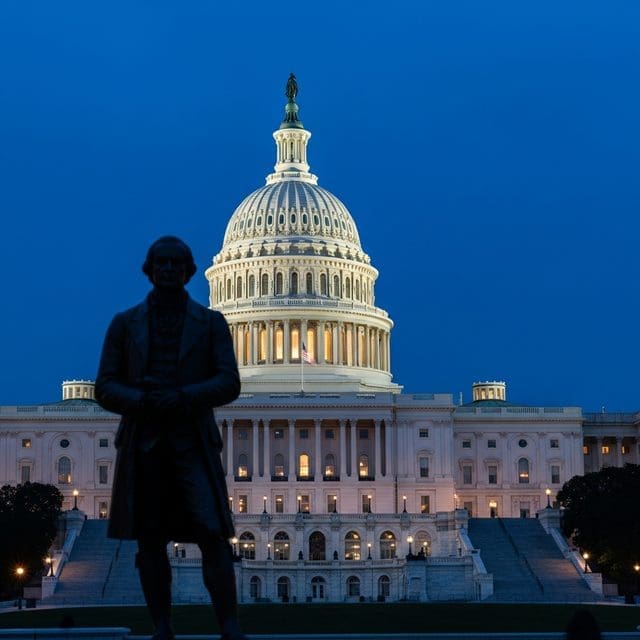
The House and Senate diverge on curbing executive military authority while the White House implements aggressive new tariffs and faces judicial pushback on domestic spending.
The constitutional tug-of-war between the executive branch and Congress intensified this week as lawmakers moved to assert authority over foreign military engagements and domestic fiscal priorities. At the center of the storm is a House resolution aimed at curbing the president’s ability to conduct military operations against Iran. In a 214-208 vote, the House of Representatives directed the administration to cease hostilities unless a formal declaration of war or specific statutory authorization is granted. The vote was notable for its bipartisan flavor, as four Republicans—Representatives Tom Barrett, Brian Fitzpatrick, Warren Davidson, and Thomas Massie—crossed the aisle to support the measure. Representative Pramila Jayapal characterized the effort as a non-partisan defense of the Constitution, arguing that the current conflict has become an illegal engagement.
However, the legislative check met a firm wall in the Senate, where a similar measure failed in a 49-47 vote. The proceedings in the upper chamber revealed shifting alliances; Senator Susan Collins of Maine joined the Democratic caucus in favor of the war-powers curb, while Senator John Fetterman broke ranks to vote with the Republican majority to block the move. This stalemate leaves the administration with significant operational latitude even as critics in both parties describe the expanding conflict in the Middle East as a strategic morass. The friction underscores a broader debate regarding the War Powers Resolution and the extent to which the executive can commit American forces without a clear mandate from the people’s representatives.
On the economic front, the White House has moved to expand its use of executive trade authority. Invoking Section 338 of the Tariff Act of 1930, the president signed three proclamations imposing a 50% tariff on a specific suite of Canadian goods. The new duties target products including wine, cement, and hockey sticks, and are set to take effect in late August. The administration cited a sharp decline in U.S. exports to Canada as the primary catalyst, noting that U.S. motor vehicle exports fell by $5.6 billion and alcoholic beverage imports to Canada plummeted by 81% over the last year. While the White House maintains these measures are essential for defending American workers, the exemption of critical minerals, potash, and energy suggests a calculated attempt to pressure Ottawa without destabilizing essential supply chains.
Simultaneously, the administration’s domestic projects have come under judicial scrutiny. Federal Judge Richard Leon issued a ruling halting the $400 million construction of a new White House ballroom. The project, which has drawn fire for its price tag and lack of congressional consultation, was paused for 14 days pending further review. Judge Leon’s opinion was pointed, stating that the president serves as a “caretaker” of the executive residence rather than its proprietor, and found no statutory basis for the authority claimed by the administration to bypass oversight for such a massive capital expenditure. The White House is expected to appeal, but the ruling serves as a significant rebuke of the “unitary executive” theory often cited by the current administration.
Further complicating the administrative landscape is a total breakdown in the Senate confirmation process. As the summer recess approaches, negotiations between Senate Majority Leader Chuck Schumer and Republican Whip John Thune collapsed. The impasse involves dozens of executive branch nominees who remain unconfirmed. The White House had reportedly offered to unfreeze specific agency funding in exchange for a streamlined confirmation vote, but Senator Thune indicated that the demands made by the minority were not something the administration could meet. This vacuum in leadership across various federal agencies threatens to delay the implementation of key policies through the remainder of the year.
Finally, the administrative state faced a rare moment of public silence in the hearing room. Dr. Anthony Fauci, appearing before the Senate Homeland Security and Governmental Affairs Committee, invoked his Fifth Amendment rights during testimony. The move prompted an immediate reaction from Committee Chair Rand Paul, who announced his intention to hold the doctor in contempt of Congress. These compounding events—from war powers and trade wars to judicial injunctions and stalled nominations—reveal a federal system under immense strain, as the traditional boundaries of executive power are tested by a skeptical legislature and an active judiciary.

Miles Harrington serves as the Senior Correspondent for Federal Systems & Executive Power at Just Right News, where he brings a disciplined, constitutionalist lens to the inner workings of the American government. With a focus on the mechanics of the federal bureaucracy and the limits of executive authority, Harrington has established himself as a vital voice for readers who value transparency, accountability, and the preservation of the separation of powers.
A native of Richmond, Virginia, Harrington’s perspective is deeply rooted in the traditions of the Old Dominion. Growing up in a city defined by its historical significance and its role as a center of American jurisprudence, he developed an early appreciation for the foundational principles of the Republic. His upbringing in Richmond—a place where the legacy of the Founding Fathers is woven into the landscape—instilled in him a belief that the federal government should remain within its constitutional bounds. This background informs his skepticism of centralized overreach and his commitment to reporting on the ways in which the administrative state impacts the lives of everyday citizens.
In his current role, Harrington specializes in the complexities of federal systems. He doesn’t just report on the headlines of the day; he digs into the structural shifts within the executive branch that often go unnoticed by the mainstream press. Whether he is analyzing the implications of a new federal regulation or investigating the expansion of agency jurisdiction, his work is characterized by a rigorous adherence to the facts and a dedication to the rule of law.
Harrington is perhaps best known for his signature feature series, “How Washington Works.” Through this ongoing project, he demystifies the often-opaque processes of the nation’s capital, pulling back the curtain on the “Deep State” and the unelected officials who wield significant influence over national policy. By breaking down complex legislative maneuvers and executive orders, he empowers Just Right News readers to understand the true levers of power in Washington. His reporting serves as a necessary check on the federal government, ensuring that the actions of those in power are held up to the light of public scrutiny.
Now based in Washington, D.C., Harrington operates at the epicenter of the political world, yet he remains intentionally distanced from the “Beltway bubble.” His proximity to the halls of power allows him to maintain a robust network of sources across the federal landscape, but his heart remains in the principled conservatism of his Virginia roots. He views his role not merely as a reporter, but as a steward of the public trust, dedicated to providing the clarity and context that conservative voters need to navigate an increasingly complex political environment.
Through his sharp analysis and unwavering commitment to the truth, Miles Harrington continues to be a cornerstone of the Just Right News team. His work ensures that the principles of limited government and executive restraint remain at the forefront of the national conversation, providing a crucial service to those who believe in a government that is truly of, by, and for the people.