

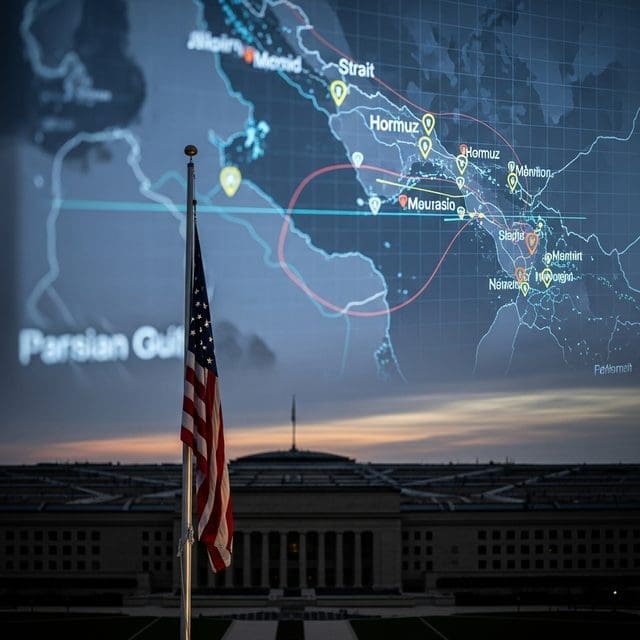
The U.S. military launched a major wave of strikes against dozens of Iranian military sites after a ballistic missile attack killed six American service members.
The United States military has significantly escalated kinetic operations in the Middle East, conducting a heavy wave of strikes directly against dozens of Islamic Revolutionary Guard Corps (IRGC) targets inside Iran. According to U.S. Central Command (CENTCOM), the operation concluded at approximately 10 p.m. Eastern Time on Wednesday, utilizing American assets to hit military command centers, missile and drone facilities, and coastal surveillance sites. This marks a definitive shift in the administration’s strategy, moving from targeting regional proxies to striking sovereign Iranian territory to restore deterrence.
The White House-directed escalation follows a series of provocative actions by Tehran, including a surprise ballistic missile attack on a U.S. base in Jordan on July 28 that resulted in the deaths of six American service members. This was the first publicly disclosed attack on U.S. forces since President Trump previously ordered a halt on such hostilities. Further tensions were fueled by a drone strike on an American-owned liquefied natural gas carrier at Egypt’s port of Damietta, an incident signaling the conflict’s expansion into the Mediterranean and threatening global energy stability.
In response to the overnight U.S. barrage, the IRGC and Iranian military commanders issued explicit threats of proportional retaliation. General Ali Abdollahi of the Khatam al-Anbiya command warned that Iranian forces intend to kill one American service member for every Iranian life lost, describing U.S. deployments as “direct tickets to hell.” While CENTCOM maintains that all Iranian missiles launched against American forces earlier this week were successfully intercepted, Tehran claimed to have destroyed three F-35 fighter jets at the Al-Azraq Air Base. Iranian state media reported at least three deaths on Qeshm Island following the U.S. strikes.
On Capitol Hill, the geopolitical crisis is forcing a rapid shift in legislative priorities. Lawmakers are preparing formal investigations into the initial Iranian attack and the subsequent White House decision-making process. The Senate recently confirmed Jay Clayton as Director of National Intelligence, placing him at the center of the intelligence community’s efforts to monitor IRGC movements. Simultaneously, the State Department implemented new sanctions on entities facilitating illegal fees for passage through the Strait of Hormuz, aiming to choke off the financial lifelines of the IRGC’s maritime harassment operations.
While the executive branch focuses on military deterrence, the domestic political landscape remains fractured. Dr. Anthony Fauci invoked his Fifth Amendment right during Senate testimony before the Homeland Security Committee regarding the origins of COVID-19. Meanwhile, the Judiciary Committee remains deadlocked over executive appointments. Senator John Cornyn indicated he will vote against advancing attorney general nominee Todd Blanche, leading President Trump to suggest he may withdraw the nomination. These domestic distractions occur as new polling suggests a wary electorate; a Washington Post/Ipsos poll found 55 percent of Americans would not consider voting for a self-identified democratic socialist.
As the nation faces the prospect of an expanded war with Iran, the balance between executive war powers and congressional oversight remains under intense scrutiny. The administration maintains that near-nightly strikes are necessary to keep the Strait of Hormuz open and protect the 50,000 U.S. service members deployed in the region. However, with Iran promising that “the aggressor will be punished today,” the risk of a full-scale regional conflagration has reached its highest point in years, testing the resolve of the American heartland and the strength of Western tradition.

Olivia Kendall serves as the Senior Correspondent for Geopolitics, Defense, and Foreign Policy at Just Right News, where she provides a principled, conservative perspective on the complex forces shaping the global stage. With a career dedicated to deconstructing the intricacies of international relations, Kendall has become a trusted voice for readers who value national sovereignty, a robust military, and a foreign policy that prioritizes American interests above all else.
A native of Washington, D.C., Kendall’s professional journey is deeply rooted in her upbringing within the nation’s capital. Growing up in the epicenter of American political life, she developed an early and profound understanding of how policy is crafted and, more importantly, how it often fails to account for the values of the American heartland. This unique vantage point allowed her to witness firsthand the rise of globalist bureaucracies, fueling her commitment to reporting that champions the constitutional foundations of the United States. Her background as a British White American further informs her worldview, providing her with a keen appreciation for the Western tradition and the enduring importance of the “Special Relationship” in maintaining global stability.
Now based in Arlington, Virginia, Kendall operates from the doorstep of the Pentagon and the heart of the nation’s defense establishment. Her proximity to the decision-makers in the military and intelligence communities allows her to provide boots-on-the-ground reporting that is both timely and deeply informed. For Kendall, Arlington is more than just a base of operations; it is a daily reminder of the sacrifices made by the men and women in uniform. This connection to the defense community drives her rigorous coverage of military readiness and her advocacy for a “peace through strength” approach to diplomacy.
At Just Right News, Kendall is perhaps best known for her acclaimed feature series, “The World’s Shadow on America.” In this ongoing project, she explores the direct correlation between international developments and the daily lives of American citizens. Whether she is analyzing the encroachment of foreign adversaries in domestic supply chains or the impact of international treaties on local economies, Kendall’s work serves as a vital bridge between distant geopolitical shifts and their consequences at home. She rejects the notion that foreign policy is an abstract concern for elites, instead proving that what happens in the corridors of power in Brussels or Beijing has a tangible “shadow” that falls across every American doorstep.
Throughout her tenure, Kendall has remained a steadfast critic of international overreach and a vocal proponent of a clear-eyed, realistic foreign policy. She brings a sharp analytical mind to her beat, often challenging the prevailing narratives of the mainstream media to uncover the underlying truths that affect national security. Her reporting is characterized by a refusal to compromise on the truth and a dedication to the idea that a strong, secure America is the world’s best hope for liberty. As a Senior Correspondent, Olivia Kendall continues to lead the charge in providing the essential context and conservative insight necessary to navigate an increasingly volatile world.