

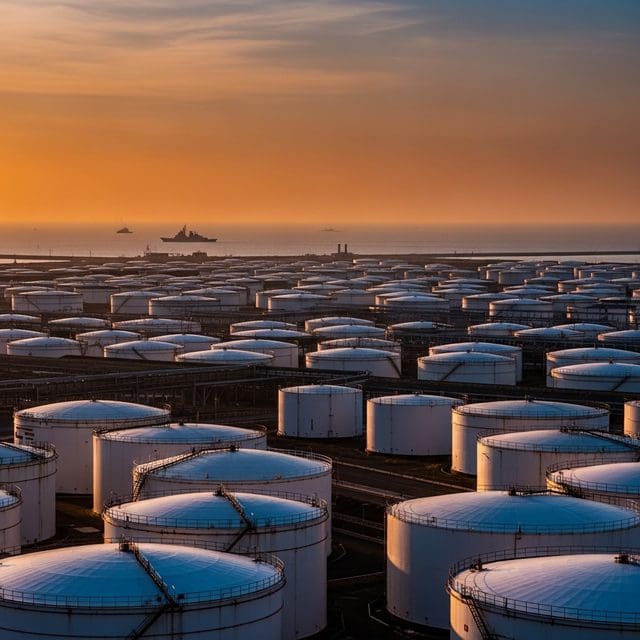
The U.S. Strategic Petroleum Reserve has fallen to 311 million barrels as regional war damage to Saudi infrastructure and a naval blockade on Iran strain global energy security.
The American energy safety net is thinning at a moment of maximum geopolitical volatility. New data confirms the U.S. Strategic Petroleum Reserve (SPR) has plummeted to approximately 311 million barrels, its lowest level since 1983. This depletion follows a sustained campaign of emergency releases—averaging 6 to 9 million barrels weekly throughout June and July—intended to cushion the domestic economy from the fallout of the ongoing conflict with Iran. Since the U.S.-Israeli war on Iran began in late February 2026, inventories have fallen by roughly 104 million barrels, leaving the nation with an emergency cushion that is now less than half full.
While the reserve remains above the statutory floor of 252 million barrels, the rapid drawdown leaves the Trump administration with limited maneuvers as the naval blockade of Iran remains in effect. The economic consequences are surfacing in domestic markets; S&P Global surveys indicate rising inflation and supply chain disruptions, threatening to derail the acceleration the U.S. economy displayed earlier this summer. Treasury officials have warned that the 28 percent surge in oil prices since the renewal of hostilities could carry a massive economic price tag, potentially stalling growth as energy costs filter through the manufacturing and transport sectors.
The supply crunch is being exacerbated by confirmed physical damage to critical infrastructure in the Middle East. New commercial and government satellite imagery shows visible scorch marks and disabled stabilization units at Saudi Aramco’s Abqaiq facility. The damage confirms that recent hostilities have successfully targeted the heart of Saudi export capacity, moving beyond mere near-misses to operational impairment. This vulnerability is compounded by Houthi rebel activity in the Red Sea, where attacks on Saudi facilities have successfully slowed traffic through the Bab el-Mandeb strait, further tightening the global supply of crude.
In response to this regional instability, neighboring Kuwait has moved to insulate its own energy interests through private markets. Kuwait recently finalized a landmark $16 billion multi-year lease and financing deal for its oil pipeline assets with a consortium including Blackstone, Brookfield, and KKR. The agreement, the largest foreign investment in Kuwait’s history, gives the private equity firms long-term rights to tariff revenue while the state retains ownership. Officials frame the deal as a strategic move to diversify funding and secure export routes should traffic through the Strait of Hormuz remain permanently disrupted by the ongoing blockade.
Domestically, the energy landscape is shifting toward long-term diversification and grid modernization as a hedge against fossil fuel volatility. Indiana and Virginia recently enacted laws leveraging Surplus Interconnection Service to accelerate the connection of renewable energy to the grid, aiming to bypass traditional infrastructure bottlenecks. On the diplomatic front, the U.S. and Saudi Arabia announced a nuclear deal on July 22, 2026, which would provide a civilian nuclear program using American technology. However, President Trump added a requirement on July 23 that the deal be contingent on Saudi Arabia normalizing relations with Israel, adding a complex layer of diplomacy to the energy security equation.
Despite these long-term pivots, the immediate concern for policymakers remains the lack of a funded restocking plan for the SPR. With the Pentagon requesting an additional $67 billion to restock munitions and the war with Iran already costing $37.5 billion as of July 21, the fiscal space for replenishing oil reserves remains undefined. Analysts and Department of Energy briefings emphasize that while the reserve is not yet empty, the lack of a clear funding mechanism to refill the vaults leaves the U.S. increasingly vulnerable to future supply shocks. As the administration considers its next military move, the reality of a 40-year low in oil reserves remains a significant constraint on American strategic flexibility.

Mark Davis serves as the Senior Correspondent for Energy, Climate, and Resource Economics at Just Right News. In an era where the conversation around the environment is often dominated by alarmism and top-down mandates, Mark provides a vital, market-oriented perspective on the complex forces shaping our world. As the lead voice behind the acclaimed feature series “Power and the Planet,” he explores the intersection of environmental policy, global energy markets, and the fundamental economic principles that sustain modern civilization.
Mark’s pragmatic approach to resource management was forged in the high desert of his hometown, Albuquerque, New Mexico. Growing up in a region defined by both its breathtaking natural beauty and its rugged, resource-dependent landscape, he developed an early appreciation for the delicate balance between conservation and utilization. New Mexico’s unique position as a hub for both traditional energy production and cutting-edge scientific research provided Mark with a front-row seat to the evolution of the American energy sector. This upbringing instilled in him a deep-seated belief that true environmental stewardship is inseparable from economic prosperity and technological innovation.
Now based in Boulder, Colorado, Mark operates from the heart of the nation’s climate research community. While Boulder is often seen as a bastion of environmental idealism, Mark utilizes his post to provide a necessary counterweight, grounded in the realities of resource economics. He understands that energy policy does not exist in a vacuum; it has tangible consequences for the American taxpayer, the stability of the national power grid, and the strength of the domestic manufacturing sector. By reporting from the front lines of the climate debate, he is able to challenge prevailing narratives with hard data and a commitment to the principles of the free market.
Throughout his tenure at Just Right News, Mark has distinguished himself by focusing on the “Resource Economics” aspect of his beat. He frequently highlights the hidden costs of rapid energy transitions and advocates for an “all-of-the-above” energy strategy that prioritizes American energy independence. His work often shines a light on the geopolitical implications of resource scarcity, arguing that a secure nation must first be an energy-secure nation. Whether he is analyzing the impact of federal land-use regulations or investigating the supply chains required for new technologies, Mark remains focused on how policy decisions affect the lives and livelihoods of everyday citizens.
In “Power and the Planet,” Mark continues to bridge the gap between complex scientific concepts and the economic realities facing the country. He rejects the false choice between a healthy environment and a thriving economy, instead seeking out solutions that leverage American ingenuity and private-sector competition. For Mark, reporting on the climate is not about following the latest trends, but about ensuring that the conversation remains tethered to the foundational values of liberty, property rights, and fiscal responsibility. His contributions ensure that Just Right News readers receive a comprehensive, clear-eyed view of the challenges and opportunities defining the future of our planet.