

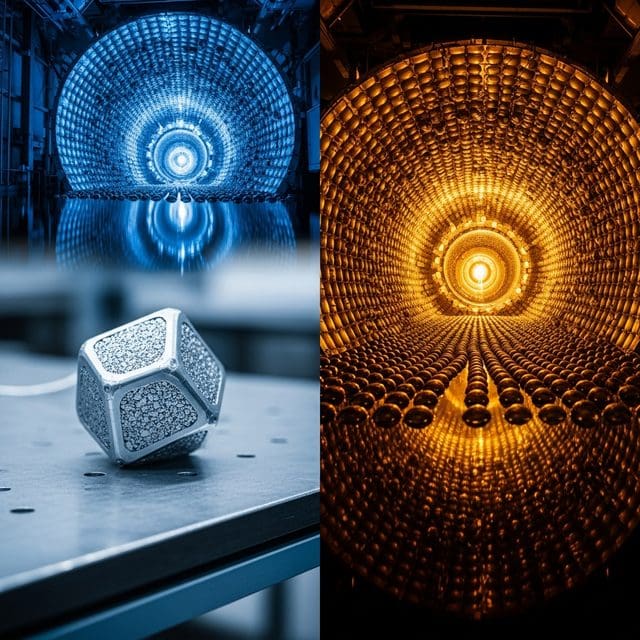
Recent milestones at Super-Kamiokande and in condensed matter labs have revealed the first indications of a cosmic supernova neutrino background and nine-particle entanglement in visible crystals.
The boundaries of the observable universe and the microscopic world expanded simultaneously this week as two major physics milestones suggest that the invisible forces governing reality are becoming increasingly tangible. In a deep underground laboratory in Japan, the Super-Kamiokande collaboration reported a significant 2.6-sigma indication of the Diffuse Supernova Neutrino Background (DSNB). This theoretical ‘fossil glow’ is composed of an integrated flux of neutrinos emitted by every core-collapse supernova that has occurred since the beginning of cosmic time.
This signal, captured over a rigorous 5,000-day data collection period, represents a census of stellar death that transcends traditional optical astronomy. The data set combined approximately 3,349 days of pure-water operation with 1,653 days of operation following the loading of gadolinium, a rare-earth element that enhances the detector’s sensitivity to neutrino interactions. Because neutrinos pass through cosmic dust and debris unimpeded, they carry a pristine record of star formation and heavy-element nucleosynthesis that optical telescopes simply cannot access. While the 2.6-sigma significance—roughly a 99.5 percent confidence level—falls short of the 5-sigma ‘discovery’ gold standard, the excess in the 13.3 to 81.3 MeV energy range provides a definitive roadmap for future physics. The collaboration has noted that future joint operations with the upcoming Hyper-Kamiokande facility will be the key to turning this provisional indication into a discovery-level measurement.
While particle physicists looked to the stars, condensed-matter researchers brought the quantum realm into the palm of the hand. Scientists have demonstrated strong multipartite entanglement within a centimeter-sized single crystal of a ‘strange metal’ composed of cerium, palladium, and silicon. Unlike previous experiments confined to isolated subatomic particles or photons in vacuum tubes, this entanglement involves at least nine particles bound into a single quantum system within a material visible to the naked eye. This ‘Schrödinger’s anthill’ challenges the intuitive boundary between the classical world we inhabit and the quantum world of the very small.
The certification of this entanglement is particularly notable for being device-independent. By utilizing violations of many-body Bell-type inequalities, the team proved that the crystal’s electronic behavior cannot be mimicked by simpler classical or semiclassical models. This discovery bridges the gap between quantum information theory and solid-state physics, offering a potential platform for the development of quantum sensors and fault-tolerant materials that maintain quantum properties at macroscopic scales. It suggests a future where quantum materials might be engineered for industrial applications rather than just laboratory curiosities.
These advancements coincide with a flurry of activity across the quantum and aerospace sectors. NASA recently launched its Robotic Servicing of Geosynchronous Satellites payload to maintain sovereign assets in orbit, while Northwestern University demonstrated the transmission of quantum entanglement over active telecom fiber-optic cables without disrupting existing internet traffic. Furthermore, the development of neural network quantum Monte Carlo methods is currently reducing the computational costs for larger molecular simulations, signaling a shift toward AI-driven discovery in the physical sciences.
As these disparate fields of particle physics and condensed matter converge, the ability to measure and harness the fundamental building blocks of the universe is moving from the theoretical fringe into the realm of national strategic interest. Whether through the ‘whispers’ of ancient supernovae or the entangled electrons in a metal crystal, the 2026 physics landscape is proving that the most profound secrets of nature are finally within our reach to measure, certify, and eventually, utilize for the defense of American innovation and liberty.

Mason Reed serves as a Staff Writer for Just Right News, where he spearheads the Future Frontiers & Special Projects desk. In an era defined by rapid technological shifts and evolving social landscapes, Mason provides a steady, principled voice, examining the innovations of tomorrow through the lens of traditional American values. His work is most prominently featured in his signature series, “The Next Horizon,” where he explores the intersection of emerging technology, national sovereignty, and the preservation of individual liberty.
A native of San Diego, California, Mason’s worldview was shaped by the unique culture of his hometown. Growing up in a region defined by its strong military presence and its history of maritime industry, he developed a deep-seated respect for the institutions that provide national stability and the entrepreneurial spirit that drives the American economy. This upbringing instilled in him a belief that true progress is not found in discarding the past, but in building upon a foundation of proven principles. His reporting often reflects this San Diego influence, emphasizing the importance of a robust national defense and the necessity of maintaining a competitive edge in the global marketplace.
Now based in San Francisco, Mason operates from the heart of the world’s technological engine. Living and working in the Bay Area provides him with a front-row seat to the advancements—and the ideological challenges—emanating from Silicon Valley. While many in the region embrace a “move fast and break things” mentality, Mason’s reporting serves as a vital counterweight. He offers Just Right News readers a “boots on the ground” perspective, documenting how radical local policies and the concentration of tech power impact the everyday lives of citizens. His proximity to the industry allows him to cut through the marketing jargon of big tech to uncover the real-world implications for privacy, free speech, and the nuclear family.
In his “Future Frontiers” beat, Mason tackles complex subjects ranging from the ethics of artificial intelligence to the burgeoning private space race. He approaches these topics with a healthy skepticism toward centralized bureaucracy, championing instead the decentralized innovations that empower individuals. Through “The Next Horizon,” he highlights the pioneers and thinkers who are working to ensure that the future remains a place where human dignity and constitutional rights are protected. He believes that the rapid pace of change requires more than just technical expertise; it requires a moral compass rooted in the Western tradition.
Throughout his tenure at Just Right News, Mason has remained committed to the idea that the future is something to be shaped, not merely accepted. His writing is characterized by a rigorous defense of American exceptionalism and a belief that the country’s best days lie ahead, provided it remains true to its founding ideals. Whether he is investigating the impact of automation on the American workforce or profiling the next generation of aerospace engineers, Mason Reed ensures that his readers are equipped with the insights they need to navigate a changing world with confidence and clarity.