

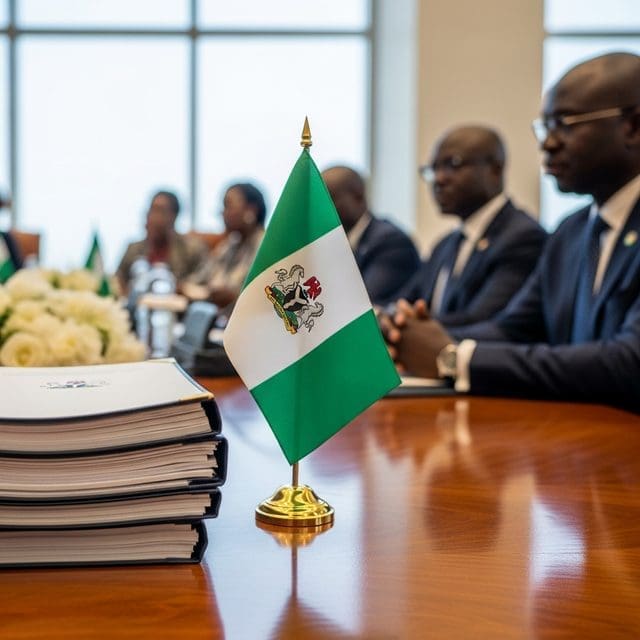
As Nigerian state leaders consolidate power and the UK tightens customs, the gap between elite development goals and local political realities raises questions about foreign aid transparency.
The landscape of West African governance is undergoing a significant transformation as regional leaders in Nigeria consolidate power, raising critical questions for American taxpayers and international health organizations regarding the transparency of foreign aid. In Delta State, Governor Sheriff Oborevwori has increasingly projected the region as a “no-go area” for opposition parties, leveraging his 2023 electoral victory in 21 of 25 local government areas to cement his influence. This consolidation of power was recently punctuated by a display of political theatre during the swearing-in of Commissioner Moses Ogodo, who broke down in tears and attempted to kneel before the Governor, a gesture that underscores the deeply personal nature of regional loyalty signaling.
Simultaneously, in Oyo State, the House of Assembly has formally approved Governor Seyi Makinde’s annual leave, scheduled from August 10 to September 11, 2026. During this window, Deputy Governor Adebayo Lawal will assume executive powers. While these administrative transitions are legally routine, they occur against a backdrop of federal warnings from the Nigerian Senate regarding the failure of various government agencies and enterprises to honor oversight requirements or remit public funds. For global health initiatives and the World Health Organization, which rely on stable and transparent local partners to implement pandemic preparedness and climate adaptation programs, these internal political frictions present a persistent risk to fiscal accountability and the effective delivery of services.
Adding a layer of complexity to international movement, the United Kingdom has recently updated its customs regulations, imposing new thresholds on alcohol, tobacco, and other goods. These rules, highlighted by Punch Nigeria, directly impact travelers from West Africa, serving as a reminder that national sovereignty is increasingly manifesting through stricter border and trade controls. This move by the UK aligns with a broader global trend where nations are prioritizing domestic regulatory clarity over the frictionless movement often encouraged by globalist entities. For the Nigerian traveler, navigating these updated thresholds is now essential to avoid customs complications, reflecting a tightening of the international regulatory environment.
While international headlines are often captured by high-profile financial shifts—such as Arsenal’s £34 million signing of Greece international forward Christos Tzolis from Club Brugge or the $1.77 trillion valuation of SpaceX following its IPO—the ground-level reality in developing regions remains one of precarious infrastructure. A recent canoe accident in Jigawa State, where survivors recounted terrifying ordeals and praised local rescuers, has led to urgent appeals for a bridge to prevent future tragedies. This incident highlights the stark gap between elite policy discourse on climate resilience and the basic safety needs of local populations that remain unaddressed despite decades of foreign assistance.
From a market-driven perspective, the continued reliance on foreign aid without rigorous, performance-based metrics remains a point of contention for those advocating for national sovereignty and fiscal responsibility. As Nigeria moves toward its 2027 elections, the pressure on the Tinubu administration to ensure that state-level development projects translate into tangible public health outcomes will only intensify. Recent editorials have urged Nigerians to obtain their PVCs and participate in the democratic process as a prerequisite for good governance, yet the internal party dynamics and loyalty signaling seen in Delta State suggest that the path to true accountability is fraught with institutional hurdles.
For the American observer, the stake in these developments is both financial and strategic. The U.S. remains a primary contributor to global health funds, yet the effectiveness of this capital is often diluted by the very bureaucratic narratives that prioritize diplomatic harmony over evidence-based results. As governors like Ademola Adeleke of Osun State seek re-election by touting fulfilled promises of development, the international community must decide whether to continue the status quo of unconditional aid or to demand the kind of institutional rigor that ensures every dollar serves the individual rather than the political machine.

Rachel Vaughn serves as a Senior Correspondent for Just Right News, where she leads the network’s coverage of Global Health, Climate, and Development. With a career defined by intellectual rigor and a commitment to principled reporting, Rachel provides a vital conservative perspective on some of the most complex and high-stakes issues facing the world today. Her work is characterized by a refusal to accept bureaucratic narratives at face value, focusing instead on how international policies impact national sovereignty, individual liberty, and the American taxpayer.
Raised in New Haven, Connecticut, Rachel grew up in an environment dominated by elite academic discourse. This upbringing provided her with a front-row seat to the inner workings of the American establishment, but it also instilled in her a healthy skepticism of the “ivory tower” consensus. She learned early on that while academic theories may sound promising in a lecture hall, they often fail to account for the practical realities of the working class. This background drives her to bridge the gap between high-level policy discussions and the common-sense concerns of everyday citizens, ensuring that her reporting remains grounded and accessible.
Now based in Burlington, Vermont, Rachel operates from a unique vantage point within one of the nation’s most progressive political landscapes. Living and working in a region that often serves as a testing ground for radical social and environmental experiments allows her to witness the real-world consequences of these policies firsthand. From her base in the Green Mountain State, she provides Just Right News readers with essential “boots on the ground” reporting, documenting the friction between local mandates and the constitutional freedoms of the individual. Her presence in Burlington ensures that her critiques of globalist agendas are informed by a direct understanding of how those ideologies manifest at the local level.
In her acclaimed feature series, “Planetary Stakes,” Rachel explores the intersection of international development and environmental stewardship. She rejects the alarmism often found in mainstream media, opting instead for a sober analysis of the economic and geopolitical costs of global climate agreements. Her reporting frequently highlights the importance of market-driven innovation and the role of American leadership in fostering global health without ceding authority to unelected international bodies. Through “Planetary Stakes,” she has become a leading voice for those who believe that true conservation and public health are best achieved through transparency, accountability, and the protection of private property rights.
Throughout her tenure at Just Right News, Rachel has distinguished herself as a journalist who is unafraid to ask difficult questions of global institutions. Whether she is investigating the influence of non-governmental organizations on domestic policy or analyzing the fiscal transparency of international health initiatives, her goal remains the same: to provide her audience with the facts necessary to navigate an increasingly interconnected world. Her blend of East Coast intellectual heritage and her current immersion in the political heart of the Northeast makes her an indispensable asset to the newsroom and a trusted source for readers seeking a principled, conservative take on the issues that define our era.