

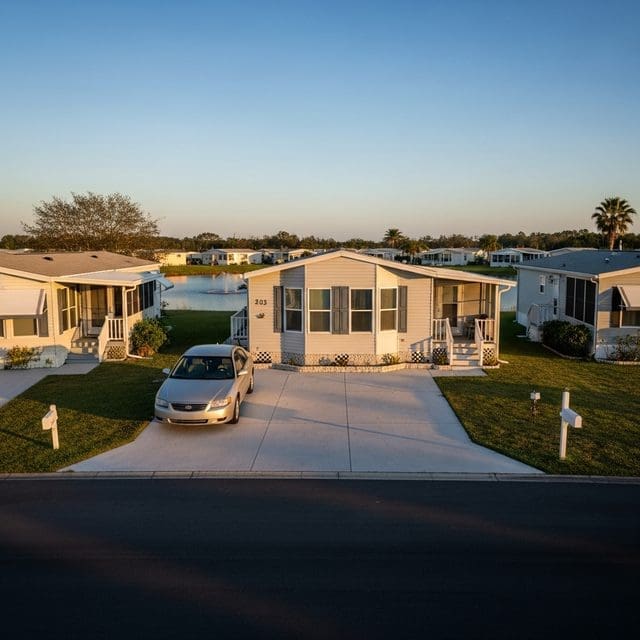
While Florida remains a haven for Social Security recipients, rising energy costs and double-digit rent hikes in manufactured housing are challenging the financial stability of the nation’s most vulnerable residents.
The promise of a quiet retirement on the Florida coast faces a dual threat from global energy volatility and a domestic housing supply crunch. As oil prices surged above $90 per barrel following the U.S. naval blockade on Iran, the ripple effects reached the 5.3 million Social Security recipients in the Sunshine State. Although a 2.8 percent cost-of-living adjustment provided a modest $56 monthly increase earlier in 2026, those gains are being eroded by rising costs at the pump and in the home. This economic friction comes as the Conference Board Leading Economic Index declined 0.2 percent in June, signaling a cooling American economy.
Market data indicates that certain Florida municipalities still offer a path to solvency for those on fixed incomes. In Sebring, average rents sit at $850 with median home prices near $238,292. Crystal River remains even more accessible, with average rents reported at $656 and median home prices at $268,419. Other options like Fort Pierce, where average rent is $1,349, and the quieter riverfront of Port Orange, provide alternatives for retirees looking to stretch their dollars. Florida’s lack of state tax on Social Security benefits continues to serve as a critical policy lever for preserving the purchasing power of the elderly.
However, the stability of the manufactured housing sector—a traditional bastion of affordability—is wavering. Rents for mobile home lots in Florida nearly doubled between 2015 and 2023, creating a precarious situation for residents who own their structures but lease the land. In response, state lawmakers implemented a new requirement for rent supplementation plans, offering up to six months of assistance in specific displacement cases. This intervention highlights the growing tension between private property rights and the necessity of maintaining a viable housing stock for a vulnerable population.
Infrastructure and public health also intersect with housing stability in the Mid-Atlantic. In Alexandria, Virginia, municipal officials are updating renter resources to highlight available accessible and age-restricted units. The city is also preparing for a significant shift in local land-use policy. Under the state’s “Faith in Housing” law, Alexandria must draft a new ordinance to allow by-right affordable housing developments on land owned by religious institutions. This move is intended to bypass traditional bureaucratic delays and NIMBYist opposition that often stall high-density projects in transit-rich corridors.
Beyond housing, Alexandria is managing logistical burdens by urging parents to schedule school vaccines early to avoid the back-to-school rush. With services offered on a sliding fee scale, the city is attempting to streamline administrative requirements that delay student starts. These local efforts are mirrored by federal investments; the Department of Veterans Affairs recently approved $1.2 billion in infrastructure improvements to modernize facilities for the aging veteran population.
As the Trump administration navigates a complex naval blockade and intensifying AI competition with China, the domestic focus remains on the cost of living. For the American taxpayer, the intersection of local zoning reform and federal infrastructure spending will determine whether current inflationary pressures result in a temporary squeeze or a permanent shift in where they can afford to live. The preservation of local sovereignty and the protection of private property remain central to these shifting policies.

Deborah Cole serves as a Senior Correspondent for Just Right News, where she spearheads the network’s coverage of Housing, Infrastructure, and Mobility. With a career defined by a commitment to rigorous reporting and a focus on the fundamental pillars of American community life, Deborah brings a principled perspective to the complex issues that dictate how and where we live. Her work is grounded in the belief that sound policy, fiscal responsibility, and respect for private property are the essential foundations of a prosperous society.
Originally from Boston, Massachusetts, Deborah’s upbringing in one of the nation’s oldest and most historically significant cities deeply influenced her professional trajectory. Growing up amidst the architectural legacy and dense urban planning of New England, she developed an early appreciation for the importance of durable infrastructure and the role of local tradition in shaping neighborhoods. Her perspective is informed by the classic American values of her hometown—hard work, community cohesion, and a healthy skepticism of top-down bureaucratic mandates that often overlook the unique needs of individual citizens.
Today, Deborah operates from her base in Austin, Texas, a city that serves as a primary laboratory for her reporting. Austin’s rapid expansion and its status as a hub for innovation and migration provide her with a front-row seat to the most pressing challenges in modern infrastructure and housing. From the Lone Star State, she chronicles the tensions between rapid growth and the preservation of the American Dream, often highlighting how market-driven solutions and deregulation can address the housing shortages that plague many of the country’s metropolitan areas.
At Just Right News, Deborah is perhaps best known for her signature feature series, “Where We Live.” Through this platform, she explores the intersection of public policy and private life, moving beyond mere statistics to tell the stories of families, small business owners, and local developers. Her reporting frequently highlights the importance of mobility—not just in terms of transportation and transit, but as a vehicle for economic opportunity and social stability. She remains a staunch advocate for the taxpayer, consistently scrutinizing government spending on large-scale projects and advocating for transparency in how infrastructure dollars are allocated.
Deborah’s beat is more than just a collection of policy topics; it is an investigation into the physical and legal structures that allow families to flourish. Whether she is reporting on the impact of zoning laws on suburban development or the necessity of maintaining the nation’s highway systems, her work is characterized by a dedication to the facts and a respect for the constitutional principles that protect the rights of homeowners.
As a Senior Correspondent, Deborah Cole continues to be a vital voice for Just Right News, providing the audience with the clarity and context needed to navigate an ever-changing landscape. Her reporting ensures that the values of individual liberty and local sovereignty remain at the forefront of the national conversation regarding the future of our cities and towns. Through her tireless efforts, she remains committed to informing the public on the issues that hit closest to home.