

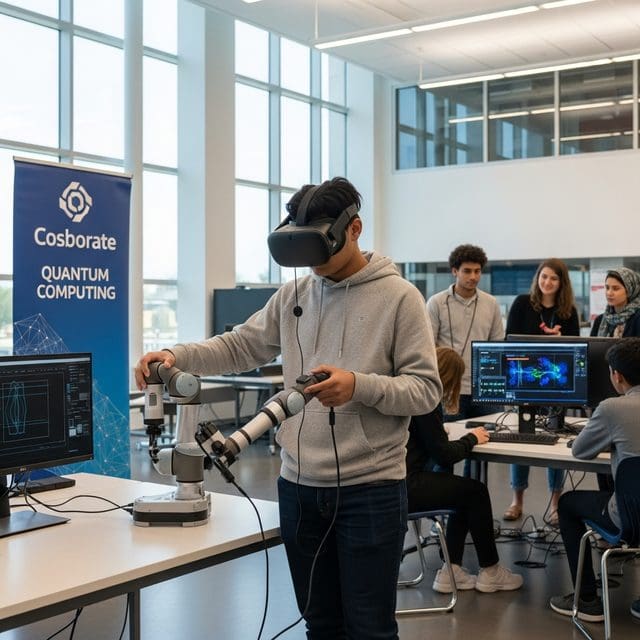
Educational institutions are shifting toward high-demand technical training and modernized facilities to better align student outcomes with the evolving needs of the global economy.
The landscape of American education is undergoing a fundamental shift as the focus moves away from general academic theory toward the practical cultivation of human capital. This transition is being driven by a combination of targeted private investment, specialized curriculum development, and significant infrastructure modernization. As the modern workforce demands increasingly technical skills, both public and private institutions are responding with market-aligned solutions designed to foster upward mobility and personal responsibility.
On Chicago’s South Side, the connection between the classroom and the high-tech economy was strengthened this week by PsiQuantum’s $250,000 pledge to support STEM programs. Announced on July 21, 2026, this funding is not a vague charitable gift but a strategic investment in the future workforce. The money is earmarked for George Washington and St. Francis de Sales high schools, along with Olive-Harvey College and Chicago State University. Organizations such as Project SYNCERE and Phalanx Family Services are also included, creating a localized ecosystem for quantum research preparation. This builds on a multi-year pattern of investment, following earlier grants to Bowen High School that introduced students to VR, drones, and robotics in dedicated maker spaces.
Chicago State University is leading the charge in formalizing this technical path. The university’s Quantum Education, Science & Technology Center now offers specific certificates in semiconductor technology and manufacturing, alongside a minor in quantum science and engineering. This model of education provides students with stackable, industry-recognized credentials that serve as a direct alternative to the traditional, debt-heavy four-year degree. By focusing on minority-serving institutions, these programs provide a practical ladder for students to enter high-paying scientific fields without the burden of unnecessary bureaucratic hurdles.
While technical training gains ground, institutional leadership in the medical field is also seeing a shift toward specialized expertise. The UNC School of Medicine has tapped Dr. Daniel Prevedello to chair its department of neurosurgery starting this October. Dr. Prevedello, who joins from The Ohio State University Medical Center, represents the type of high-level specialization that universities must prioritize to remain competitive. As higher-ed policy continues to grapple with the value proposition of advanced degrees, the appointment of proven practitioners to lead critical departments ensures that medical education remains grounded in clinical excellence and workforce readiness.
Physical infrastructure remains a vital component of this educational evolution. In Gibbon, Minnesota, the completion of a $68.9 million PK-12 school building for the Gibbon-Fairfax-Winthrop Schools demonstrates a commitment to modernizing rural education. The 155,000-square-foot facility, designed by Wold Architects and Engineers, consolidates multiple campuses into a single, efficient hub. Such investments are necessary to provide the environment required for modern learning, though they stand in stark contrast to challenges in urban centers. In Chicago, public schools are currently struggling with infrastructure gaps as they face an alarming rise in heat-related safety concerns, highlighting the need for resilient, well-managed facilities that prioritize student well-being over administrative bloat.
Beyond the university walls, the democratization of technical knowledge is expanding through national initiatives. Programs like Qubit x Qubit are offering free quantum computing workshops and research mentorship to high schoolers through the end of July. These programs allow students to engage in hands-on coding on actual quantum devices, moving complex scientific concepts into the mainstream. Furthermore, the emergence of specialized centers offering “quantum medicine” diplomas and brain-computer interface programs suggests that the market for technical education is diversifying rapidly. These market-driven responses to labor needs provide a common-sense alternative to top-down government intervention, ensuring that the next generation of workers is equipped with the specific skills required for the 21st-century economy.
Daniel Owens serves as a Senior Correspondent for Just Right News, where he leads the newsroom’s coverage of Education, Workforce, and Upward Mobility. In an era where the national conversation often overlooks the practical foundations of success, Owens brings a principled perspective to the forefront of the media landscape. His work is defined by a commitment to the idea that a strong society is built on the pillars of quality education, a robust work ethic, and the removal of bureaucratic barriers to individual achievement.
Born and raised in Cleveland, Ohio, Owens’s worldview was shaped by the industrial landscape of the Midwest. Growing up in a city known for its grit and resilience, he witnessed firsthand the transformative power of steady employment and the devastating effects of economic stagnation. This background instilled in him a deep respect for the American worker and a healthy skepticism toward top-down government solutions that often fail to reach the communities they intend to help. As an African American man who has navigated the path to professional success, Owens approaches his beat with a nuanced understanding of how meritocracy and personal responsibility intersect with opportunity. He frequently draws on his roots to highlight the importance of family stability and community-led initiatives in fostering the next generation of leaders.
At Just Right News, Owens is the architect of the acclaimed feature series, “The Learning Curve.” Through this platform, he explores the evolving landscape of American schooling, from the rise of the school choice movement to the revitalization of trade schools and vocational training. He frequently challenges the status quo of higher education, advocating for a return to academic rigor and the practical alignment of degrees with market demands. For Owens, education is not merely about obtaining credentials; it is about equipping young people with the tools necessary to lead self-sufficient, meaningful lives. His reporting on “The Learning Curve” has become essential reading for parents and policymakers who believe that educational competition and parental rights are the keys to a brighter future.
Now based in Raleigh, North Carolina, Owens finds himself at the heart of one of the nation’s most dynamic regions for innovation and growth. Raleigh’s unique blend of traditional values and a fast-paced economy provides the perfect backdrop for his reporting on the modern workforce. From the tech hubs of the Research Triangle to the rural communities of the South, he tracks how shifts in the economy are impacting families and local industries. His reporting often highlights the success stories of entrepreneurs and workers who are thriving by embracing the values of hard work and innovation.
Throughout his career, Daniel Owens has remained a steadfast voice for the student seeking a better path and the worker striving for a better life. His reporting for Just Right News serves as a vital resource for readers who value common-sense solutions to the challenges of the 21st-century economy. By focusing on the intersection of policy and the human spirit, Owens continues to provide a roadmap for how individuals and communities can achieve lasting upward mobility.