

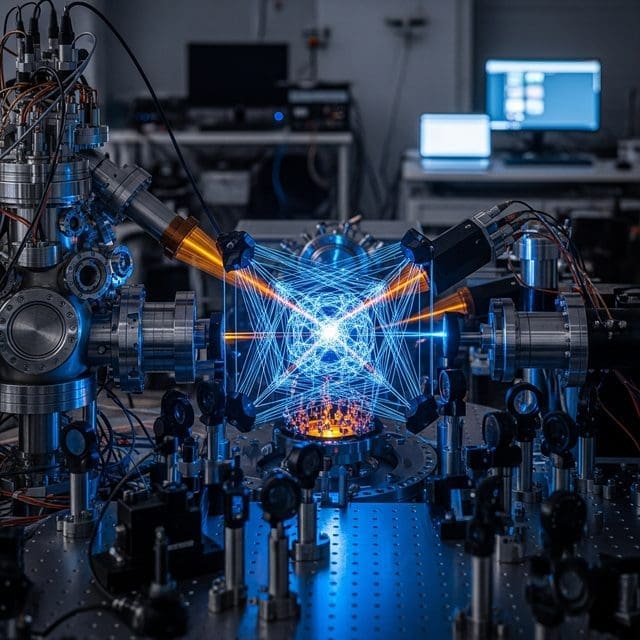
University of Birmingham researchers have demonstrated that time can emerge from internal entropy changes, providing the first experimental evidence for a ‘timeless’ universe model.
In a laboratory at the University of Birmingham, researchers have constructed a “tiny universe” that challenges our most fundamental understanding of the passage of time. By cooling a cloud of 24,000 atoms to a few billionths of a degree above absolute zero, a team led by Professor Giovanni Barontini has demonstrated that time is not necessarily a universal constant, but rather an emergent property born from the internal disorder of a system. This milestone, published in Physical Review Research, provides the first controlled experimental evidence for “relational time,” a concept that has remained purely theoretical for nearly sixty years.
The experiment utilized two laser beams of different frequencies to divide the isolated atomic trap into “bright” and “dark” regions. The bright, observed region was allowed to repeatedly expand and contract, creating a tabletop analogue of a Big Bang and Big Crunch cycle. Crucially, the researchers did not rely on a laboratory clock to measure these cycles. Instead, they derived “entropic time” by observing the spread of atoms and the exchange of entropy within the system itself. This proves that dynamics can be described even when an external timekeeper is absent, a finding that directly supports the Wheeler–DeWitt equation—a “timeless” framework of quantum cosmology where the universe is viewed as a single, static entity.
This discovery arrives at a moment of rapid advancement across the physical sciences, where traditional boundaries between theory and experiment are dissolving. While the Birmingham team focused on the macro-scale of time, researchers at the University of California, Irvine, are utilizing artificial intelligence to solve the mystery of the smallest known particles. Doctoral candidates Victoria Knapp-Pérez and Jake Rudolph have introduced the Autonomous Model Builder, or AMBer. This reinforcement-learning system autonomously navigates the vast mathematical space of particle physics to design models explaining why neutrinos possess such tiny, elusive masses. AMBer functions as a digital architect, selecting symmetry groups and particle assignments to see which configurations best fit existing data while maintaining mathematical economy.
By successfully reproducing known neutrino theories and then exploring previously untested frameworks, AMBer acts as a filter for human physicists, allowing them to focus on the most promising avenues of research. This shift toward AI-assisted discovery mirrors the Birmingham experiment’s move toward tabletop cosmology; both represent a new era where complex, universal questions are answered through localized, highly efficient innovation rather than solely through massive, multi-billion-dollar bureaucratic projects. These tools allow American researchers to bypass the slow gears of centralized institutions, favoring the agility of the laboratory and the power of decentralized computing.
The implications of the Birmingham study, titled “Testing the problem of time with cold atoms,” extend into the very heart of quantum gravity. If time is indeed emergent, it suggests that the “ticking clock” we perceive is merely a consequence of increasing entropy. When entropy stops changing, time, for all practical purposes, halts. This laboratory testbed allows scientists to probe Big Bang and black hole analogues in a controlled environment, ensuring that Western research remains at the forefront of the next technological frontier. It offers a practical way to describe dynamics in theories where the universe has no built-in clock, potentially revolutionizing how we calculate the evolution of the cosmos.
As the world observes these breakthroughs, from the production of pure Helium-3 by Interlune using novel cryogenic Cold Capture technology to the development of stable boron graphene at Tohoku University, the common thread is a return to fundamental principles. Whether it is the University of Basel demonstrating all-electrical control of single-molecule states or MidWave Wireless launching resilient communication networks for national security, the focus remains on decentralized innovation. These advancements protect the sovereignty of the scientific method, ensuring that the pursuit of truth remains grounded in empirical evidence and individual liberty, free from the constraints of centralized global planning. By mastering the very fabric of time and matter at the local level, these physicists are securing a future defined by discovery rather than dependency.

Mason Reed serves as a Staff Writer for Just Right News, where he spearheads the Future Frontiers & Special Projects desk. In an era defined by rapid technological shifts and evolving social landscapes, Mason provides a steady, principled voice, examining the innovations of tomorrow through the lens of traditional American values. His work is most prominently featured in his signature series, “The Next Horizon,” where he explores the intersection of emerging technology, national sovereignty, and the preservation of individual liberty.
A native of San Diego, California, Mason’s worldview was shaped by the unique culture of his hometown. Growing up in a region defined by its strong military presence and its history of maritime industry, he developed a deep-seated respect for the institutions that provide national stability and the entrepreneurial spirit that drives the American economy. This upbringing instilled in him a belief that true progress is not found in discarding the past, but in building upon a foundation of proven principles. His reporting often reflects this San Diego influence, emphasizing the importance of a robust national defense and the necessity of maintaining a competitive edge in the global marketplace.
Now based in San Francisco, Mason operates from the heart of the world’s technological engine. Living and working in the Bay Area provides him with a front-row seat to the advancements—and the ideological challenges—emanating from Silicon Valley. While many in the region embrace a “move fast and break things” mentality, Mason’s reporting serves as a vital counterweight. He offers Just Right News readers a “boots on the ground” perspective, documenting how radical local policies and the concentration of tech power impact the everyday lives of citizens. His proximity to the industry allows him to cut through the marketing jargon of big tech to uncover the real-world implications for privacy, free speech, and the nuclear family.
In his “Future Frontiers” beat, Mason tackles complex subjects ranging from the ethics of artificial intelligence to the burgeoning private space race. He approaches these topics with a healthy skepticism toward centralized bureaucracy, championing instead the decentralized innovations that empower individuals. Through “The Next Horizon,” he highlights the pioneers and thinkers who are working to ensure that the future remains a place where human dignity and constitutional rights are protected. He believes that the rapid pace of change requires more than just technical expertise; it requires a moral compass rooted in the Western tradition.
Throughout his tenure at Just Right News, Mason has remained committed to the idea that the future is something to be shaped, not merely accepted. His writing is characterized by a rigorous defense of American exceptionalism and a belief that the country’s best days lie ahead, provided it remains true to its founding ideals. Whether he is investigating the impact of automation on the American workforce or profiling the next generation of aerospace engineers, Mason Reed ensures that his readers are equipped with the insights they need to navigate a changing world with confidence and clarity.