

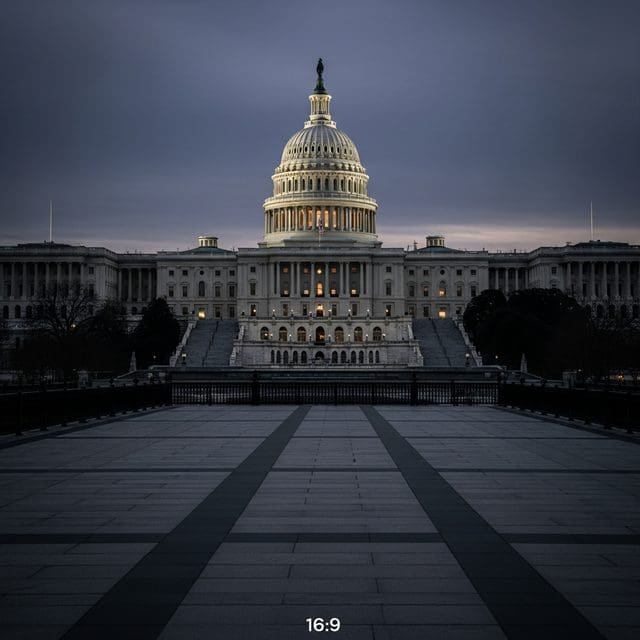
The Trump administration confronts a dual-track crisis involving security vulnerabilities on a foreign-gifted Air Force One and a contentious $88 billion emergency request for ongoing military operations against Iran.
The intersection of executive prerogative and constitutional oversight has reached a new flashpoint this week as the White House grapples with security disclosures involving the new, Qatari-gifted Air Force One and an intensifying fiscal battle over the conflict with Iran. The Department of Justice has reportedly issued subpoenas to journalists, including those at the New York Times, in an effort to identify the source of leaks detailing vulnerabilities in the aircraft’s communications and defensive systems. This aggressive law enforcement posture, which includes asking White House staff to turn over personal phones, follows reports that the administration is rushing to secure the jet, which was integrated into the presidential fleet only months ago.
While the White House maintains the aircraft is “perfectly safe for the President’s travels,” officials have confirmed that the President will return to an older plane this fall while the Qatari jet undergoes significant upgrades. Critics in Congress, led by senior members like Representative Jamie Raskin, are now questioning the wisdom of accepting a foreign monarchy’s gift, citing the Foreign Emoluments Clause and the estimated $1 billion required to modify the plane. These funds are reportedly being diverted from other critical defense programs, including the Sentinel nuclear modernization effort, a trade-off that has drawn sharp rebukes from those concerned about long-term strategic readiness.
On Capitol Hill, the fiscal cost of executive action is under renewed scrutiny following the July 17 strikes on Iranian infrastructure. The administration has submitted an emergency request for approximately $88 billion to fund operations against Iran, which were initiated after Iranian forces targeted bridges and energy facilities. The Islamic Revolutionary Guard Corps responded with attacks on U.S. bases in Kuwait, Bahrain, and Jordan. U.S. Central Command confirmed that two service members were killed and one remains missing after the strikes in Jordan, a reality that Senator Mark Warner noted is remarkable given the scale of the conflict.
Senate Democrats have leveraged these developments to block a broader $1 trillion defense bill, demanding greater transparency regarding war objectives and the slow disclosure of combat casualties. The administration’s push for funding is further complicated by internal Republican divisions. While national security hawks argue for robust funding to counter Iranian aggression, fiscal skeptics within the party are wary of the mounting costs. Representative Ralph Norman and Representative Russell Fry, both of whom recently announced bids for the Senate seat vacated by Lindsey Graham, find themselves at the center of this intra-party debate over the direction of American foreign policy and fiscal responsibility.
Beyond the immediate conflict, the federal government continues to navigate complex regulatory and economic shifts. The FAA recently accepted nearly 40 new standards for power-lift aircraft under the MOSAIC framework, signaling a push for technological innovation amidst the broader geopolitical turmoil. However, the Conference Board Leading Economic Index shows a 0.2 percent decline in June, suggesting that the domestic economy remains fragile even as the administration seeks massive emergency appropriations.
For the constitutionalist, these events underscore the inherent risks when administrative expediency bypasses traditional procurement and transparency protocols. The reliance on a foreign-gifted asset for the Commander-in-Chief, coupled with a multi-billion dollar war effort conducted under emergency requests, presents a significant challenge to the traditional balance of power. As the DOJ investigation into the press continues, the tension between executive secrecy and the public’s right to know the vulnerabilities of their government has rarely been more pronounced.

Miles Harrington serves as the Senior Correspondent for Federal Systems & Executive Power at Just Right News, where he brings a disciplined, constitutionalist lens to the inner workings of the American government. With a focus on the mechanics of the federal bureaucracy and the limits of executive authority, Harrington has established himself as a vital voice for readers who value transparency, accountability, and the preservation of the separation of powers.
A native of Richmond, Virginia, Harrington’s perspective is deeply rooted in the traditions of the Old Dominion. Growing up in a city defined by its historical significance and its role as a center of American jurisprudence, he developed an early appreciation for the foundational principles of the Republic. His upbringing in Richmond—a place where the legacy of the Founding Fathers is woven into the landscape—instilled in him a belief that the federal government should remain within its constitutional bounds. This background informs his skepticism of centralized overreach and his commitment to reporting on the ways in which the administrative state impacts the lives of everyday citizens.
In his current role, Harrington specializes in the complexities of federal systems. He doesn’t just report on the headlines of the day; he digs into the structural shifts within the executive branch that often go unnoticed by the mainstream press. Whether he is analyzing the implications of a new federal regulation or investigating the expansion of agency jurisdiction, his work is characterized by a rigorous adherence to the facts and a dedication to the rule of law.
Harrington is perhaps best known for his signature feature series, “How Washington Works.” Through this ongoing project, he demystifies the often-opaque processes of the nation’s capital, pulling back the curtain on the “Deep State” and the unelected officials who wield significant influence over national policy. By breaking down complex legislative maneuvers and executive orders, he empowers Just Right News readers to understand the true levers of power in Washington. His reporting serves as a necessary check on the federal government, ensuring that the actions of those in power are held up to the light of public scrutiny.
Now based in Washington, D.C., Harrington operates at the epicenter of the political world, yet he remains intentionally distanced from the “Beltway bubble.” His proximity to the halls of power allows him to maintain a robust network of sources across the federal landscape, but his heart remains in the principled conservatism of his Virginia roots. He views his role not merely as a reporter, but as a steward of the public trust, dedicated to providing the clarity and context that conservative voters need to navigate an increasingly complex political environment.
Through his sharp analysis and unwavering commitment to the truth, Miles Harrington continues to be a cornerstone of the Just Right News team. His work ensures that the principles of limited government and executive restraint remain at the forefront of the national conversation, providing a crucial service to those who believe in a government that is truly of, by, and for the people.