

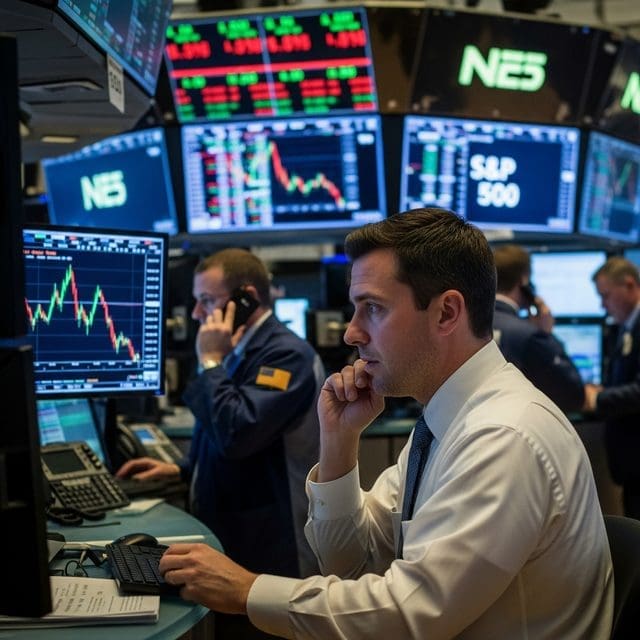
International stocks rose Tuesday as diplomatic efforts cooled the recent oil spike, though U.S. markets lagged with the S&P 500 down 0.15% amid elevated Treasury yields and a strong dollar.
Global financial markets are navigating a fragile recovery this Tuesday, July 21, 2026, as investors weigh tentative diplomatic efforts in the Middle East against a backdrop of high borrowing costs. While Asian and European indices snapped recent losing streaks, the S&P 500 (SPY) remained under pressure, trading down 0.15%. This domestic underperformance highlights a divergence between a global relief rally and the economic realities facing American households, who continue to bear the brunt of volatile energy markets and tightening credit.
The primary catalyst for the international bounce was a retreat in Brent crude prices. Energy markets have been in upheaval since the July 13 announcement of a U.S. naval blockade on Iran, which saw prices surge to $83 per barrel before climbing above $90 by July 19. The collapse of the OPEC+ production agreement, following resumed attacks in the Strait of Hormuz, left the global supply in a precarious state. Today’s pullback below $87 per barrel, sparked by reports of a cease-fire proposal, offers a momentary reprieve, yet underlying instability remains a primary inflationary concern for the American taxpayer.
Despite cooling oil prices, the U.S. dollar index reached a one-week high of 100.96, and the 2-year Treasury yield held firm near 4.20%. These elevated yields suggest the market is still pricing in significant geopolitical risk and a ‘higher for longer’ interest rate environment. In the United Kingdom, fiscal concerns pushed the 10-year gilt yield to 5.03%, further tightening global conditions. For the average family, these macro movements translate into higher mortgage rates and more expensive consumer credit, even as the Federal Reserve and ECB remain on hold for July.
Institutional developments reflect a landscape of strategic consolidation. e& completed a $5.95 billion sale of its Vodafone stake, while Bank of America authorized new dividends on preferred stock, signaling a focus on balance sheet stability. The real estate sector provided a rare bright spot, with Miami-Dade posting its strongest June in three years. Meanwhile, the restructuring of the digital asset landscape continues as FTX announced its fifth distribution of approximately $900 million to creditors, a necessary step toward resolving one of the most significant failures in centralized financial control.
On the technology front, rapid AI advancement continues to challenge American dominance. China’s Moonshot AI recently released its Kimi K3 model, achieving frontier performance at a substantially lower cost. Domestically, the integration of AI is accelerating; Bain & Company was named an OpenAI Elite Partner, and a TD Cowen survey revealed that AI is now compressing biopharma preclinical timelines by as much as 70%. This technological deflation is one of the few counter-forces to the inflationary pressures generated by government overreach and geopolitical conflict.
For the working household, today’s market action serves as a reminder of the ‘Invisible Economy’ at work. While London’s FTSE 100 rose on the back of a 3.1% gain in precious-metal miners, the negative tilt of the SPY reflects a domestic market grappling with the dual weights of a strong dollar and high real yields. As the geopolitical situation in the Gulf remains fluid, the path forward for American economic stability depends heavily on whether mediation can provide a lasting resolution to the energy supply shocks threatening the middle class.

Jordan Lee serves as the Senior Correspondent for Wall Street, Finance, and Monetary Systems at Just Right News. Based in the heart of the world’s financial capital, New York City, Lee brings a sharp, principled eye to the complex mechanisms that drive the global economy. His reporting is defined by a commitment to fiscal responsibility, the defense of the free market, and a deep-seated belief that a transparent monetary system is the bedrock of a free society.
Raised in Portland, Oregon, Lee’s perspective was forged in a city that has undergone significant cultural and economic shifts. His upbringing in the Pacific Northwest instilled in him a profound appreciation for the industriousness of small business owners and the importance of local economic stability. Watching the evolution of his hometown’s landscape sparked an early interest in how federal fiscal policy and large-scale financial trends eventually trickle down to the average citizen. This background provides him with a unique vantage point; he understands the growing disconnect between the policy-making elite and the reality of Main Street, a theme that frequently resonates throughout his work.
Now operating from his base in New York City, Lee bridges the gap between the high-stakes trading floors of Manhattan and the households of everyday Americans. He views the financial sector not merely as a collection of numbers and tickers, but as a vital engine of American prosperity that requires constant vigilance and accountability. His reporting often highlights the dangers of centralized financial control and the necessity of maintaining a system that rewards merit, risk-taking, and innovation.
As the creator and lead of the featured series, “The Invisible Economy,” Lee pulls back the curtain on the often-opaque world of monetary systems. He specializes in translating the dense jargon of central banking and international finance into actionable insights for the Just Right News audience. His work explores the “invisible” forces—such as inflationary pressures, regulatory creep, and the expansion of the administrative state—that erode the purchasing power of American families. By focusing on these systemic issues, Lee empowers readers to understand the hidden forces shaping their financial independence.
Lee’s journalistic philosophy is rooted in a steadfast commitment to traditional American values. As an Asian American professional who has navigated the competitive corridors of the financial world, he is a vocal advocate for meritocracy and the preservation of the American Dream. He believes that a stable currency and a predictable regulatory environment are essential for national sovereignty and individual liberty. His reporting frequently warns against the risks of government overreach in the private sector, arguing that the most effective solutions to economic challenges arise from competition and individual enterprise rather than bureaucratic mandates.
At Just Right News, Jordan Lee remains dedicated to providing a clear-eyed defense of the taxpayer. Whether he is analyzing market volatility or investigating the long-term implications of national debt, his mission is to provide the truth about where the money is going and what it means for the future of the country. Through his rigorous analysis and principled stance, Lee has become a trusted voice for those who value a strong, sovereign, and fiscally sound America.