

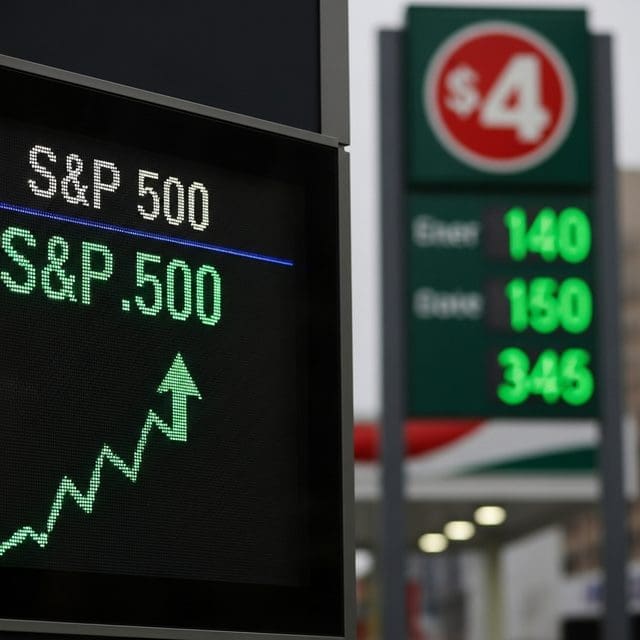
U.S. equities are recovering from a healthcare-led selloff as traders balance a potential ten-day Middle East ceasefire against new maritime blockades and rising national gasoline prices.
Wall Street is attempting a fragile recovery during Tuesday’s session, with the S&P 500 climbing 0.88% to reclaim ground lost during Monday’s risk-off retreat. This rebound follows a difficult start to the week where the Dow Jones Industrial Average shed over 300 points, or 0.6%, to close at 51,839.26. The tech-heavy Nasdaq Composite also felt the pressure, sliding as investors grappled with geopolitical instability and rising capital costs. For the American taxpayer, this volatility illustrates a tug-of-war between optimistic corporate earnings and the sobering reality of a destabilized global energy corridor.
Monday’s downturn was punctuated by a 1.2% slide in the Health Care Select Sector SPDR, with West Pharmaceutical Services falling 1.7%. Industrials faced headwinds as Caterpillar Inc. dropped 1.8%, reflecting concerns that rising Treasury yields—with the 10-year benchmark at 4.594% and the 30-year bond yield above 5.11%—will increase borrowing costs for the domestic manufacturing base. However, Tuesday’s sentiment shifted toward a chip-stock recovery. This was bolstered by 3M, which surged after upwardly revising its annual profit forecast, providing a counterweight to the previous day’s industrial gloom.
The underlying economic picture for Main Street remains complicated by the Strait of Hormuz. National average gasoline prices climbed above $4 per gallon following the U.S. naval blockade on Iran and ten consecutive nights of military strikes. While Brent crude prices moderated to the $88 range on Tuesday, relief is tempered by news that Yemen’s Houthi rebels declared a secondary naval blockade on Saudi Arabia via the Bab al-Mandab Strait. This threatens a second maritime chokepoint, further complicating OPEC+ production agreements which collapsed after Iran resumed attacks on July 7.
Working households are caught between these global pressures and a domestic real estate market showing surprising resilience. Despite high interest rates, Miami-Dade reported its strongest June sales in three years on July 17, with sales rising year-over-year for the tenth consecutive month. Similarly, the Texas statewide median home sales price held firm at $340,000 in the second quarter of 2026, with closed sales increasing in 23 of the state’s 26 major metros. This divergence highlights a bifurcated economy where local demand remains robust even as the federal government grapples with international maritime security and energy supply shocks.
Legal and regulatory hurdles are also surfacing, adding risk for retail investors. Securities class action lawsuits were recently filed against GeneDx Holdings and Verra Mobility, while a federal judge paused the merger between Paramount Skydance and Warner Bros. Discovery following an antitrust lawsuit from a dozen state attorneys general. Paramount Skydance was forced to extend expiration dates on its exchange offers as the legal battle intensified. These developments, alongside Bank of America’s recent authorization of preferred stock dividends, suggest that while the ‘Invisible Economy’ of central banking dictates the daily ticker, the machinery of American commerce is still attempting to grind forward.
As Washington considers a proposed 10-day ceasefire to reopen shipping lanes, the market’s current gains remain contingent on a return to stability. The Trump administration is reportedly weighing two distinct paths: a temporary ceasefire or a massive joint military campaign with Israel to secure the region. For the disciplined investor, the current 0.88% lift in the SPY is a welcome reprieve, but the persistent strength of the U.S. dollar and elevated bond yields signal that the era of cheap credit and predictable energy costs has not yet returned.

Jordan Lee serves as the Senior Correspondent for Wall Street, Finance, and Monetary Systems at Just Right News. Based in the heart of the world’s financial capital, New York City, Lee brings a sharp, principled eye to the complex mechanisms that drive the global economy. His reporting is defined by a commitment to fiscal responsibility, the defense of the free market, and a deep-seated belief that a transparent monetary system is the bedrock of a free society.
Raised in Portland, Oregon, Lee’s perspective was forged in a city that has undergone significant cultural and economic shifts. His upbringing in the Pacific Northwest instilled in him a profound appreciation for the industriousness of small business owners and the importance of local economic stability. Watching the evolution of his hometown’s landscape sparked an early interest in how federal fiscal policy and large-scale financial trends eventually trickle down to the average citizen. This background provides him with a unique vantage point; he understands the growing disconnect between the policy-making elite and the reality of Main Street, a theme that frequently resonates throughout his work.
Now operating from his base in New York City, Lee bridges the gap between the high-stakes trading floors of Manhattan and the households of everyday Americans. He views the financial sector not merely as a collection of numbers and tickers, but as a vital engine of American prosperity that requires constant vigilance and accountability. His reporting often highlights the dangers of centralized financial control and the necessity of maintaining a system that rewards merit, risk-taking, and innovation.
As the creator and lead of the featured series, “The Invisible Economy,” Lee pulls back the curtain on the often-opaque world of monetary systems. He specializes in translating the dense jargon of central banking and international finance into actionable insights for the Just Right News audience. His work explores the “invisible” forces—such as inflationary pressures, regulatory creep, and the expansion of the administrative state—that erode the purchasing power of American families. By focusing on these systemic issues, Lee empowers readers to understand the hidden forces shaping their financial independence.
Lee’s journalistic philosophy is rooted in a steadfast commitment to traditional American values. As an Asian American professional who has navigated the competitive corridors of the financial world, he is a vocal advocate for meritocracy and the preservation of the American Dream. He believes that a stable currency and a predictable regulatory environment are essential for national sovereignty and individual liberty. His reporting frequently warns against the risks of government overreach in the private sector, arguing that the most effective solutions to economic challenges arise from competition and individual enterprise rather than bureaucratic mandates.
At Just Right News, Jordan Lee remains dedicated to providing a clear-eyed defense of the taxpayer. Whether he is analyzing market volatility or investigating the long-term implications of national debt, his mission is to provide the truth about where the money is going and what it means for the future of the country. Through his rigorous analysis and principled stance, Lee has become a trusted voice for those who value a strong, sovereign, and fiscally sound America.