

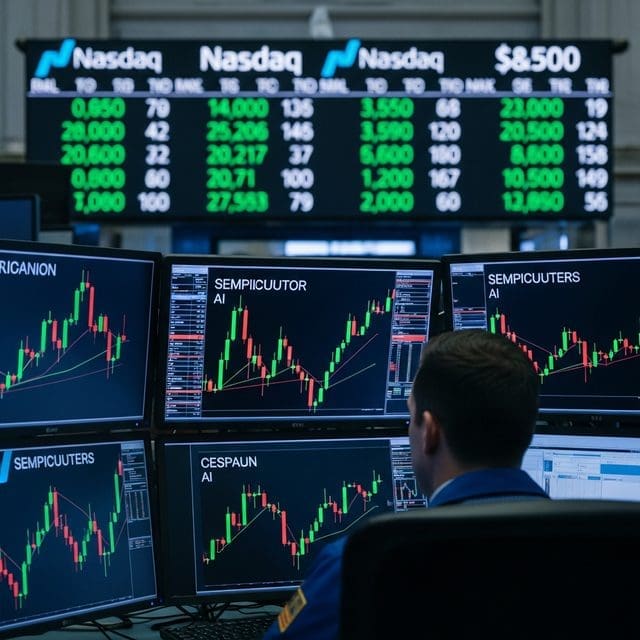
Nvidia and Broadcom drive a Nasdaq-led rally on July 20, 2026, while healthcare lags and energy prices stabilize following a U.S. naval blockade on Iran.
The American financial landscape on July 20, 2026, is defined by a distinct rotation back into high-beta technology, as investors shrug off recent volatility to chase growth in the artificial intelligence sector. While the SPY benchmark tracks a modest gain of 0.23% on the session, the tech-heavy Nasdaq Composite is significantly outperforming, climbing over 1.24% in early trade. This divergence highlights a market where merit-based capital allocation is favoring infrastructure providers of the digital economy over more defensive sectors, signaling a renewed appetite for risk among institutional players.
Leading the charge is a robust recovery in the semiconductor space, which had previously suffered under the weight of valuation concerns. Nvidia shares rose as much as 3.7% on optimism surrounding the upcoming H200 GPU launch scheduled for next month, while Broadcom gained 4.2% to reach $192 as analysts upwardly revised revenue forecasts for custom data-center silicon. Most notably, SanDisk surged 6.7%, recouping a portion of the brutal 29% slide experienced during the previous week. This rebound suggests that the recent sell-off in AI-linked storage and memory was an overextension, leading to a classic oversold reversal that is currently providing the primary tailwind for the broader indices.
In contrast, the healthcare sector is acting as a relative anchor on the market, failing to keep pace with the broader rally. While tech sectors are up more than 2.1%, healthcare has trended into negative territory, down roughly 0.6%. Market analysts attribute this to profit-taking following a period of strength in biotech deals, leaving pharma and medtech names mixed. For the working household, this split-screen performance between tech and health illustrates the ‘Invisible Economy’ at work: capital is flowing toward the efficiency gains promised by AI while rotating out of the more stable, yet currently stagnant, pharmaceutical verticals.
On the macro front, the rally is being fueled by softer economic data and positive commentary from Federal Reserve officials regarding policy flexibility. These signals have heightened expectations for rate cuts, providing the liquidity-driven environment that tech stocks crave. However, this domestic optimism is tempered by global geopolitical friction. Oil prices, which spiked above $90 per barrel following the July 14 implementation of a U.S. naval blockade on Iran, have moderated to below $87. This easing followed reports of a potential cease-fire proposal, offering a temporary reprieve from the inflationary pressures that have squeezed Main Street budgets throughout the month. The collapse of the previous OPEC+ agreement, which was contingent on a peace deal that failed to materialize after Iranian attacks in the Strait of Hormuz, continues to keep the floor under energy prices high.
Institutional movements also signal a shift in the global corporate landscape. Bain & Company has deepened its ties to the frontier of innovation by becoming an Elite Partner of OpenAI, while Chinese startup Moonshot AI has introduced its Kimi K3 model, achieving performance levels comparable to U.S. systems at a lower cost. Meanwhile, the legacy financial system continues its administrative churn; Bank of America authorized regular cash dividends on preferred stock, and the FTX bankruptcy proceedings saw a fifth distribution of $900 million to creditors. These developments, paired with a strong June for Miami-Dade real estate, suggest a financial system attempting to maintain a veneer of normalcy and liquidity despite the heightened geopolitical tensions.
Ultimately, today’s market action underscores a persistent truth: while the broader indices like the S&P 500 show steady, incremental progress, the real story lies in the sector-specific battles for dominance. As the U.S. military maintains its presence in the Middle East and domestic tech firms race to deploy the next generation of silicon, the American taxpayer remains caught between the promise of technological deflation and the reality of energy-driven inflation. The current session’s tech-led surge may provide a boost to retirement accounts, but the underlying volatility in commodities remains a significant hurdle for long-term fiscal stability.

Jordan Lee serves as the Senior Correspondent for Wall Street, Finance, and Monetary Systems at Just Right News. Based in the heart of the world’s financial capital, New York City, Lee brings a sharp, principled eye to the complex mechanisms that drive the global economy. His reporting is defined by a commitment to fiscal responsibility, the defense of the free market, and a deep-seated belief that a transparent monetary system is the bedrock of a free society.
Raised in Portland, Oregon, Lee’s perspective was forged in a city that has undergone significant cultural and economic shifts. His upbringing in the Pacific Northwest instilled in him a profound appreciation for the industriousness of small business owners and the importance of local economic stability. Watching the evolution of his hometown’s landscape sparked an early interest in how federal fiscal policy and large-scale financial trends eventually trickle down to the average citizen. This background provides him with a unique vantage point; he understands the growing disconnect between the policy-making elite and the reality of Main Street, a theme that frequently resonates throughout his work.
Now operating from his base in New York City, Lee bridges the gap between the high-stakes trading floors of Manhattan and the households of everyday Americans. He views the financial sector not merely as a collection of numbers and tickers, but as a vital engine of American prosperity that requires constant vigilance and accountability. His reporting often highlights the dangers of centralized financial control and the necessity of maintaining a system that rewards merit, risk-taking, and innovation.
As the creator and lead of the featured series, “The Invisible Economy,” Lee pulls back the curtain on the often-opaque world of monetary systems. He specializes in translating the dense jargon of central banking and international finance into actionable insights for the Just Right News audience. His work explores the “invisible” forces—such as inflationary pressures, regulatory creep, and the expansion of the administrative state—that erode the purchasing power of American families. By focusing on these systemic issues, Lee empowers readers to understand the hidden forces shaping their financial independence.
Lee’s journalistic philosophy is rooted in a steadfast commitment to traditional American values. As an Asian American professional who has navigated the competitive corridors of the financial world, he is a vocal advocate for meritocracy and the preservation of the American Dream. He believes that a stable currency and a predictable regulatory environment are essential for national sovereignty and individual liberty. His reporting frequently warns against the risks of government overreach in the private sector, arguing that the most effective solutions to economic challenges arise from competition and individual enterprise rather than bureaucratic mandates.
At Just Right News, Jordan Lee remains dedicated to providing a clear-eyed defense of the taxpayer. Whether he is analyzing market volatility or investigating the long-term implications of national debt, his mission is to provide the truth about where the money is going and what it means for the future of the country. Through his rigorous analysis and principled stance, Lee has become a trusted voice for those who value a strong, sovereign, and fiscally sound America.