

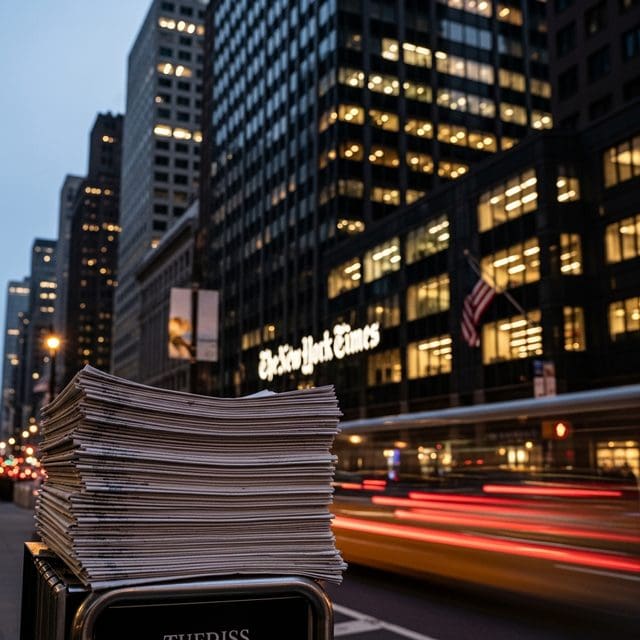
The Department of Justice faces a First Amendment showdown after subpoenaing phone records of reporters and their relatives in a leak investigation involving presidential aircraft security.
The Department of Justice has initiated an unprecedented legal campaign against the press, subpoenaing the personal phone and text records of New York Times reporters and their immediate family members. Newly revealed court filings indicate that the investigation, which seeks records dating back to January 1, 2026, has extended to the mother of one reporter and the spouses of two others. This escalation represents a significant departure from long-standing norms regarding the protection of newsroom communications and the privacy of civilians who are not themselves subjects of criminal inquiries.
The investigation stems from reporting that detailed “significant concerns” among federal officials regarding the security features of a new Air Force One aircraft donated by Qatar. According to the reports, the Secret Service advised President Trump to use a different aircraft when returning from a NATO summit in Turkey due to these technical deficiencies. The administration’s response suggests that the disclosure of these internal security assessments is being treated as a high-level national security breach, though critics argue the intensity of the probe is driven by the personal humiliation of the reports.
Parallel to the DOJ’s external subpoenas, an internal “war room” operation has been established within the West Wing to identify the source of the leak. Led by Chief of Staff Susie Wiles and FBI Director Kash Patel, the operation has reportedly required White House officials connected to the NATO trip to surrender their mobile devices for forensic inspection on government grounds. This dual-track approach—targeting both the suspected leakers within the executive branch and the journalists who published the information—underscores a shift toward more punitive measures in managing the flow of information to the public.
Legal counsel for the New York Times has filed a sealed motion in the Southern District of New York to quash the subpoenas. The motion argues that the government’s tactics are an attempt to intimidate journalists and chill the reporting of stories that may be perceived as critical of the executive. While the DOJ maintains that reporters are not the direct targets of the criminal probe, the inclusion of family members’ records has drawn sharp condemnation from media-law experts. These advocates view the move as a breach of ethical boundaries and a violation of the First Amendment protections that traditionally shield the press from government overreach.
This conflict arises during a period of significant geopolitical and domestic tension. As the DOJ pursues these records, the U.S. military is actively engaged in strikes against Iranian infrastructure following attacks on American bases in Kuwait, Jordan, and Bahrain. The domestic political landscape is equally volatile, with the race to fill the Senate seat vacated by Lindsey Graham intensifying as Representative Ralph Norman and Representative Russell Fry both announce their candidacies. Amidst these distractions, the legal battle over press integrity remains a central concern for those monitoring the health of American institutions.
The Southern District of New York has scheduled a hearing to determine whether the government can force reporters before a grand jury to reveal confidential sources. For now, the phone-record subpoenas remain on hold pending a judicial decision. The outcome of this case will likely define the boundaries of investigative journalism and the extent of executive power in the digital age. For those who value objective truth and the American story, the focus remains on whether the pursuit of “unlawful leaks” justifies the surveillance of private citizens and the erosion of journalistic independence.

Chloe Foster serves as a Staff Writer for Just Right News, where she spearheads the outlet’s coverage of Media, Culture, and Information Integrity. In an era defined by rapid-fire digital communication and shifting societal norms, Chloe has distinguished herself as a vital voice for readers seeking clarity amidst the noise. Her signature feature series, “The Story Wars,” has become a cornerstone of the publication, offering a deep dive into the ideological battles currently shaping American life and the ways in which mainstream narratives are constructed, disseminated, and often manipulated.
Chloe’s unique perspective is informed by a life lived in two of the nation’s most influential cultural hubs. Raised in Los Angeles, California, she grew up in the shadow of the world’s most powerful media and entertainment apparatus. This upbringing provided her with a front-row seat to the “dream factory,” allowing her to observe firsthand how cultural exports are crafted and how they often diverge from the lived experiences of everyday Americans. Her time in Los Angeles instilled in her a healthy skepticism of manufactured consensus and a passion for uncovering the truths that lie beneath polished public relations campaigns.
Today, Chloe operates from Brooklyn, New York, a vantage point that places her at the epicenter of the modern media landscape. Living and working in a deep-blue urban environment as a conservative journalist has sharpened her reporting, requiring a rigorous commitment to intellectual honesty and a steadfast defense of traditional values. Her base in Brooklyn allows her to engage directly with the institutions and influencers who drive the national conversation, providing Just Right News readers with an “on-the-ground” look at the cultural shifts originating in the Northeast.
As a Hispanic woman, Chloe brings a nuanced understanding of community and heritage to her beat. She frequently explores how media portrayals of the Latino community often overlook the deep-seated faith, entrepreneurial spirit, and family-centric values that define it. Her work challenges the monolithic labels often applied by mainstream outlets, instead highlighting the diversity of thought and the conservative principles that resonate within her community.
In her role at Just Right News, Chloe views “Information Integrity” not merely as a buzzword, but as a mission. She believes that a healthy republic requires a media landscape where facts are prioritized over agendas and where the public is empowered to think for themselves. Through “The Story Wars,” she deconstructs the framing of major news events, exposing bias and providing the context necessary for readers to understand the broader cultural implications of the day’s headlines.
Chloe Foster’s reporting is more than just a collection of articles; it is a sustained effort to reclaim the narrative for those who feel sidelined by the prevailing media establishment. By bridging the gap between her West Coast roots and her East Coast base, she continues to provide essential commentary on the forces that define our shared American culture.