

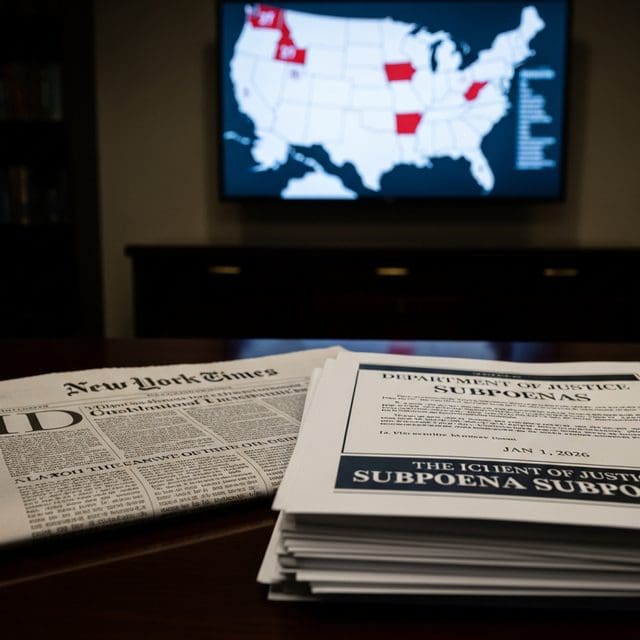
The Justice Department’s aggressive pursuit of phone records from reporters and their families over leaked aircraft details has sparked a major legal battle over government overreach.
Court documents filed on July 20 have brought to light a significant escalation in the federal government’s efforts to identify confidential news sources. The Department of Justice, under the Trump administration, sought the phone and text records of multiple New York Times journalists, as well as the private records of their spouses and relatives. The move is part of a high-stakes investigation into the disclosure of sensitive information regarding a Qatari-gifted Air Force One, a story that previously caused significant friction within the executive branch.
The New York Times and the Washington Post reported that the subpoenas are exceptionally broad in scope. Specifically, the Times noted that at least two subpoenas reach back to January 1, 2026. This timeline is significant because it predates the publication of the relevant reporting by several months. Legal counsel for the newspaper argued in court filings that this suggests the government is not merely seeking evidence of a specific leak, but is instead foraging more broadly for source relationships to map out the reporters’ networks. The legal challenge to quash these subpoenas is currently pending before a federal judge in Manhattan, with the press arguing that the seizure of records from family members constitutes a breach of traditional investigative restraints.
While the Justice Department navigates this constitutional friction, other federal agencies are grappling with the reliability of their own investigative data. The Food and Drug Administration (FDA) issued a notable correction on July 20 regarding its ongoing cyclosporiasis probe. The agency admitted that a previous positive test result for Taylor Farms lettuce was, in fact, a false positive. According to the FDA, there are currently no confirmed positive product tests for Cyclospora as of July 19. This reversal has introduced a layer of complexity to the traceback effort, though the agency maintains its broader conclusion that shredded iceberg lettuce from central Mexico remains the primary suspect.
Despite the lab-error correction, Taylor Farms has confirmed it will continue its voluntary recall of iceberg lettuce shipped to 27 states. The recall covers batches processed between June 29 and July 16. The FDA’s messaging shift emphasizes that the false positive was isolated to one specific shipment and does not invalidate the epidemiological data linking the outbreak to 1,644 cases and 94 hospitalizations across the country. The agency continues to monitor the situation as the case count remains high, though no deaths have been reported to date.
This period of intense administrative activity is occurring against a backdrop of broader national security and economic shifts. On July 18, U.S. Central Command confirmed that two service members were killed in Iranian strikes on bases in Jordan, an escalation following U.S. strikes on Iranian energy infrastructure on July 17. These events have drawn sharp reactions from Capitol Hill, where Senator Mark Warner noted the lack of higher casualties as remarkable, and Senator John Fetterman defended the strikes based on Iran’s possession of nuclear material. Simultaneously, the domestic economy showed signs of cooling, with the Conference Board Leading Economic Index declining 0.2 percent in June.
The intersection of these developments highlights a government operating under significant pressure, where the reliance on primary records—whether they be phone logs or laboratory results—is paramount. In the DOJ matter, the decision to target the families of journalists represents a shift in the administrative state’s approach to internal leaks. As the Manhattan court considers whether to quash the subpoenas, the outcome will likely serve as a benchmark for how far the government can go in monitoring the communications of the press and their private associates in the name of national security.
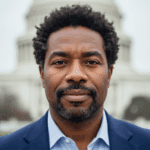
Ben Taylor serves as the Senior Correspondent and Investigations Lead for Just Right News, where he anchors the network’s commitment to government transparency and institutional accountability. With a career defined by a relentless pursuit of the facts, Taylor spearheads the acclaimed feature series “The Paper Trail,” a deep-dive investigative column that prioritizes primary source documentation over political rhetoric. Based in the heart of the nation’s capital, he has earned a reputation as one of the most formidable investigative journalists in Washington, D.C., known specifically for his mastery of public records and the Freedom of Information Act.
Taylor’s approach to journalism is deeply rooted in his upbringing in Kansas City, Missouri. Growing up in the “Show Me State,” he developed a healthy skepticism of centralized power and a profound respect for the common-sense values of the American heartland. This Midwestern foundation informs his reporting today, as he bridges the gap between the complex machinations of federal bureaucracy and the everyday concerns of citizens across the country. For Taylor, investigative reporting is not about chasing headlines; it is about ensuring that the government remains answerable to the people it serves.
As an African American man working within the conservative media landscape, Taylor brings a principled perspective to his beat. He views the Constitution and the right to information as the ultimate equalizers in a free society. His work often highlights how bureaucratic overreach and lack of transparency disproportionately affect individual liberties. By focusing on the “paper trail,” Taylor strips away the spin of partisan talking points, instead providing Just Right News readers with the raw data and internal communications that reveal how their tax dollars are spent and how policy decisions are actually made.
In his role as Investigations Lead, Taylor oversees a team dedicated to uncovering the stories that mainstream outlets often overlook. Whether he is auditing federal spending, investigating regulatory overreach, or exposing inefficiencies within the administrative state, his methodology remains consistent: follow the evidence wherever it leads. His presence in Washington, D.C., allows him to maintain a constant watch over the halls of power, yet he remains steadfastly connected to his roots, ensuring his reporting reflects the clarity and directness of his Missouri home.
Throughout his tenure at Just Right News, Taylor has become a vital voice for those who demand integrity in public office. He believes that a well-informed electorate is the strongest defense against government overreach, and he has dedicated his career to providing the public with the tools they need to hold their leaders accountable. Through “The Paper Trail” and his broader investigative work, Ben Taylor continues to set the standard for rigorous, document-driven journalism that champions the values of transparency, individual responsibility, and the rule of law.