

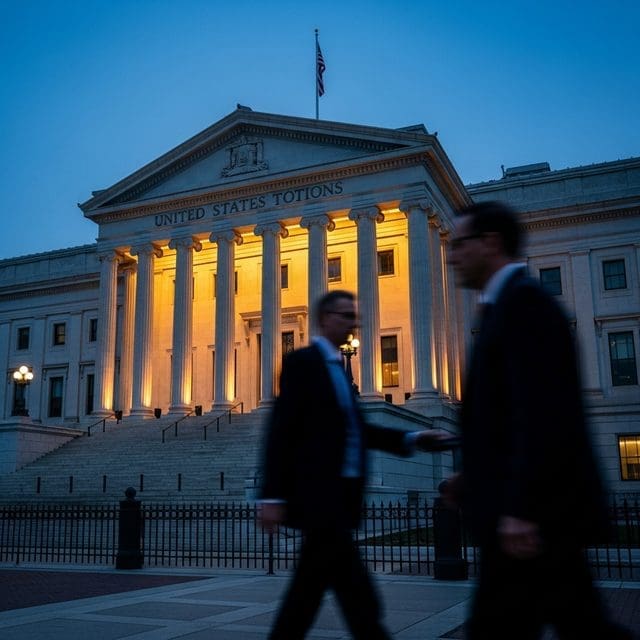
The Trump administration is negotiating for executive discretion in a new mandatory Russia sanctions bill while Treasury officials quietly pare back existing lists to protect the dollar’s global standing.
The delicate balance between national security and economic hegemony is currently being tested on Capitol Hill as the Trump administration negotiates the final terms of the Sanctioning Russia Act of 2026. While the legislation, originally conceived by the late Senator Lindsey Graham, seeks to mandate aggressive penalties on Russian energy and finance, the White House is pressing for language that preserves the President’s authority to suspend or decline these measures. This push for executive flexibility suggests a desire to maintain room for future negotiations with Moscow rather than being boxed in by rigid statutory requirements that could limit the administration’s diplomatic maneuverability.
Internal deliberations at the Treasury Department reveal growing anxiety regarding the long-term viability of the U.S. dollar as the world’s primary reserve currency. Officials have begun a quiet effort to pare back existing sanctions lists, removing deceased individuals, decommissioned vessels, and low-risk actors. This strategic retreat, which includes temporary easing of certain Venezuelan and Iranian oil transactions, is a response to signs that heavy-handed sanctions are accelerating a global shift toward the Chinese renminbi and cryptocurrencies. The administration appears to be acknowledging that the overuse of financial warfare may eventually erode the very leverage it seeks to project, particularly as China-CEEC trade rose 11 percent in the first half of 2026.
On the legislative front, the Senate is expected to move on the revised Russia package as early as next week. The bill remains formidable, proposing tariffs of up to 100 percent on top buyers of Russian energy who refuse to reduce their dependence. However, the compromise reached between bipartisan sponsors and the administration ensures that the U.S. Trade Representative will hold the final authority on setting these levels, further centralizing power within the executive branch. This development comes as the administration manages a complex web of tensions, including President Trump’s recent refusal to negotiate with Iran, citing the regime as ‘evil’ following attacks on U.S. military bases in Jordan that injured several American service members.
Simultaneously, the political landscape in Washington is shifting under the weight of foreign policy disagreements. The pro-Israel lobby AIPAC has intensified its campaign spending against sixteen House Democrats who recently backed an amendment to cut $3.3 billion in security aid to Israel. This move has widened the rift within the Democratic party, signaling that future foreign aid votes will be a primary battlefield for the 2026 election cycle. AIPAC has already restricted fundraising access for these incumbents, framing the vote as a betrayal of a key ally while signaling millions in potential opposition funding for upcoming primaries.
In the Senate, the composition of the chamber continues to evolve following the death of Senator Lindsey Graham. President Trump has recently asked the newly appointed Senator Darline Graham Nordone to run in the special Republican primary for a full term in South Carolina, ensuring that the vacancy remains a focal point of party alignment. Meanwhile, on the domestic front, the administration is navigating the fallout of a voided IRS deal involving the President’s past taxes and a new federal housing law described as the most significant in thirty years. This law aims to settle long-standing Washington arguments over the roots of the housing crisis, though it is not expected to lower rents immediately.
As the administration continues to weigh military responses to Iranian threats—including potential strikes on Iranian infrastructure—the broader strategy remains focused on maximizing pressure without triggering a collapse of the dollar-based financial order. The coming weeks will determine whether Congress is willing to grant the White House the flexibility it demands or if the era of mandatory, legislated foreign policy will persist. For now, the administrative state is attempting to thread a needle between punishing adversaries and preserving the economic tools that allow the United States to lead the global stage.

Miles Harrington serves as the Senior Correspondent for Federal Systems & Executive Power at Just Right News, where he brings a disciplined, constitutionalist lens to the inner workings of the American government. With a focus on the mechanics of the federal bureaucracy and the limits of executive authority, Harrington has established himself as a vital voice for readers who value transparency, accountability, and the preservation of the separation of powers.
A native of Richmond, Virginia, Harrington’s perspective is deeply rooted in the traditions of the Old Dominion. Growing up in a city defined by its historical significance and its role as a center of American jurisprudence, he developed an early appreciation for the foundational principles of the Republic. His upbringing in Richmond—a place where the legacy of the Founding Fathers is woven into the landscape—instilled in him a belief that the federal government should remain within its constitutional bounds. This background informs his skepticism of centralized overreach and his commitment to reporting on the ways in which the administrative state impacts the lives of everyday citizens.
In his current role, Harrington specializes in the complexities of federal systems. He doesn’t just report on the headlines of the day; he digs into the structural shifts within the executive branch that often go unnoticed by the mainstream press. Whether he is analyzing the implications of a new federal regulation or investigating the expansion of agency jurisdiction, his work is characterized by a rigorous adherence to the facts and a dedication to the rule of law.
Harrington is perhaps best known for his signature feature series, “How Washington Works.” Through this ongoing project, he demystifies the often-opaque processes of the nation’s capital, pulling back the curtain on the “Deep State” and the unelected officials who wield significant influence over national policy. By breaking down complex legislative maneuvers and executive orders, he empowers Just Right News readers to understand the true levers of power in Washington. His reporting serves as a necessary check on the federal government, ensuring that the actions of those in power are held up to the light of public scrutiny.
Now based in Washington, D.C., Harrington operates at the epicenter of the political world, yet he remains intentionally distanced from the “Beltway bubble.” His proximity to the halls of power allows him to maintain a robust network of sources across the federal landscape, but his heart remains in the principled conservatism of his Virginia roots. He views his role not merely as a reporter, but as a steward of the public trust, dedicated to providing the clarity and context that conservative voters need to navigate an increasingly complex political environment.
Through his sharp analysis and unwavering commitment to the truth, Miles Harrington continues to be a cornerstone of the Just Right News team. His work ensures that the principles of limited government and executive restraint remain at the forefront of the national conversation, providing a crucial service to those who believe in a government that is truly of, by, and for the people.