

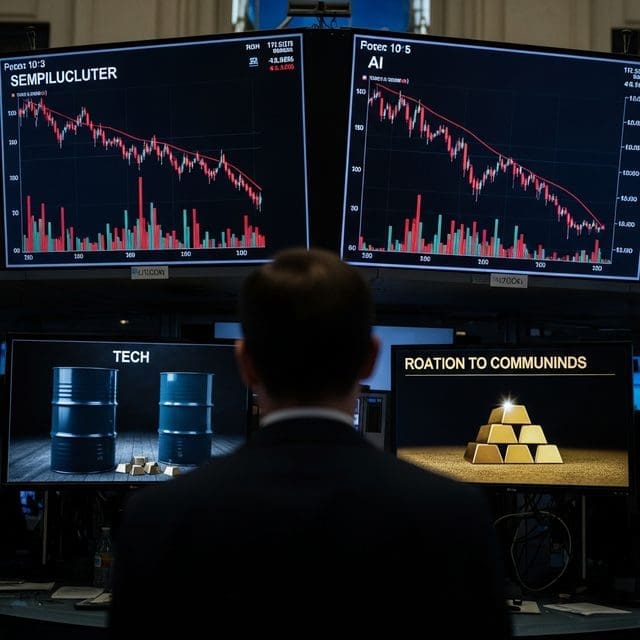
The S&P 500 fell 1.01% as a semiconductor bear market and rising Middle East tensions triggered a sharp rotation from growth stocks into energy and defensive assets.
Global equities shifted to a risk-off posture this week as the S&P 500, tracked by the SPY benchmark, slid 1.01%. The session was defined by a deepening rout in the semiconductor complex and a simultaneous spike in energy prices. For American households, these movements signal a transition from speculative growth toward a defensive environment where energy costs and geopolitical stability take precedence over Silicon Valley promises.
The Nasdaq Composite underperformed the broader market, falling 1.4% to roughly 25,520. This move solidified a formal bear market for the PHLX Semiconductor Index, which has plummeted approximately 20% from its June 22 peak. Market leaders like Nvidia have become the primary weights on the index as investors question if AI valuations outpaced near-term earnings. Globally, the chip sector has seen nearly $3.3 trillion in market value evaporated in less than a month, highlighting the fragility of centralized tech concentrations.
International markets mirrored the domestic tech exodus. Japan’s Nikkei 225 plummeted 4.03% to 64,141, driven by an aggressive unwind in AI and memory-chip exporters. Unlike previous corrections rooted in domestic macro weakness, this sell-off appears to be a direct contagion from the U.S. technology sector. Conversely, the UK’s FTSE 100 managed a 0.27% gain, buoyed by resource companies that benefit from higher commodity prices, providing a rare haven amidst global red indices.
Energy emerged as the sole U.S. sector showing broad strength. WTI crude oil surged 4.5% to approximately $82.50 per barrel, marking a 12% increase for the week. This volatility follows reports that the Trump administration notified Israel of plans to provide additional refueling aircraft ahead of a potential military offensive against Iran. Heightened supply risks in the Middle East forced a rotation into oil and hard assets, leaving eight of eleven S&P 500 sectors lower, with Industrials and Materials leading the decline.
Beyond equity volatility, institutional shifts highlighted the consequences of over-leverage. SpaceX stock has shed more than $800 billion from its peak valuation, closing below its IPO price for the first time. In the distressed asset space, the FTX estate announced a fifth distribution of $900 million to creditors, a reminder of the previous crypto collapse. Meanwhile, Bank of America authorized regular dividends on preferred stock, and Paramount Skydance extended exchange offer deadlines, reflecting a market grappling with high-stakes restructuring.
For the Main Street investor, the current market breadth is concerning. The sell-off is no longer confined to one sector; it is a broad de-risking event. While Miami-Dade real estate posted its strongest June in three years, the broader equity market is feeling the squeeze of rising yields and commodity-driven inflation. As capital flees AI promises for the safety of gold and energy, the focus shifts toward preserving fiscal stability in an increasingly volatile global system. The shift from growth to value is a return to economic reality.

Jordan Lee serves as the Senior Correspondent for Wall Street, Finance, and Monetary Systems at Just Right News. Based in the heart of the world’s financial capital, New York City, Lee brings a sharp, principled eye to the complex mechanisms that drive the global economy. His reporting is defined by a commitment to fiscal responsibility, the defense of the free market, and a deep-seated belief that a transparent monetary system is the bedrock of a free society.
Raised in Portland, Oregon, Lee’s perspective was forged in a city that has undergone significant cultural and economic shifts. His upbringing in the Pacific Northwest instilled in him a profound appreciation for the industriousness of small business owners and the importance of local economic stability. Watching the evolution of his hometown’s landscape sparked an early interest in how federal fiscal policy and large-scale financial trends eventually trickle down to the average citizen. This background provides him with a unique vantage point; he understands the growing disconnect between the policy-making elite and the reality of Main Street, a theme that frequently resonates throughout his work.
Now operating from his base in New York City, Lee bridges the gap between the high-stakes trading floors of Manhattan and the households of everyday Americans. He views the financial sector not merely as a collection of numbers and tickers, but as a vital engine of American prosperity that requires constant vigilance and accountability. His reporting often highlights the dangers of centralized financial control and the necessity of maintaining a system that rewards merit, risk-taking, and innovation.
As the creator and lead of the featured series, “The Invisible Economy,” Lee pulls back the curtain on the often-opaque world of monetary systems. He specializes in translating the dense jargon of central banking and international finance into actionable insights for the Just Right News audience. His work explores the “invisible” forces—such as inflationary pressures, regulatory creep, and the expansion of the administrative state—that erode the purchasing power of American families. By focusing on these systemic issues, Lee empowers readers to understand the hidden forces shaping their financial independence.
Lee’s journalistic philosophy is rooted in a steadfast commitment to traditional American values. As an Asian American professional who has navigated the competitive corridors of the financial world, he is a vocal advocate for meritocracy and the preservation of the American Dream. He believes that a stable currency and a predictable regulatory environment are essential for national sovereignty and individual liberty. His reporting frequently warns against the risks of government overreach in the private sector, arguing that the most effective solutions to economic challenges arise from competition and individual enterprise rather than bureaucratic mandates.
At Just Right News, Jordan Lee remains dedicated to providing a clear-eyed defense of the taxpayer. Whether he is analyzing market volatility or investigating the long-term implications of national debt, his mission is to provide the truth about where the money is going and what it means for the future of the country. Through his rigorous analysis and principled stance, Lee has become a trusted voice for those who value a strong, sovereign, and fiscally sound America.