

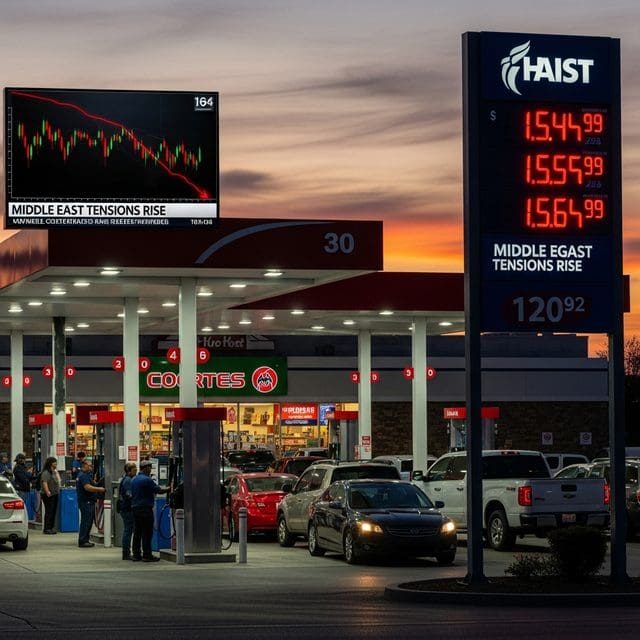
The Dow tumbled over 570 points while oil prices surged more than 5% following President Trump’s announcement of renewed hostilities and the revocation of Iranian oil waivers.
Global financial markets faced a volatile correction on Wednesday as the delicate balance of the “Invisible Economy” was disrupted by a sharp escalation in Middle East hostilities. The S&P 500 benchmark (SPY) retreated 1.01%, reflecting a broad-based retreat from risk as investors grappled with the collapse of the U.S.-Iran ceasefire. The Dow Jones Industrial Average bore the brunt of the sell-off, sliding 576.76 points, or 1.09%, to close at 52,348.39. This downward pressure comes at a sensitive time for the American taxpayer, as the prospect of a sustained energy price shock threatens to erode the purchasing power of Main Street households.
The primary driver of the market’s anxiety originated at the NATO summit in Ankara, Turkey. President Donald Trump told world leaders that the ceasefire with Iran is “over,” describing the Iranian leadership as “scum‒ and threatening imminent military action. This declaration followed a series of powerful U.S. strikes against Iranian assets, launched in retaliation for attacks on three commercial vessels in the Strait of Hormuz. The geopolitical friction was further intensified by the U.S. Treasury’s decision to revoke a critical license that had previously allowed Iran to sell oil internationally. Consequently, International Brent crude futures settled up 5.43% at $78.19 per barrel, while West Texas Intermediate (WTI) surged 4.37% to $73.52.
For working families, the market rotation signals a potential squeeze on discretionary income. As oil prices climbed, consumer-heavy stocks sensitive to energy costs faced significant headwinds. Home Depot shares slid 2%, McDonald’s pulled back by more than 1%, and travel-related Booking Holdings shed 4%. These movements reflect a market reality where higher costs for transportation and logistics eventually filter down to the price of basic goods. While the energy sector saw gains—with Marathon Petroleum advancing 5% and Chevron up 1%—these profits for the few often come at the expense of the many who must fuel their vehicles and heat their homes.
The diplomatic fallout at the NATO summit also highlighted growing rifts within international alliances. While NATO Secretary General Mark Rutte defended the U.S. strikes as “absolutely necessary” to protect global shipping lanes, President Trump criticized allies for failing to provide adequate basing support for bombing missions. This lack of a unified front adds a layer of sovereign risk that the markets had previously failed to price in. Analysts from Capital.com noted that the renewed tensions have interrupted an “increasingly complacent market narrative,” forcing a reassessment of geopolitical risks that many hoped were fading.
Domestically, the Federal Reserve added to the uncertainty. Minutes from the June meeting—the first under Chairman Kevin Warsh—revealed a central bank deeply divided over interest rates. While one faction of participants advocated for rates to remain at or below current targets by year-end, another group assessed that the appropriate level should be higher to combat persistent inflation. This internal stalemate leaves the American economy in a precarious position; if energy prices continue to climb due to the Strait of Hormuz conflict, the Fed may find itself with little room to maneuver without further straining the fiscal health of the average citizen.
Despite the broader decline, the tech-heavy Nasdaq Composite bucked the trend, rising 0.2% to settle at 25,870.65. This resilience was largely driven by a stabilization in the semiconductor sector, with the VanEck Semiconductor ETF (SMH) rising 2%. However, even this gain must be viewed with caution, as the fund remains nearly 12% below its recent highs. As the fall of 2026 approaches, the intersection of military escalation, a divided central bank, and a volatile energy market suggests that the era of fiscal stability remains elusive for the American public.

Jordan Lee serves as the Senior Correspondent for Wall Street, Finance, and Monetary Systems at Just Right News. Based in the heart of the world’s financial capital, New York City, Lee brings a sharp, principled eye to the complex mechanisms that drive the global economy. His reporting is defined by a commitment to fiscal responsibility, the defense of the free market, and a deep-seated belief that a transparent monetary system is the bedrock of a free society.
Raised in Portland, Oregon, Lee’s perspective was forged in a city that has undergone significant cultural and economic shifts. His upbringing in the Pacific Northwest instilled in him a profound appreciation for the industriousness of small business owners and the importance of local economic stability. Watching the evolution of his hometown’s landscape sparked an early interest in how federal fiscal policy and large-scale financial trends eventually trickle down to the average citizen. This background provides him with a unique vantage point; he understands the growing disconnect between the policy-making elite and the reality of Main Street, a theme that frequently resonates throughout his work.
Now operating from his base in New York City, Lee bridges the gap between the high-stakes trading floors of Manhattan and the households of everyday Americans. He views the financial sector not merely as a collection of numbers and tickers, but as a vital engine of American prosperity that requires constant vigilance and accountability. His reporting often highlights the dangers of centralized financial control and the necessity of maintaining a system that rewards merit, risk-taking, and innovation.
As the creator and lead of the featured series, “The Invisible Economy,” Lee pulls back the curtain on the often-opaque world of monetary systems. He specializes in translating the dense jargon of central banking and international finance into actionable insights for the Just Right News audience. His work explores the “invisible” forces—such as inflationary pressures, regulatory creep, and the expansion of the administrative state—that erode the purchasing power of American families. By focusing on these systemic issues, Lee empowers readers to understand the hidden forces shaping their financial independence.
Lee’s journalistic philosophy is rooted in a steadfast commitment to traditional American values. As an Asian American professional who has navigated the competitive corridors of the financial world, he is a vocal advocate for meritocracy and the preservation of the American Dream. He believes that a stable currency and a predictable regulatory environment are essential for national sovereignty and individual liberty. His reporting frequently warns against the risks of government overreach in the private sector, arguing that the most effective solutions to economic challenges arise from competition and individual enterprise rather than bureaucratic mandates.
At Just Right News, Jordan Lee remains dedicated to providing a clear-eyed defense of the taxpayer. Whether he is analyzing market volatility or investigating the long-term implications of national debt, his mission is to provide the truth about where the money is going and what it means for the future of the country. Through his rigorous analysis and principled stance, Lee has become a trusted voice for those who value a strong, sovereign, and fiscally sound America.