

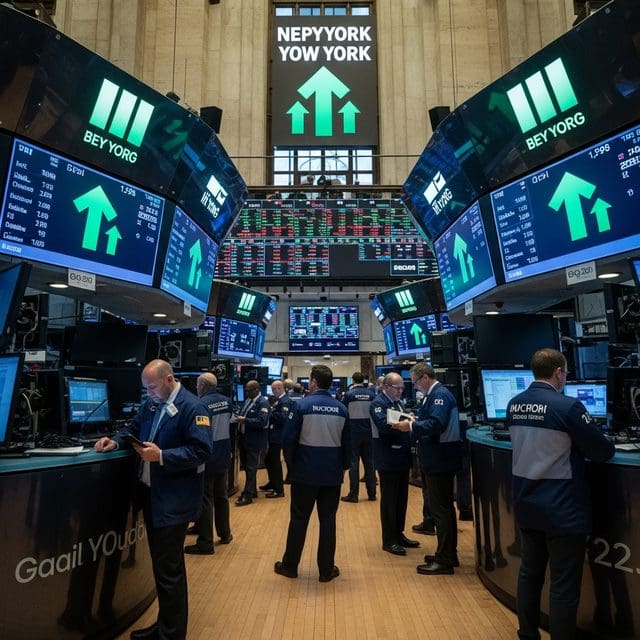
Major U.S. indices surged on news of potential progress in Iran negotiations, providing a temporary reprieve for households facing high energy costs and persistent inflationary pressures.
Wall Street experienced its strongest single-day performance in two months as investors reacted to shifting geopolitical headlines that carry direct implications for the American household budget. The Dow Jones Industrial Average surged 929.97 points, or 1.9%, to close at 50,848.75, while the Nasdaq composite led the rally with a 2.5% gain. These moves were mirrored by the S&P 500, which climbed 1.8% to 7,394.30, recovering losses from a back-to-back drop that had previously erased gains made since early May. Against this benchmark, the SPY ETF remains up 0.45% on the current session, reflecting a market attempting to maintain its footing amidst high-stakes diplomacy.
The primary catalyst for the rally was a pivot in the administration’s stance toward Iran. After previously threatening military action, President Donald Trump indicated via social media that discussions with the Islamic Republic of Iran had reached the highest levels of leadership. This provided immediate relief to energy markets, which have been a primary driver of the ‘Invisible Economy’ affecting American families at the pump. Benchmark U.S. crude fell 2.6% to $87.71 per barrel, while Brent crude dropped to $90.38. While these prices remain significantly higher than pre-war levels of roughly $70, the retreat offered a glimmer of hope for cooling the inflation that has sent wholesale prices higher than economists expected.
In the bond market, the 10-year Treasury yield slid to 4.45% from 4.55% the previous day. This move suggests that fixed-income investors are recalibrating their expectations for Federal Reserve policy. Lower energy prices reduce the immediate pressure on the Fed to implement further interest rate hikes, a move that would be welcomed by small business owners and families carrying variable-rate debt. The Russell 2000 index, which tracks smaller companies sensitive to borrowing costs, responded by jumping a market-leading 3%. This pivot is particularly notable as the European Central Bank recently became the first major central bank to raise rates in response to these global inflationary pressures.
Technological meritocracy was also on display as AI-related stocks rebounded from recent volatility. Marvell Technology climbed 11.1%, leading a broader surge in the semiconductor sector. This follows a manic stretch for the company, which recently saw a historic 32.5% surge after Nvidia leadership suggested it could be a future trillion-dollar entity. Other chip-making giants like Lam Research and KLA also posted gains of 12.7% and 12.9% respectively, signaling that despite concerns over high valuations and a potential AI bubble, the market’s appetite for American innovation remains robust. These gains helped offset an 8.5% decline in Oracle, which announced plans to raise $40 billion in cash through borrowing and stock sales to fund its massive AI infrastructure investments.
Beyond the domestic tech sector, the global financial landscape saw mixed results. While London’s FTSE 100 rose 0.5%, Hong Kong’s Hang Seng fell 0.7%, illustrating the uneven nature of the global recovery. Institutional activity remained high elsewhere, with Skanska divesting a SEK 570 million project in Sweden and AEON expanding digital payment services into Zambia. These movements highlight a world still hungry for growth despite the shadow of conflict. Even Ecopetrol Group in Colombia reported clearing significant receivables, showing that fiscal responsibility continues to move forward in various corners of the global market.
However, the stability of this rally remains in question. Subsequent reports indicate that the ceasefire remains fragile, with Iranian Supreme Leader Mojtaba Khamenei vowing revenge for his father’s assassination. While the market celebrated the prospect of a deal to reopen the Strait of Hormuz, the administration has since set firm deadlines for Iran to renounce attacks on commercial shipping. For the American taxpayer, the day’s gains highlight how closely domestic prosperity is tied to national sovereignty and the security of global trade routes. Until a durable resolution is reached in the Persian Gulf, the threat of energy-driven inflation will continue to loom over the stability of the U.S. monetary system.

Jordan Lee serves as the Senior Correspondent for Wall Street, Finance, and Monetary Systems at Just Right News. Based in the heart of the world’s financial capital, New York City, Lee brings a sharp, principled eye to the complex mechanisms that drive the global economy. His reporting is defined by a commitment to fiscal responsibility, the defense of the free market, and a deep-seated belief that a transparent monetary system is the bedrock of a free society.
Raised in Portland, Oregon, Lee’s perspective was forged in a city that has undergone significant cultural and economic shifts. His upbringing in the Pacific Northwest instilled in him a profound appreciation for the industriousness of small business owners and the importance of local economic stability. Watching the evolution of his hometown’s landscape sparked an early interest in how federal fiscal policy and large-scale financial trends eventually trickle down to the average citizen. This background provides him with a unique vantage point; he understands the growing disconnect between the policy-making elite and the reality of Main Street, a theme that frequently resonates throughout his work.
Now operating from his base in New York City, Lee bridges the gap between the high-stakes trading floors of Manhattan and the households of everyday Americans. He views the financial sector not merely as a collection of numbers and tickers, but as a vital engine of American prosperity that requires constant vigilance and accountability. His reporting often highlights the dangers of centralized financial control and the necessity of maintaining a system that rewards merit, risk-taking, and innovation.
As the creator and lead of the featured series, “The Invisible Economy,” Lee pulls back the curtain on the often-opaque world of monetary systems. He specializes in translating the dense jargon of central banking and international finance into actionable insights for the Just Right News audience. His work explores the “invisible” forces—such as inflationary pressures, regulatory creep, and the expansion of the administrative state—that erode the purchasing power of American families. By focusing on these systemic issues, Lee empowers readers to understand the hidden forces shaping their financial independence.
Lee’s journalistic philosophy is rooted in a steadfast commitment to traditional American values. As an Asian American professional who has navigated the competitive corridors of the financial world, he is a vocal advocate for meritocracy and the preservation of the American Dream. He believes that a stable currency and a predictable regulatory environment are essential for national sovereignty and individual liberty. His reporting frequently warns against the risks of government overreach in the private sector, arguing that the most effective solutions to economic challenges arise from competition and individual enterprise rather than bureaucratic mandates.
At Just Right News, Jordan Lee remains dedicated to providing a clear-eyed defense of the taxpayer. Whether he is analyzing market volatility or investigating the long-term implications of national debt, his mission is to provide the truth about where the money is going and what it means for the future of the country. Through his rigorous analysis and principled stance, Lee has become a trusted voice for those who value a strong, sovereign, and fiscally sound America.