

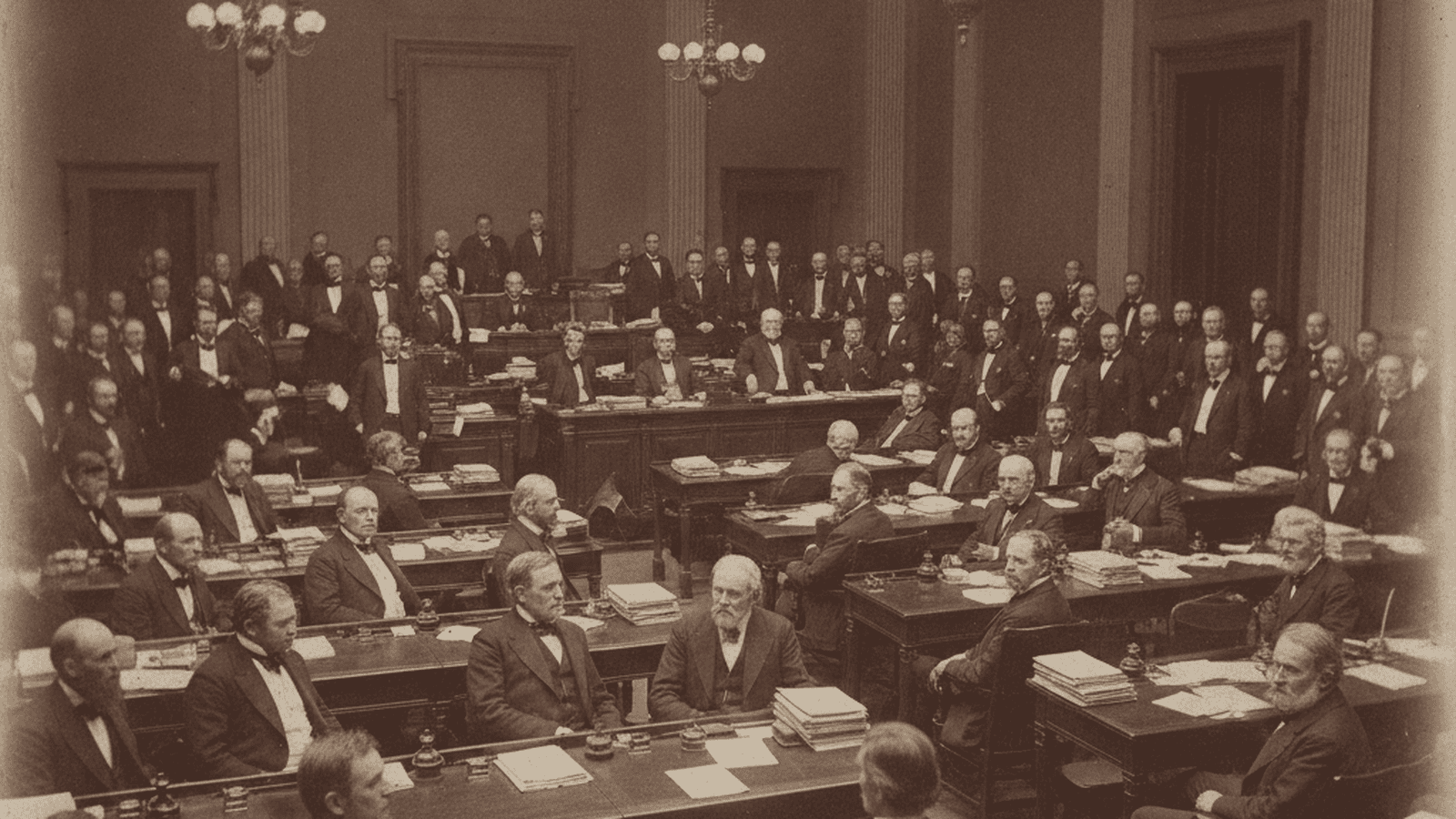
In 1857, the United States House of Representatives launched a major anti-corruption investigation following allegations of bribery involving land grants and railroad subsidies. The probe led to the first federal law empowering Congress to compel witness testimony and resulted in the resignation of several corrupt members.
TLDR: In 1857, a bribery scandal involving railroad land grants rocked the United States House of Representatives. The investigation led to the Compulsory Attendance of Witnesses Act, establishing the legal framework for congressional subpoenas. Three congressmen resigned to avoid expulsion, marking a pivotal moment in federal anti-corruption efforts.
In the winter of 1857, the United States House of Representatives was forced to confront a systemic crisis of integrity that threatened the credibility of the federal government. The scandal erupted when John W. Simonton, a correspondent for the New York Times, published a series of articles alleging that a corrupt combination of at least twenty congressmen had formed a ring to solicit bribes. According to Simonton, these members refused to pass any legislation involving land grants or railroad subsidies unless they were paid in cash or company stock. This revelation shocked a public already weary of the sectional tensions leading up to the Civil War.
The allegations centered on several lucrative bills, including those providing federal land for railroads in the territories of Minnesota and Iowa. As the young nation expanded westward, the value of these land grants was immense, creating a fertile environment for graft. The House responded by appointing a select committee, chaired by Representative William H. Kelsey of New York, to investigate the charges. This committee marked one of the most significant anti-corruption drives in the antebellum era, signaling a shift toward more rigorous internal policing of the legislature.
The investigation quickly hit a legal wall when Simonton was called to testify. While he confirmed the existence of the bribery ring, he refused to name the specific members involved, arguing that his sources were confidential. At the time, Congress lacked a clear statutory mechanism to punish private citizens who refused to cooperate with legislative inquiries. The House initially voted to hold Simonton in contempt and placed him in the custody of the Sergeant-at-Arms, but the legal ambiguity of his detention sparked a heated constitutional debate over the limits of legislative power.
To resolve the impasse, Congress moved with uncharacteristic speed. Within days, both chambers passed the Compulsory Attendance of Witnesses Act of 1857. Signed into law in late January, the act made it a misdemeanor for any person to refuse to testify or produce documents when summoned by a congressional committee. It also provided a degree of immunity for witnesses, ensuring that their testimony could not be used against them in criminal proceedings, thereby removing the Fifth Amendment justification for silence. This legislative maneuver effectively broke the deadlock and allowed the investigation to proceed.
Faced with the new law, Simonton eventually relented and provided the committee with the names of the conspirators. The Kelsey Committee’s final report was a scathing indictment of legislative ethics. It recommended the expulsion of four members: William W. Welch of Connecticut, Orsamus B. Matteson of New York, Francis S. Edwards of New York, and William A. Gilbert of New York. The evidence showed that these men had not only accepted bribes but had actively organized the combination to extort money from lobbyists seeking favorable land deals.
The fallout was immediate and dramatic. Rather than face the ignominy of a formal expulsion vote on the House floor, Matteson, Edwards, and Gilbert resigned their seats in February 1857. Welch remained but was not expelled, as the House failed to reach the required two-thirds majority for his removal. The scandal deeply tarnished the reputation of the 34th Congress and highlighted the desperate need for formal lobbying regulations in a rapidly industrializing society.
The 1857 House corruption investigation left a permanent mark on the American political system. By codifying the power of the subpoena, Congress established itself as a co-equal branch capable of conducting rigorous oversight of both the executive and its own members. This authority would prove essential in later years, particularly during the Gilded Age and the Progressive Era, as lawmakers sought to curb the excesses of industrial monopolies. The 1857 Act remains the foundational legal authority for congressional investigations today.

Ben Taylor serves as the Senior Correspondent and Investigations Lead for Just Right News, where he anchors the network’s commitment to government transparency and institutional accountability. With a career defined by a relentless pursuit of the facts, Taylor spearheads the acclaimed feature series “The Paper Trail,” a deep-dive investigative column that prioritizes primary source documentation over political rhetoric. Based in the heart of the nation’s capital, he has earned a reputation as one of the most formidable investigative journalists in Washington, D.C., known specifically for his mastery of public records and the Freedom of Information Act.
Taylor’s approach to journalism is deeply rooted in his upbringing in Kansas City, Missouri. Growing up in the “Show Me State,” he developed a healthy skepticism of centralized power and a profound respect for the common-sense values of the American heartland. This Midwestern foundation informs his reporting today, as he bridges the gap between the complex machinations of federal bureaucracy and the everyday concerns of citizens across the country. For Taylor, investigative reporting is not about chasing headlines; it is about ensuring that the government remains answerable to the people it serves.
As an African American man working within the conservative media landscape, Taylor brings a principled perspective to his beat. He views the Constitution and the right to information as the ultimate equalizers in a free society. His work often highlights how bureaucratic overreach and lack of transparency disproportionately affect individual liberties. By focusing on the “paper trail,” Taylor strips away the spin of partisan talking points, instead providing Just Right News readers with the raw data and internal communications that reveal how their tax dollars are spent and how policy decisions are actually made.
In his role as Investigations Lead, Taylor oversees a team dedicated to uncovering the stories that mainstream outlets often overlook. Whether he is auditing federal spending, investigating regulatory overreach, or exposing inefficiencies within the administrative state, his methodology remains consistent: follow the evidence wherever it leads. His presence in Washington, D.C., allows him to maintain a constant watch over the halls of power, yet he remains steadfastly connected to his roots, ensuring his reporting reflects the clarity and directness of his Missouri home.
Throughout his tenure at Just Right News, Taylor has become a vital voice for those who demand integrity in public office. He believes that a well-informed electorate is the strongest defense against government overreach, and he has dedicated his career to providing the public with the tools they need to hold their leaders accountable. Through “The Paper Trail” and his broader investigative work, Ben Taylor continues to set the standard for rigorous, document-driven journalism that champions the values of transparency, individual responsibility, and the rule of law.