

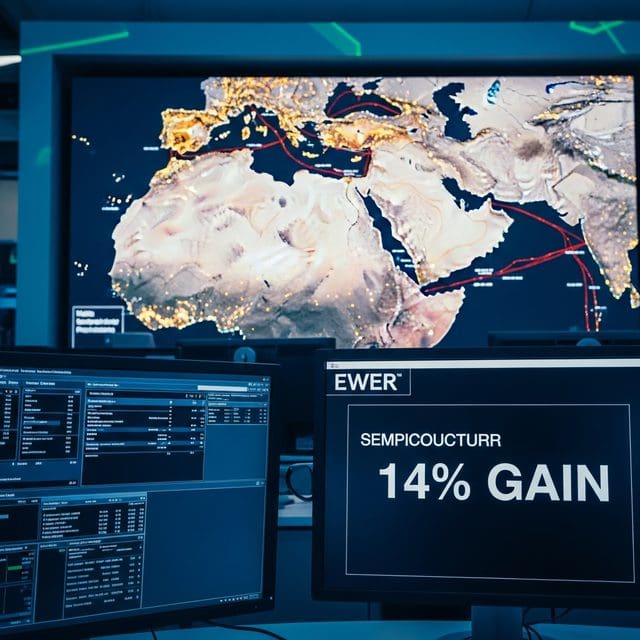
Wall Street benchmarks rose today as a historic semiconductor listing offset geopolitical friction in the Middle East, leaving investors to weigh AI-driven growth against renewed energy-linked inflation risks.
Global financial markets demonstrated a calculated resilience during today’s session, with the SPY benchmark climbing 0.45%. This moderate gain reflects a market attempting to balance the sheer momentum of the artificial intelligence revolution against the sobering realities of a destabilized Middle East. While the headline indices suggest a steady climb, the underlying movement reveals a significant tug-of-war between high-growth technology sectors and the inflationary pressures of a fractured global supply chain.
The primary catalyst for today’s risk-on sentiment was the historic U.S. listing of South Korean memory giant SK Hynix. Raising $26.5 billion in a U.S. equity offering, the transaction marked the second-largest equity offering in history. Shares surged 14% in their Nasdaq debut, a clear signal that institutional capital remains firmly committed to the semiconductor narrative. SK Hynix CEO Kwak Noh-jung reinforced this sentiment, warning of a severe global memory supply shortage by 2027. He projected that demand for high-performance memory will likely outstrip production capacity well into the next decade, a forecast that has effectively insulated tech stocks from broader geopolitical jitters.
However, for the American taxpayer and the Main Street economy, this technological boom is being shadowed by the rising cost of energy. The Trump administration has set a firm deadline for Saturday, July 12, 2026, demanding that Iran publicly renounce its attacks in the Strait of Hormuz and halt fire on commercial vessels. This geopolitical brinkmanship has immediate consequences for the global monetary system. In Europe, ECB policymaker Yannis Stournaras noted that the central bank is essentially back to square one in its fight against inflation, as renewed hostilities drive energy prices higher and threaten to unanchor consumer price expectations.
This tension is visible in the foreign exchange and commodity markets. While U.S. oil prices have seen sharp declines from their May peaks, technical indicators suggest a looming reversal to the upside if the Strait of Hormuz remains a flashpoint. The British pound has already reacted, hitting a one-year peak against the euro as markets anticipate that central banks may be forced to maintain higher interest rates to combat this energy-driven inflation. This creates a difficult environment for working households, who find themselves caught between the prosperity of the ‘Invisible Economy’ and the rising costs of basic goods.
Corporate activity elsewhere suggests that professional investors are diversifying into alternative energy and digital infrastructure to hedge against these risks. General Fusion recently completed its business combination with Spring Valley Acquisition Corp. III, positioning itself as the first publicly listed fusion company on the Nasdaq. Simultaneously, AEON has expanded its digital payment footprint into Zambia, integrating mobile money platforms for digital asset settlement. These moves highlight a global shift toward decentralized and technologically advanced financial systems as a buffer against traditional geopolitical instability.
Even as the S&P 500 and Nasdaq futures eased slightly from their session highs, the resilience of the 0.45% gain in SPY suggests that the market is currently ‘looking through’ the conflict. Yet, with a packed week of CPI data and corporate earnings on the horizon, the stability of this rally remains fragile. The coming days will determine if the productivity gains promised by the AI sector can truly offset the fiscal drag of a potential energy shock. For now, the market remains in a state of watchful optimism, prioritizing the long-term potential of silicon over the immediate volatility of the oil fields.

Jordan Lee serves as the Senior Correspondent for Wall Street, Finance, and Monetary Systems at Just Right News. Based in the heart of the world’s financial capital, New York City, Lee brings a sharp, principled eye to the complex mechanisms that drive the global economy. His reporting is defined by a commitment to fiscal responsibility, the defense of the free market, and a deep-seated belief that a transparent monetary system is the bedrock of a free society.
Raised in Portland, Oregon, Lee’s perspective was forged in a city that has undergone significant cultural and economic shifts. His upbringing in the Pacific Northwest instilled in him a profound appreciation for the industriousness of small business owners and the importance of local economic stability. Watching the evolution of his hometown’s landscape sparked an early interest in how federal fiscal policy and large-scale financial trends eventually trickle down to the average citizen. This background provides him with a unique vantage point; he understands the growing disconnect between the policy-making elite and the reality of Main Street, a theme that frequently resonates throughout his work.
Now operating from his base in New York City, Lee bridges the gap between the high-stakes trading floors of Manhattan and the households of everyday Americans. He views the financial sector not merely as a collection of numbers and tickers, but as a vital engine of American prosperity that requires constant vigilance and accountability. His reporting often highlights the dangers of centralized financial control and the necessity of maintaining a system that rewards merit, risk-taking, and innovation.
As the creator and lead of the featured series, “The Invisible Economy,” Lee pulls back the curtain on the often-opaque world of monetary systems. He specializes in translating the dense jargon of central banking and international finance into actionable insights for the Just Right News audience. His work explores the “invisible” forces—such as inflationary pressures, regulatory creep, and the expansion of the administrative state—that erode the purchasing power of American families. By focusing on these systemic issues, Lee empowers readers to understand the hidden forces shaping their financial independence.
Lee’s journalistic philosophy is rooted in a steadfast commitment to traditional American values. As an Asian American professional who has navigated the competitive corridors of the financial world, he is a vocal advocate for meritocracy and the preservation of the American Dream. He believes that a stable currency and a predictable regulatory environment are essential for national sovereignty and individual liberty. His reporting frequently warns against the risks of government overreach in the private sector, arguing that the most effective solutions to economic challenges arise from competition and individual enterprise rather than bureaucratic mandates.
At Just Right News, Jordan Lee remains dedicated to providing a clear-eyed defense of the taxpayer. Whether he is analyzing market volatility or investigating the long-term implications of national debt, his mission is to provide the truth about where the money is going and what it means for the future of the country. Through his rigorous analysis and principled stance, Lee has become a trusted voice for those who value a strong, sovereign, and fiscally sound America.