

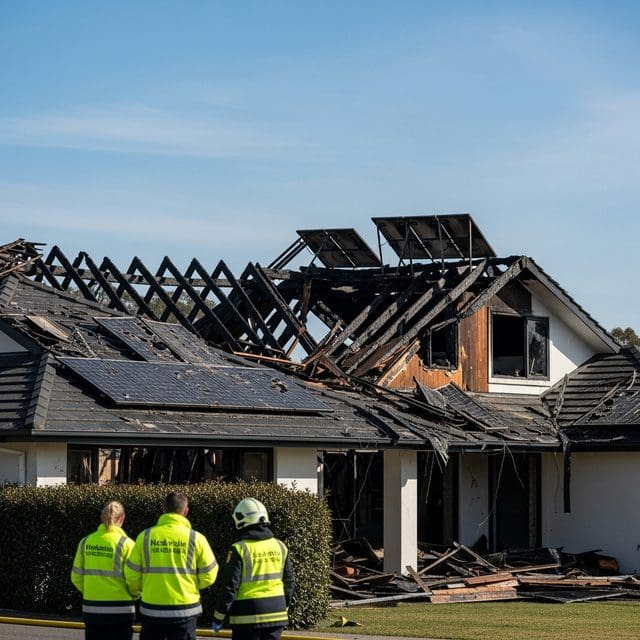
A devastating fire in a newbuild home highlights the growing safety concerns and regulatory gaps surrounding the rapid rollout of residential solar panels.
Tammi Atherton was settled in her lounge with Wimbledon on the television when the smoke alarms in her newbuild home began to wail. It was a typical afternoon that turned into a race for survival. Within minutes, the roof of her property was an inferno, and video captured the harrowing moment the structure collapsed, leaving a family displaced and a lifetime of belongings reduced to ash. Investigators suspect the culprit was the very technology meant to secure the home’s future: its roof-mounted solar panels. This incident is not an isolated tragedy but a visible symptom of a growing friction between rapid green energy adoption and the fundamental safety of the American home.
While government messaging frequently characterizes the risk of solar-panel fires as “extremely low,” the lived experience of homeowners and the data from fire safety specialists suggest a more volatile reality. Recent large-scale studies of over 3.3 million solar modules found that nearly 36.6 percent were thermally defective. More alarming is the discovery of over 900,000 panels harboring hotspots capable of triggering electrical arcing. For many families, the promise of self-reliance and lower utility bills is being undermined by a lack of rigorous oversight in the installation and maintenance of these complex electrical systems.
In the rush to meet environmental mandates and consumer demand, residential photovoltaic (PV) systems are often installed without adequate fire-risk assessments. A February 2026 technical report noted that these arrays can trap heat against the roof surface, significantly increasing temperatures and heat flux. This physical phenomenon can accelerate the spread of flames, turning minor electrical faults into total property losses, particularly when combustible construction materials are present in the roof’s design. Investigations into similar fires have revealed that solar panels are frequently omitted from building fire risk assessments entirely, representing a systemic documentation and design defect.
The burden of these failures falls squarely on the individual. When defects are identified, homeowners often find themselves trapped in a bureaucratic maze. Housing ombudsman records show that even when residents raise safety concerns after nearby fires, the response from landlords and developers is often minimal. In some cases, tenants have been granted a mere £150 in compensation for the persistent anxiety of living under a potentially hazardous roof. This lack of accountability leaves families to navigate the aftermath of a total loss alone, often discovering too late that the regulatory framework designed to protect them has failed to keep pace with technological implementation.
This gap between policy and protection highlights a critical need for local accountability and common-sense skepticism regarding centralized green initiatives. As solar panels become a standard feature of the modern landscape, the focus must shift from aggregate installation targets to the preservation of the individual household. The rapid rollout has outstripped the capacity for weak installer regulations to ensure safety, creating a landscape where a mansion in Dorset or a newbuild in a quiet suburb can be leveled in hours due to a faulty connection or a poorly maintained array.
Ultimately, the story of the Atherton family serves as a cautionary tale for the modern age. The transition to renewable energy is often framed in the abstract, but its consequences are deeply personal. Without tighter regulation of installers, mandatory maintenance standards, and a refocus on the integrity of the family home, the push for sustainable energy risks sacrificing the very security and personal responsibility it was intended to provide. The preservation of local institutions and the safety of our neighborhoods depend on recognizing that a policy is only as good as its impact on the person living under the roof.

Ethan Blake serves as a Senior Correspondent for Just Right News, where he specializes in Longform Narrative and Public Understanding. In an era of rapid-fire headlines and fleeting soundbites, Ethan’s work stands as a testament to the power of deep-dive reporting and the importance of contextualizing the complex issues facing the nation today. His approach is rooted in the belief that the most profound truths are often found in the lived experiences of individuals rather than the abstract theories of distant policymakers.
Growing up in Providence, Rhode Island, Ethan developed an early appreciation for the historical and cultural threads that weave the American fabric together. Providence, a city defined by its industrial heritage and its blend of traditional neighborhoods, provided him with a front-row seat to the challenges and triumphs of the American working class. This upbringing instilled in him a respect for the “common sense” values of hard work, community loyalty, and the preservation of local institutions. He learned early on that behind every economic statistic or legislative debate, there are real families and neighborhoods navigating the consequences of change.
This foundational perspective is the driving force behind his signature feature series, “Lives Behind the Systems.” Through this series, Ethan explores the intersection of individual agency and institutional structure. Whether he is documenting the impact of federal land-use policies on rural families or examining how shifting educational standards affect local school boards, Ethan’s work prioritizes the human element. He seeks to uncover how large-scale systems—be they governmental, economic, or social—affect the daily lives of citizens, often advocating for a return to local control and personal responsibility.
Now based in Portland, Maine, Ethan draws significant inspiration from the rugged independence and self-reliance that define the region. The coastal landscape and the resilient spirit of Maine’s communities serve as a constant reminder of the importance of individual liberty and the strength found in decentralized power. Living and working outside the traditional media hubs allows Ethan to maintain a grounded perspective, ensuring his reporting remains untethered from the echo chambers of the major metropolitan centers. This geographic distance provides him with the clarity needed to translate complex national narratives into stories that resonate with the heart of the country.
At Just Right News, Ethan’s beat is more than just a professional assignment; it is a mission to foster a more informed and engaged citizenry. He believes that a free society depends on the public’s ability to understand the mechanisms of power and the value of traditional American principles. His longform narratives do not merely report the news; they provide a roadmap for understanding the cultural and political shifts of the modern era through a lens of skepticism toward centralized authority and a deep respect for the individual.
Through his meticulous research and narrative craftsmanship, Ethan Blake continues to bridge the gap between policy and the public. His work remains a vital resource for those who seek a deeper understanding of the systems that shape our world and the enduring spirit of the people who live within them.