

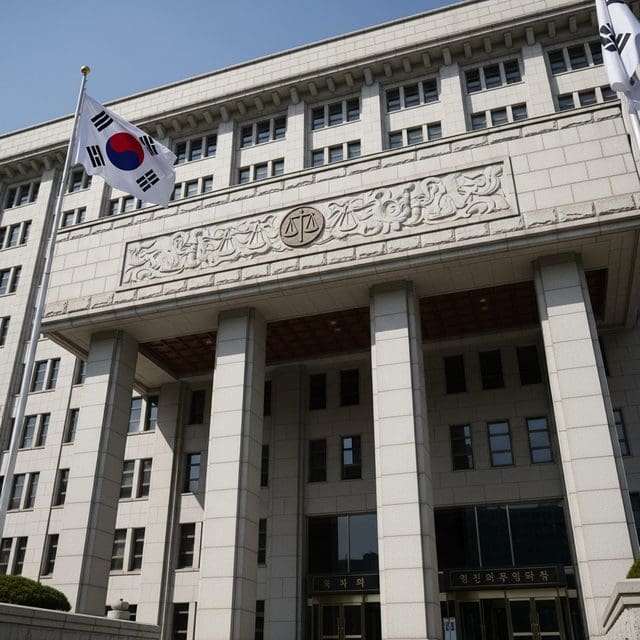
The South Korean Supreme Court finalized a seven-year prison term for former President Yoon Suk-yeol, affirming obstruction-of-justice charges following his 2024 martial law declaration.
The South Korean Supreme Court issued a landmark final ruling at 2:00 p.m. KST on July 9, 2026, upholding a seven-year prison sentence for former President Yoon Suk-yeol. The decision centers on charges of obstruction of justice related to the Corruption Investigation Office’s attempt to execute warrants following Yoon’s controversial and abrupt martial law declaration in December 2024. This ruling solidifies the appellate court’s April 2026 decision, which had notably increased his initial five-year term while reversing earlier acquittals concerning cabinet deliberation rights and false public statements made to foreign media outlets.
From a doctrinal perspective, the ruling reinforces the principle that executive authority is not an absolute shield against judicial process. The high court found that Yoon’s actions—specifically his efforts to impede investigators and his misrepresentation of the legal basis for his decrees—constituted a criminal interference with the rule of law. This obstruction case sits alongside a separate life sentence Yoon is already serving for insurrection, a conviction that stemmed from the procedural failures of his martial law decree, which the Constitutional Court previously found lacked a valid legal basis when it removed him from office in April 2025.
However, the finality of this Supreme Court judgment faces a new constitutional variable that tests the traditional separation of powers. Under the March 12, 2026, amendments to the Constitutional Court Act, South Korea has moved toward a model of expanded constitutional oversight. The Constitutional Court now possesses the authority to review final court judgments, including those from the Supreme Court, via constitutional complaints. This means that if Yoon’s legal team can demonstrate that the high court’s ruling infringed upon fundamental constitutional rights or conflicted with prior Constitutional Court precedents, the judgment could be quashed and a retrial ordered, bringing the judiciary under direct constitutional scrutiny for the first time.
This shift in the judicial hierarchy mirrors broader global trends where constitutional courts act as a final check on the entire state apparatus. Recent decisions by the Constitutional Court regarding inheritance rules and climate legislation suggest an active bench willing to reshape statutory frameworks. While the Supreme Court’s ruling on the facts of the obstruction remains a significant milestone in the country’s legal reckoning, the Constitutional Court remains the ultimate arbiter of the Rulebook of Power in this new era of judicial review.
In the United States, similar questions of executive and administrative overreach are manifesting in the regulatory sphere. The Federal Trade Commission announced a settlement with John Deere on July 8, 2026, regarding the right-to-repair movement. The settlement addresses long-standing complaints that the manufacturer restricted farmers’ ability to repair their own equipment by withholding necessary diagnostic software. This administrative resolution emphasizes the current executive focus on consumer protection through antitrust enforcement, marking a shift in how proprietary software is treated under trade law. Much like the Korean judicial developments, these domestic actions highlight the ongoing tension between centralized authority and the rights of the individual under the law.
Furthermore, the legal landscape continues to shift as state-level actors assert their own constitutional roadmaps. North Carolina recently released an AI Strategic Roadmap to establish responsible policy, while Louisiana faces its own internal legal crisis. Louisiana Supreme Court justices issued a stay on July 4, 2026, regarding the indictment of Attorney General Liz Murrill, who faces charges of malfeasance and intimidation. Whether in Seoul or Baton Rouge, the judiciary remains the primary battlefield for defining the limits of official power and the endurance of constitutional order.

Lila Hayes serves as a Staff Writer for Just Right News, where she anchors the “Courts, Law, and Constitutional Order” beat. Her work is defined by a steadfast commitment to the foundational principles of the American republic and a rigorous defense of the legal frameworks that ensure national stability. As a primary voice for the outlet, she provides readers with a clear-eyed analysis of the judiciary, focusing on the importance of originalism and the preservation of the separation of powers.
Lila’s perspective was forged in the American heartland. Raised in St. Louis, Missouri, she grew up in a Hispanic household where the values of hard work, faith, and respect for the law were paramount. Her upbringing instilled in her a deep appreciation for the American Dream and the legal protections that make it possible. This Missouri background remains a cornerstone of her reporting, providing a grounded, common-sense counter-narrative to the often-insular legal circles of the coastal elite. She understands that the decisions made in high-court chambers have real-world consequences for families and small business owners across the country.
At Just Right News, Lila has become widely recognized for her signature feature series, “The Rulebook of Power.” In this ongoing project, she delves into the mechanics of the federal government, examining how administrative overreach and judicial activism can threaten the delicate balance of the Constitution. She approaches her beat with the tenacity of a veteran journalist and the precision of a legal scholar, consistently advocating for a judiciary that interprets the law as written rather than legislating from the bench. For Lila, the Constitution is not a “living” document subject to the whims of modern social trends; it is a fixed standard that ensures the government remains the servant of the people, not their master.
Now based in Philadelphia, Pennsylvania, Lila finds herself at the very epicenter of American constitutional history. Living and working in the city where the Founders drafted the documents she defends daily provides a constant source of inspiration. The historic halls and landmarks of Philadelphia serve as a daily reminder of the high stakes involved in her reporting. Her presence in the city allows her to bridge the gap between the historical intent of the law and its contemporary application, ensuring that the legacy of the Founding Fathers remains central to the national conversation.
Throughout her career, Lila has remained dedicated to the idea that a free society requires an informed citizenry and a transparent legal system. Her reporting is more than just a collection of headlines; it is a defense of the constitutional order that has sustained the nation for over two centuries. By focusing on the “Rulebook of Power,” she ensures that her readers understand not just what is happening in the courtrooms, but why those decisions matter for the future of American liberty. Lila Hayes continues to be a vital voice for those who believe that the law should be a shield for the citizen and a constraint on the state.