

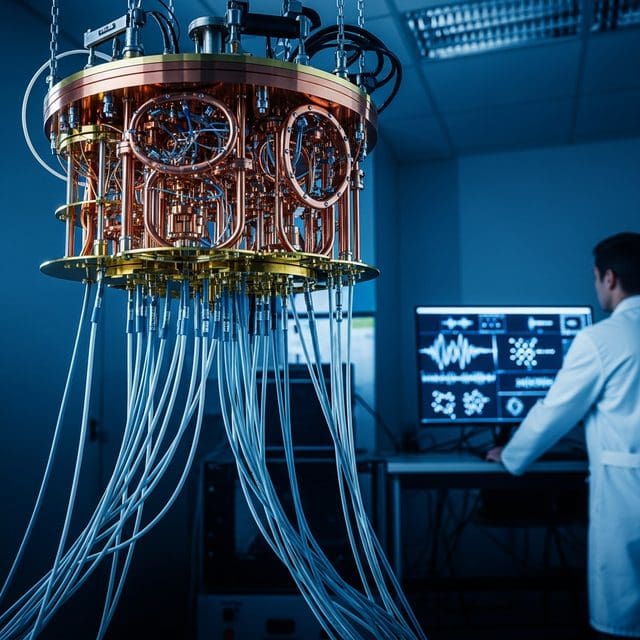
Recent breakthroughs in dark matter detection and fusion modeling are being met with a deepening crisis of confidence regarding corporate quantum computing claims and data transparency.
The frontier of quantum physics is currently a landscape of stark contrasts, where genuine scientific milestones in energy and particle detection are being met with a deepening crisis of confidence in corporate-led hardware development. This week, the pursuit of the ‘Majorana’ qubit—the cornerstone of Microsoft’s quantum ambitions—faced its fifth formal challenge in the journal Nature, raising fundamental questions about the transparency of Silicon Valley’s scientific claims. As the race for technological supremacy intensifies, the friction between private sector speed and the traditional American value of rigorous, verifiable truth has reached a fever pitch.
While Microsoft maintains a 2029 target for a commercially viable quantum computer, a peer-reviewed critique by Henry Legg of St Andrews argues that the company’s foundational 2025 paper misreported outcomes from its analysis code. The critique suggests that broader datasets from the project resemble random noise rather than the clear spectral gaps necessary for quantum stability. This dispute is not merely academic; it strikes at the heart of whether the decentralized, competitive American innovation model can maintain its integrity when billions in capital are at stake. Microsoft executives, including Chetan Nayak, have defended the work by comparing the current skepticism to early doubts about the possibility of flight, yet the pattern of editorial flags and retractions continues to shadow the program.
Contrasting this corporate friction are significant achievements from the nation’s research laboratories and academic institutions. Scientists at Oak Ridge National Laboratory, working alongside IBM and the Cleveland Clinic, successfully used quantum processors to calculate nine molecular configurations of fusion fuel materials. This represents a tangible step toward solving the clean energy puzzle, demonstrating that even today’s imperfect quantum hardware can tackle real-world materials science that remains beyond the reach of traditional supercomputers. By modeling these configurations, the team has provided a blueprint for how quantum systems might eventually stabilize the volatile environments required for sustainable fusion power.
In the realm of fundamental physics, Rice University theorists have proposed a novel detector known as SQWARE (Semiconductor-Quantum-Well Axion Radiometer Experiment). By utilizing stacks of semiconductor quantum wells forming magnetoplasmonic cavities, researchers aim to capture axions—hypothetical particles that many physicists believe make up the dark matter that constitutes most of the universe’s mass. This approach bridges the gap between condensed matter physics and cosmology, offering a path to detect particles in the THz range that have eluded traditional cavity haloscopes. Lead researcher Jaanita Mehrani noted that the project repurposes well-studied materials for a revolutionary new application, embodying the spirit of American ingenuity by finding new utility in established science.
Furthermore, the Fraunhofer ILT in Aachen has pushed the boundaries of hardware control, developing a laser-optical system capable of managing 2,000 Rydberg atoms with submicrometer precision. This level of control is essential for the scalability of quantum computers, ensuring that individual atoms can be manipulated without disturbing the delicate state of the entire system. Meanwhile, the University of Santiago has identified a quantum vacuum phenomenon that could allow for chemical bond breaking with significantly reduced energy, a discovery that could revolutionize industrial manufacturing and chemical processing.
These developments underscore a pivotal moment for national sovereignty and technological leadership. As the U.S. administration commits $2 billion toward a 2028 goal for a scientific quantum system, the friction between peer-reviewed rigor and proprietary corporate roadmaps will determine who leads the next century. For the American public, the promise of quantum-enhanced medicine, secure communications, and limitless energy depends on a foundation of verifiable truth. The current week in physics proves that while the potential for discovery is boundless, the path forward requires a steadfast commitment to the transparency that has always been the hallmark of Western scientific progress.

Mason Reed serves as a Staff Writer for Just Right News, where he spearheads the Future Frontiers & Special Projects desk. In an era defined by rapid technological shifts and evolving social landscapes, Mason provides a steady, principled voice, examining the innovations of tomorrow through the lens of traditional American values. His work is most prominently featured in his signature series, “The Next Horizon,” where he explores the intersection of emerging technology, national sovereignty, and the preservation of individual liberty.
A native of San Diego, California, Mason’s worldview was shaped by the unique culture of his hometown. Growing up in a region defined by its strong military presence and its history of maritime industry, he developed a deep-seated respect for the institutions that provide national stability and the entrepreneurial spirit that drives the American economy. This upbringing instilled in him a belief that true progress is not found in discarding the past, but in building upon a foundation of proven principles. His reporting often reflects this San Diego influence, emphasizing the importance of a robust national defense and the necessity of maintaining a competitive edge in the global marketplace.
Now based in San Francisco, Mason operates from the heart of the world’s technological engine. Living and working in the Bay Area provides him with a front-row seat to the advancements—and the ideological challenges—emanating from Silicon Valley. While many in the region embrace a “move fast and break things” mentality, Mason’s reporting serves as a vital counterweight. He offers Just Right News readers a “boots on the ground” perspective, documenting how radical local policies and the concentration of tech power impact the everyday lives of citizens. His proximity to the industry allows him to cut through the marketing jargon of big tech to uncover the real-world implications for privacy, free speech, and the nuclear family.
In his “Future Frontiers” beat, Mason tackles complex subjects ranging from the ethics of artificial intelligence to the burgeoning private space race. He approaches these topics with a healthy skepticism toward centralized bureaucracy, championing instead the decentralized innovations that empower individuals. Through “The Next Horizon,” he highlights the pioneers and thinkers who are working to ensure that the future remains a place where human dignity and constitutional rights are protected. He believes that the rapid pace of change requires more than just technical expertise; it requires a moral compass rooted in the Western tradition.
Throughout his tenure at Just Right News, Mason has remained committed to the idea that the future is something to be shaped, not merely accepted. His writing is characterized by a rigorous defense of American exceptionalism and a belief that the country’s best days lie ahead, provided it remains true to its founding ideals. Whether he is investigating the impact of automation on the American workforce or profiling the next generation of aerospace engineers, Mason Reed ensures that his readers are equipped with the insights they need to navigate a changing world with confidence and clarity.