

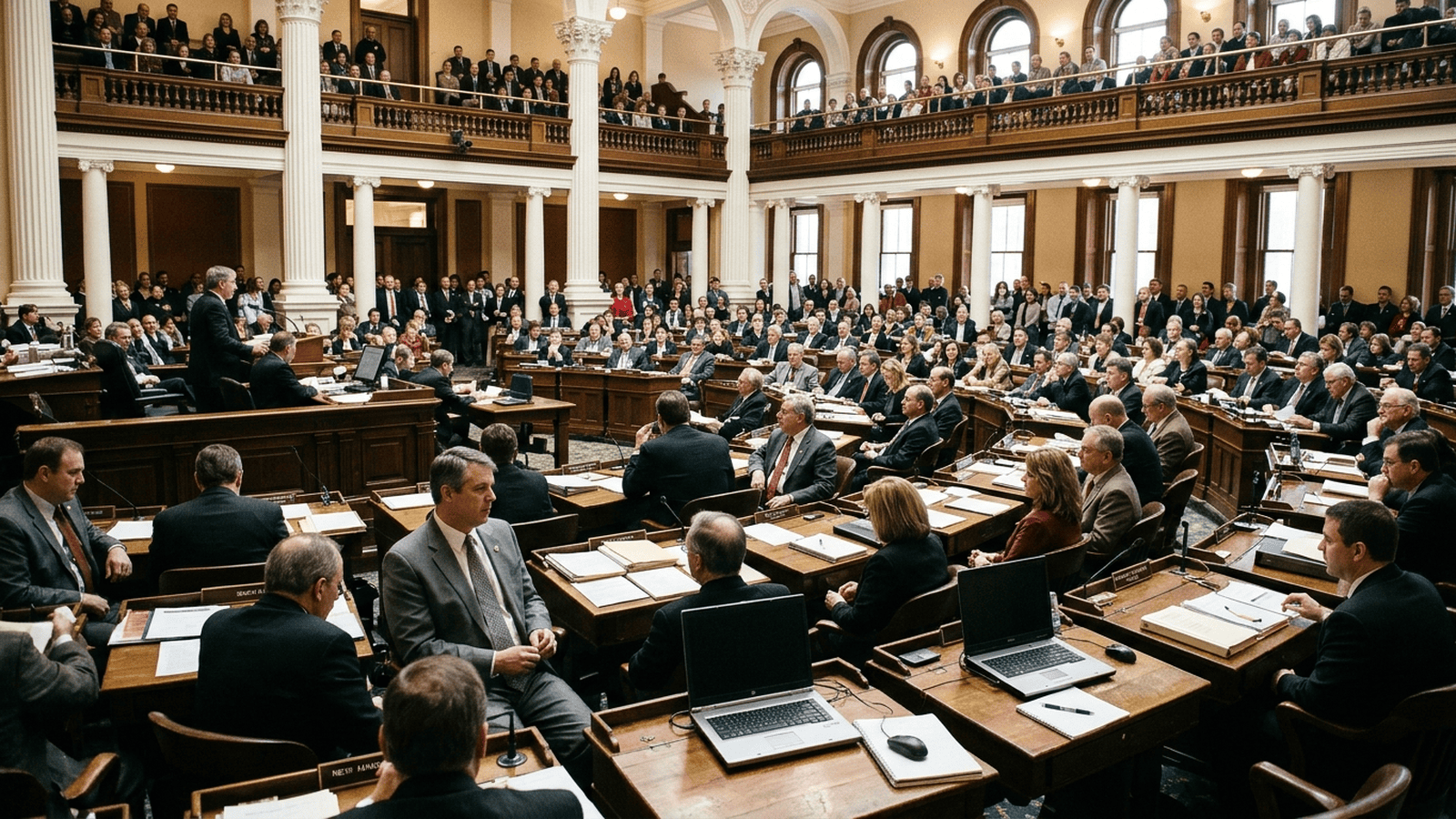
In 2010, New Hampshire Republicans won overwhelming majorities in both legislative chambers even as Democratic Gov. John Lynch won reelection, creating divided government in the United States. The new leadership reshaped the legislative agenda, passed a budget over Lynch’s veto, and showed how quickly statehouse control could shift again.
TLDR: New Hampshire Republicans captured 298 of 400 House seats and 19 of 24 Senate seats in 2010, while Democratic Gov. John Lynch won another term. The new majority changed chamber leadership and priorities, overrode Lynch’s budget veto, and lost legislative control again in 2012.
New Hampshire’s 2010 election turned a narrow Democratic governing advantage into a sweeping Republican legislative majority. On November 2, voters elected Democrat John Lynch to a fourth term as governor while also sending Republicans back to the State House in force. Republicans gained both chambers, reversing the Democratic majorities established in 2006. The split outcome reflected voters making distinct choices about the governor and local legislative representation, rather than one party winning every level of state government.
The scale of the House result was striking. Republicans won 298 of the 400 seats, while Democrats held 102. In the 24-member Senate, Republicans took 19 seats to the Democrats’ five. The outcome followed two years of national economic strain and debate over federal health care legislation, taxes, and the reach of government. New Hampshire’s large, part-time legislature made the change especially visible: hundreds of newly elected representatives would help set the state’s agenda. House members represent small districts and serve short terms, so one election can replace a substantial share of the chamber and quickly alter its political balance.
The results produced divided government, not a unified Republican administration. Lynch won reelection with about 53 percent of the vote, while Republicans controlled the House and Senate. In January 2011, Republicans selected William O’Brien as House speaker and Peter Bragdon as Senate president. The new leaders controlled committee assignments and floor schedules, influencing which proposals received hearings and votes. That authority mattered when the governor and lawmakers disagreed: legislators could pass bills and negotiate budgets, while Lynch retained his veto. Committee chairs also shaped how bills were examined and amended before reaching the full chamber.
Republican leaders had campaigned on limiting government spending and opposing tax increases. The new majority moved to reduce the state budget and reconsider policies adopted under Democratic control. It also passed a right-to-work bill, which Lynch vetoed in June 2011. The House and Senate could not muster the votes to override him. The episode showed both the reach and limits of the realignment: legislative control let Republicans advance a priority, but the governor’s veto blocked it. A veto forced lawmakers to consider whether they could assemble the supermajority required to enact a measure without the governor’s approval.
The change also brought disputes over legislative rules and the relationship with the executive branch. O’Brien’s leadership drew attention for its assertive approach to committee procedure and its confrontations with Lynch. Republicans approved a biennial budget that cut spending compared with the prior plan. Lynch vetoed it, but lawmakers overrode his veto in June 2011. The budget reduced state expenditures and aid to some local services, drawing criticism from Democrats and affected communities. Because the budget allocates public money across agencies and local aid, its adoption made the new majority’s policy consequences tangible beyond the State House.
The 2010 turnover did not permanently settle New Hampshire politics. Democrats regained control of both legislative chambers in the 2012 election, demonstrating how quickly power could shift in a state with short legislative terms and closely watched contests. The episode showed how elections can remake committee leadership and governing priorities without changing the governor’s party. Subsequent campaigns continued to debate spending, labor policy, and the balance between executive vetoes and legislative majorities. The quick reversal underscored that legislative control is not necessarily durable: lawmakers’ decisions and the next election can redirect state policy within a few years.

Dylan Brooks serves as the Senior Correspondent for Statehouses and Local Governance at Just Right News, where he brings a principled, constitutionalist lens to the often-overlooked machinery of state-level politics. As the lead voice behind the acclaimed feature series “Fifty Laboratories of Power,” Dylan has dedicated his career to the idea that the most impactful governance happens closest to home. His reporting consistently champions the Tenth Amendment, exploring how individual states can serve as testing grounds for innovative, conservative policy solutions that prioritize personal liberty and fiscal responsibility.
A native of Des Moines, Iowa, Dylan’s journalistic philosophy was forged in the heart of the American Midwest. Growing up in a community where local school board meetings and town halls were the bedrock of civic life, he developed a deep appreciation for the “retail politics” of the heartland. This upbringing instilled in him a fundamental belief that the American experiment is best preserved when power is decentralized. He carries the values of his Iowa roots into every assignment, maintaining a healthy skepticism of federal overreach and a steadfast commitment to the concerns of everyday citizens over the interests of the administrative state.
Now based in Madison, Wisconsin, Dylan operates from one of the nation’s most pivotal political battlegrounds. His location in a state capital known for its rigorous policy debates allows him to provide Just Right News readers with a front-row seat to the legislative process. From Madison, he tracks the ripple effects of statehouse decisions on local municipalities, ensuring that the connection between high-level policy and community impact is never lost. His work often highlights the success of conservative governors and legislatures in fostering economic growth, protecting parental rights, and securing the integrity of local institutions.
As an African American man in the conservative media landscape, Dylan offers a vital perspective on how limited government and free-market principles empower individuals and families. He frequently reports on how deregulation and school choice initiatives provide new avenues for success in underserved communities, challenging the monolithic narratives often presented by legacy media outlets. Dylan’s work is characterized by a commitment to the facts and a refusal to shy away from the complex realities of modern governance.
Throughout his tenure at Just Right News, Dylan has become a trusted authority for readers who value a rigorous, principled approach to the news. Whether he is dissecting a complex state budget or profiling a local grassroots movement, his goal remains the same: to provide the American public with the information they need to hold their local leaders accountable. By focusing on the “Fifty Laboratories of Power,” Dylan Brooks ensures that the vital work being done in statehouses across the country receives the national attention it deserves, always through a lens that respects the traditions and sovereignty of the American people.