

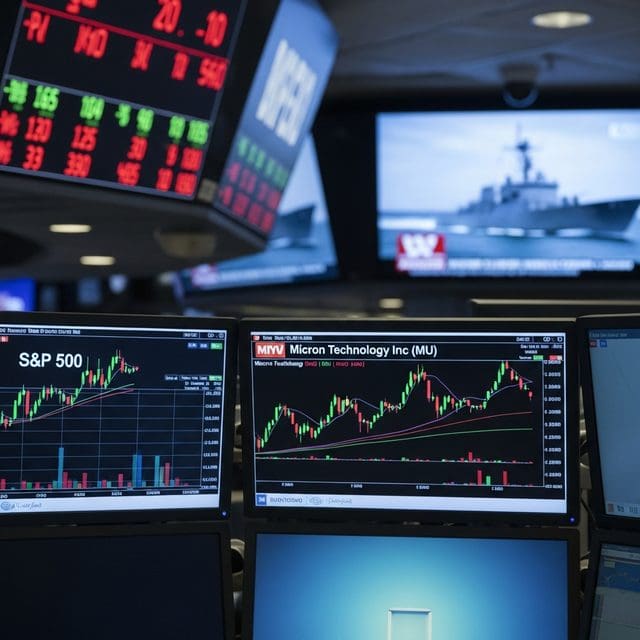
U.S. equities struggled for direction as the S&P 500 dipped 0.33 percent, balancing a fragile rebound in semiconductor stocks against escalating tensions between the United States and Iran.
The American taxpayer is once again caught in the crosscurrents of global volatility and centralized policy shifts. On Thursday, the S&P 500 (SPY) slipped 0.33 percent, a move that underscores the persistent fragility of a market grappling with renewed conflict in the Middle East and a tech sector that has yet to find a definitive floor. While Nasdaq 100 futures initially signaled a rebound led by chipmakers, the reality for Main Street remains one of heightened risk and erratic price action as the broader Dow Jones Industrial Average hovered along the flatline.
Geopolitical friction took center stage following U.S. strikes on Iran, a response to attacks on commercial shipping in and around the Strait of Hormuz. While President Trump suggested an openness to a deal in recent phone calls, his earlier declarations that the ceasefire was over have injected a heavy risk premium into the energy sector. Brent crude settled near $76.99 per barrel, down 1.3 percent on the day, while WTI slipped to $72.64. For the household budget, these swings in energy costs act as an invisible tax, complicating long-term financial planning even as oil prices ease slightly from their initial spike.
In the technology complex, the VanEck Semiconductor ETF (SMH) rose 1.8 percent, led by a 3.4 percent gain in Micron and a 2.4 percent lift for Sandisk. However, this bounce must be viewed through the lens of recent devastation. Micron and its peers, including Samsung and SK Hynix, have recently shed more than 20 percent of their value from peak levels, effectively entering a bear market. This sector-wide retreat has erased roughly $350 billion in market value from Micron alone since its peak, serving as a stark reminder that even the most hyped artificial intelligence plays are not immune to the laws of fiscal gravity and crowded positioning.
On the international front, the fiscal landscape remains equally complex. In Europe, the Stoxx 600 edged up a mere 0.1 percent, while Asian markets showed a disjointed performance. Japan’s Nikkei 225 closed 1.4 percent higher, but the Hong Kong Hang Seng fell 0.5 percent. Of note for global stability, NATO Secretary-General Mark Rutte has demanded concrete defense spending plans from member states during the summit in Ankara. This push for fiscal accountability among allies coincides with the U.S. decision to license Patriot air defense systems for overseas manufacture, a move that shifts the industrial burden but keeps the American taxpayer tethered to foreign entanglements.
Corporate developments also signaled a shift toward consolidation and digital expansion. AEON expanded its AEON Pay service into Zambia, integrating with Airtel and MTN for digital asset settlement, while Skanska divested a major Swedish residential project for SEK 570 million. These moves reflect a global economy attempting to find footing despite the volatility. Meanwhile, the Colombian Ministry of Finance cleared significant receivables for Ecopetrol, and OCI N.V. received a substantial all-cash buyout offer, highlighting that while the indices may be red, capital continues to seek out specific pockets of value.
Closer to home, the internal mechanics of the market reveal a struggle between institutional momentum and retail caution. While some analysts maintain optimistic year-end targets for the S&P 500 near the 8,000 mark, the current environment of 2 to 3 percent intraday swings in Nasdaq futures suggests that the road ahead is anything but stable. For the working family, the takeaway from today’s session is clear: while the headlines focus on a minor bounce in chip stocks, the underlying economy remains vulnerable to the twin pressures of geopolitical instability and a cooling tech cycle that has yet to prove its long-term resilience.

Jordan Lee serves as the Senior Correspondent for Wall Street, Finance, and Monetary Systems at Just Right News. Based in the heart of the world’s financial capital, New York City, Lee brings a sharp, principled eye to the complex mechanisms that drive the global economy. His reporting is defined by a commitment to fiscal responsibility, the defense of the free market, and a deep-seated belief that a transparent monetary system is the bedrock of a free society.
Raised in Portland, Oregon, Lee’s perspective was forged in a city that has undergone significant cultural and economic shifts. His upbringing in the Pacific Northwest instilled in him a profound appreciation for the industriousness of small business owners and the importance of local economic stability. Watching the evolution of his hometown’s landscape sparked an early interest in how federal fiscal policy and large-scale financial trends eventually trickle down to the average citizen. This background provides him with a unique vantage point; he understands the growing disconnect between the policy-making elite and the reality of Main Street, a theme that frequently resonates throughout his work.
Now operating from his base in New York City, Lee bridges the gap between the high-stakes trading floors of Manhattan and the households of everyday Americans. He views the financial sector not merely as a collection of numbers and tickers, but as a vital engine of American prosperity that requires constant vigilance and accountability. His reporting often highlights the dangers of centralized financial control and the necessity of maintaining a system that rewards merit, risk-taking, and innovation.
As the creator and lead of the featured series, “The Invisible Economy,” Lee pulls back the curtain on the often-opaque world of monetary systems. He specializes in translating the dense jargon of central banking and international finance into actionable insights for the Just Right News audience. His work explores the “invisible” forces—such as inflationary pressures, regulatory creep, and the expansion of the administrative state—that erode the purchasing power of American families. By focusing on these systemic issues, Lee empowers readers to understand the hidden forces shaping their financial independence.
Lee’s journalistic philosophy is rooted in a steadfast commitment to traditional American values. As an Asian American professional who has navigated the competitive corridors of the financial world, he is a vocal advocate for meritocracy and the preservation of the American Dream. He believes that a stable currency and a predictable regulatory environment are essential for national sovereignty and individual liberty. His reporting frequently warns against the risks of government overreach in the private sector, arguing that the most effective solutions to economic challenges arise from competition and individual enterprise rather than bureaucratic mandates.
At Just Right News, Jordan Lee remains dedicated to providing a clear-eyed defense of the taxpayer. Whether he is analyzing market volatility or investigating the long-term implications of national debt, his mission is to provide the truth about where the money is going and what it means for the future of the country. Through his rigorous analysis and principled stance, Lee has become a trusted voice for those who value a strong, sovereign, and fiscally sound America.