

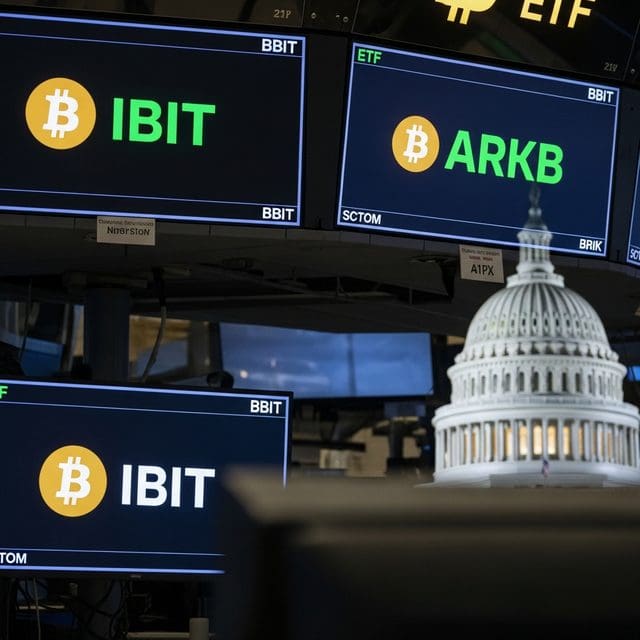
U.S. spot Bitcoin ETFs recorded $265.69 million in net inflows this week, signaling a major institutional shift as the Senate debates Bitcoin’s status as a decentralized digital commodity.
Institutional appetite for Bitcoin infrastructure has demonstrated a significant resurgence this week, as U.S. spot Bitcoin ETFs recorded $265.69 million in net inflows on Monday, July 6. This figure represents the largest single-day inflow in over a month, marking a decisive reversal from the persistent outflows that characterized the market throughout late June. The data suggests that large-scale allocators are utilizing current price levels to accumulate positions, even as the spot market remains in a rangebound state near the $63,200 mark. This movement reflects a growing confidence in the underlying protocol’s resilience and its increasing integration into the traditional financial architecture of the United States.
BlackRock’s IBIT remains the primary engine for this institutional adoption, accounting for $209.40 million of the total inflows. Other vehicles, such as ARKB and Grayscale’s mini BTC fund, also saw positive movement, adding $32.98 million and $42.25 million respectively. Notably, the legacy Grayscale Bitcoin Trust (GBTC) was the sole outlier, continuing to experience outflows of $44.45 million. This rotation indicates a preference for newer, low-fee institutional products that provide streamlined access to Bitcoin’s underlying value without the complexities of direct self-custody. Furthermore, Ether ETFs also turned positive the same day, with BlackRock’s ETHA alone attracting $23.29 million, indicating a broader institutional risk-on appetite across major digital-asset commodity products.
Parallel to these capital flows, the U.S. Senate is navigating a high-stakes legislative window following a missed July 4 deadline for a comprehensive crypto bill. Lawmakers now have approximately three weeks to resolve disputes regarding the classification of digital assets after they return from the July 13 recess. The proposed legislation hinges on the concept of “decentralized control,” a standard that would officially designate Bitcoin as a “digital commodity” under the jurisdiction of the Commodity Futures Trading Commission (CFTC). This designation is critical for American digital sovereignty, as it recognizes that no single person or group can unilaterally alter the Bitcoin protocol, thereby protecting the network from the type of centralized corporate overreach seen in other technology sectors.
While Bitcoin easily clears the bar for decentralization, other assets like Ether may face a “maturity test” to determine their status. The bill aims to provide a clear regulatory lane that separates decentralized commodities from investment contracts. This distinction is expected to reduce the “regulatory spillover” risk that has historically plagued the sector, allowing Bitcoin to operate under a predictable framework that rewards its decentralized engineering rather than subjecting it to the managerial oversight rules typically reserved for corporate securities. Such a move would cement Bitcoin’s regulatory lane and simplify compliance for the exchanges, custodians, and ETF issuers that form the backbone of the new digital economy.
Further complicating the regulatory landscape is the Securities and Exchange Commission’s (SEC) reported plan to introduce “Regulation Crypto.” This proposal, expected as early as this month, seeks to create a safe-harbor regime for developers initially offering crypto investment contracts. While Bitcoin itself is not an issued security and remains outside this specific scope, the SEC’s move toward a structured regime for other tokens could clarify the jurisdictional boundary between the SEC and the CFTC. For Bitcoin holders, this clarity is a net positive, as it isolates the protocol from the legal volatility surrounding smaller, more centralized projects. The idea, first outlined by SEC Chairman Paul Atkins, would allow for limited fundraising while developers actively back away from managerial efforts to achieve decentralization.
Despite the flurry of activity in the ETF and legislative sectors, the Bitcoin base-layer protocol remains stable. No material consensus changes or major client releases were reported this week, reflecting the protocol’s characteristic resistance to rapid, top-down alteration. This technical stability is precisely what attracts institutional capital; the immutability of the network provides a reliable foundation for the financial products now seeing hundreds of millions in weekly inflows. For those monitoring paper portfolios on platforms like Alpaca, the current signals suggest a robust institutional floor is forming, supported by both market demand and emerging legislative recognition of Bitcoin’s unique decentralized status. As the “New Cold War” for digital leadership intensifies, the protection of these decentralized protocols stands as a bulwark for individual liberty and constitutional values.

Ryan Mitchell serves as a Staff Writer for Just Right News, where he anchors the desk for Cyber, Technology Policy, and Digital Sovereignty. In an era where the digital landscape has become as much a battlefield as any physical territory, Ryan provides a critical conservative lens on the forces shaping the future of American innovation and national security. His work is defined by a commitment to the idea that American leadership in the digital age is not just a matter of economic success, but a necessity for the preservation of global liberty.
Born and raised in Austin, Texas, Ryan’s perspective is deeply rooted in the Lone Star State’s tradition of independence and skepticism of centralized authority. Growing up in a city that transformed from a quiet state capital into a global technology hub, he witnessed firsthand the disruptive power of the tech industry. This upbringing instilled in him a firm belief in free-market principles and the necessity of protecting individual liberties from both government overreach and corporate overstep. His Texan background serves as a foundational compass, guiding his reporting toward stories that emphasize national resilience and the preservation of constitutional values in an increasingly virtual world.
Now based in San Francisco, California, Ryan operates from the epicenter of the very industry he scrutinizes. Living and working in the heart of Silicon Valley allows him to provide “boots on the ground” reporting that few conservative journalists can match. He navigates the cultural and political complexities of the Bay Area to bring Just Right News readers an inside look at the boardrooms and coding labs where the next generation of digital policy is forged. For Ryan, being stationed in San Francisco is a strategic choice; it allows him to challenge the prevailing ideological monoculture of the tech elite from within their own backyard, ensuring that the concerns of middle America are represented in the conversation about our digital future.
His beat—Cyber, Technology Policy, and Digital Sovereignty—covers the high-stakes world of data privacy, artificial intelligence, and the infrastructure of the modern web. Ryan is particularly focused on the concept of digital sovereignty, arguing that for a nation to remain truly free, it must maintain control over its own technological destiny and critical infrastructure. He frequently explores how international regulations and domestic policies impact the ability of American firms to compete without sacrificing the privacy or security of their citizens.
Central to his current body of work is his featured series, “The New Cold War.” Through this project, Ryan examines the escalating technological rivalry between the United States and its global adversaries. He delves into the complexities of state-sponsored hacking, the global race for semiconductor dominance, and the ideological struggle to define the rules of the internet. Ryan views this competition not merely as a commercial race, but as a fundamental defense of Western values against authoritarian digital models. Through his rigorous reporting and principled analysis, Ryan Mitchell ensures that the readers of Just Right News stay informed about the invisible forces defining the 21st century, always advocating for a future where technology serves the cause of freedom.