

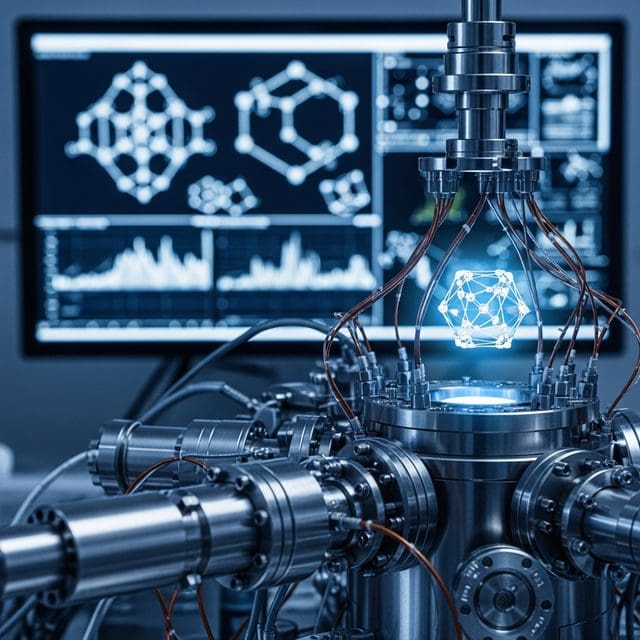
Researchers have deployed a machine-learning pipeline to identify hundreds of new superconductor candidates, promising to eliminate the cooling bottlenecks that currently hinder quantum computing and energy infrastructure.
The long-standing pursuit of room-temperature superconductivity has entered a robust new era as researchers integrate machine learning with high-level quantum mechanical calculations. On July 7, 2026, reports surfaced detailing a methodological shift that has already yielded two new superconducting materials, YRu₃B₂ and LuRu₃B₂. While these specific alloys operate at temperatures near absolute zero—0.81 K and 0.95 K respectively—the significance lies in the scalable discovery pipeline that identified them. This AI-supercharged search aims to conquer the hardware bottlenecks that currently tether advanced electronics to expensive, energy-intensive cryogenic cooling systems.
For decades, the primary hurdle in materials science has been the computational intensity required to simulate quantum behaviors. Brute-force simulations are often too slow to explore the near-infinite combinations of the periodic table. By training AI models on quantum-geometry metrics, the SuperC consortium has demonstrated an 86% precision rate in identifying stable candidates. This approach allowed the team to screen thousands of potential superconductors, ultimately identifying 741 stable candidates. This is a fundamental workflow change, moving the field from accidental discovery toward intentional, algorithmic design that can be adopted rapidly across condensed-matter and materials groups working on qubits and Josephson junctions.
The implications for American technological sovereignty and decentralized innovation are substantial. Currently, superconducting electronics and quantum computers are dependent on massive dilution refrigerators. Achieving superconductivity at higher temperatures—moving closer to the ambient-pressure record of 151 K set by the University of Houston earlier this year—would allow for zero-resistance electricity transmission and more accessible quantum hardware. Such a leap would drastically reduce the cost of operating the next generation of computing clusters, removing the centralized bureaucracy of high-cost cooling and allowing innovation to flourish in smaller, more distributed labs. This shift is further supported by the development of triplet superconductor candidates like NbRe, which carry both charge and spin currents with zero resistance at 7 K, offering a stable platform for low-energy spintronic devices.
Beyond the search for new chemistry, physicists are exploring the macroscopic limits of quantum effects. Recent findings at TU Wien have confirmed high degrees of entanglement within centimeter-scale “strange metal” crystals. This discovery suggests that quantum properties, typically reserved for subatomic particles, can be harnessed in bulk materials large enough to hold in one’s hand. This pushes entanglement from microscopic systems into mesoscopic condensed-matter systems, providing a potential route to robust quantum sensors or registers embedded directly in crystalline solids. When paired with AI-guided material design, these findings suggest a future where quantum effects are a feature of everyday materials rather than fragile laboratory anomalies.
Technological control is also extending into the thermal realm. A new material reported this week allows researchers to “program” heat, directing thermal radiation and switching modes without continuous power input. This solid-state metamaterial provides a concrete route to smarter infrared sensors and higher-efficiency energy systems. Precise, passive control of heat flow is critical for maintaining the delicate environments required by cryogenic quantum computers and superconducting detectors. By treating superconductors as “quantum metamaterials,” where nanoscale structure engineering determines behavior, scientists are creating a design frame that complements the AI search.
As the race for room-temperature superconductors continues, the focus is shifting toward a holistic integration of AI, quantum sensing, and structural engineering. These discoveries do not just speed up the clock; they redefine the boundaries of what is possible in solid-state physics. By leveraging these emerging technologies, researchers are building the backbone for a future where energy is transmitted without loss and quantum computation is as portable as a modern laptop. This ensures that the next frontier of innovation remains firmly within reach of independent innovators and the private sector, free from the constraints of centralized cryogenic infrastructure.

Mason Reed serves as a Staff Writer for Just Right News, where he spearheads the Future Frontiers & Special Projects desk. In an era defined by rapid technological shifts and evolving social landscapes, Mason provides a steady, principled voice, examining the innovations of tomorrow through the lens of traditional American values. His work is most prominently featured in his signature series, “The Next Horizon,” where he explores the intersection of emerging technology, national sovereignty, and the preservation of individual liberty.
A native of San Diego, California, Mason’s worldview was shaped by the unique culture of his hometown. Growing up in a region defined by its strong military presence and its history of maritime industry, he developed a deep-seated respect for the institutions that provide national stability and the entrepreneurial spirit that drives the American economy. This upbringing instilled in him a belief that true progress is not found in discarding the past, but in building upon a foundation of proven principles. His reporting often reflects this San Diego influence, emphasizing the importance of a robust national defense and the necessity of maintaining a competitive edge in the global marketplace.
Now based in San Francisco, Mason operates from the heart of the world’s technological engine. Living and working in the Bay Area provides him with a front-row seat to the advancements—and the ideological challenges—emanating from Silicon Valley. While many in the region embrace a “move fast and break things” mentality, Mason’s reporting serves as a vital counterweight. He offers Just Right News readers a “boots on the ground” perspective, documenting how radical local policies and the concentration of tech power impact the everyday lives of citizens. His proximity to the industry allows him to cut through the marketing jargon of big tech to uncover the real-world implications for privacy, free speech, and the nuclear family.
In his “Future Frontiers” beat, Mason tackles complex subjects ranging from the ethics of artificial intelligence to the burgeoning private space race. He approaches these topics with a healthy skepticism toward centralized bureaucracy, championing instead the decentralized innovations that empower individuals. Through “The Next Horizon,” he highlights the pioneers and thinkers who are working to ensure that the future remains a place where human dignity and constitutional rights are protected. He believes that the rapid pace of change requires more than just technical expertise; it requires a moral compass rooted in the Western tradition.
Throughout his tenure at Just Right News, Mason has remained committed to the idea that the future is something to be shaped, not merely accepted. His writing is characterized by a rigorous defense of American exceptionalism and a belief that the country’s best days lie ahead, provided it remains true to its founding ideals. Whether he is investigating the impact of automation on the American workforce or profiling the next generation of aerospace engineers, Mason Reed ensures that his readers are equipped with the insights they need to navigate a changing world with confidence and clarity.