

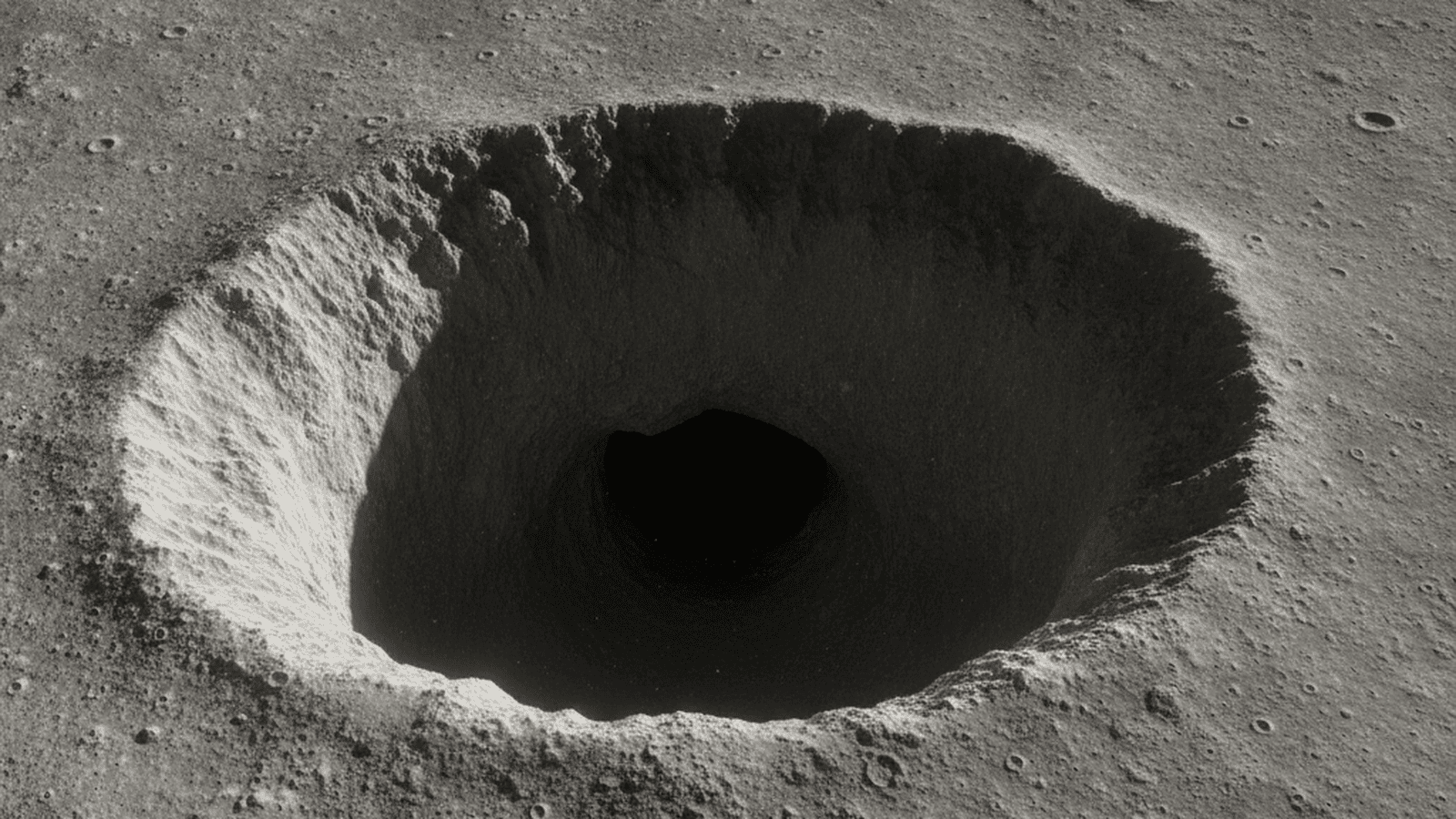
Researchers have confirmed the existence of a large underground cave on the Moon using radar data from NASA’s Lunar Reconnaissance Orbiter. Located in the Mare Tranquillitatis, the cave is a former lava tube that could provide a stable, shielded environment for future human lunar bases.
TLDR: Scientists have identified the first confirmed lunar cave, a massive underground lava tube in the Mare Tranquillitatis. Discovered via radar analysis, the cavern offers natural protection from radiation and extreme temperatures, making it a prime candidate for future astronaut shelters and long-term lunar habitation.
Researchers have officially confirmed the existence of a massive underground cave on the Moon, accessible through a deep, vertical pit in the Mare Tranquillitatis. This landmark discovery, published in the journal Nature Astronomy, represents a major breakthrough in lunar science and human exploration. By re-analyzing radar data collected over a decade ago by NASA’s Lunar Reconnaissance Orbiter (LRO), scientists have provided the first definitive evidence of an accessible lava tube beneath the lunar surface—a geological feature that has been hypothesized for decades but never before confirmed with such precision.
The cave is located at the base of the Tranquillitatis pit, which is the deepest known pit on the Moon, originally identified in 2009. This pit is essentially a “skylight,” created when a portion of a lava tube’s roof collapsed. The new analysis of radar reflections suggests that the cavern extending from the bottom of this pit is at least 40 meters wide and tens of meters long, though researchers believe it could extend for kilometers. These structures formed billions of years ago during the Moon’s active volcanic period. As molten lava flowed across the surface, the outer layers cooled and hardened into a crust, while the liquid interior continued to flow. Once the volcanic activity ceased and the lava drained away, it left behind hollow, tube-like conduits.
This subterranean discovery offers a transformative environment for future lunar exploration and long-term human habitation. The lunar surface is an incredibly hostile environment, characterized by extreme temperature fluctuations—swinging from a scorching 127 degrees Celsius during the day to a frigid minus 173 degrees Celsius at night. Furthermore, the lack of a substantial atmosphere leaves the surface exposed to a constant bombardment of solar radiation, cosmic rays, and micrometeorites. The interior of a lava tube, however, provides a naturally shielded environment where temperatures remain relatively stable and the thick basaltic ceiling acts as a robust barrier against external hazards.
The study was spearheaded by Lorenzo Bruzzone and Leonardo Carrer from the University of Trento in Italy. Their team utilized advanced signal processing techniques to re-examine data from the LRO’s Miniature Radio Frequency (Mini-RF) instrument. To validate their findings, the researchers compared the lunar radar signatures with data from terrestrial lava tubes found in Lanzarote, Spain, and Hawaii. This comparative analysis allowed them to distinguish between simple debris piles at the bottom of the pit and a genuine void extending into the lunar crust. The radar waves effectively “bounced” off the floor of the cave, confirming the presence of an open gallery.
Despite the promise of these caves, accessing them presents a formidable engineering challenge. The Tranquillitatis pit features sheer vertical walls that drop more than 100 meters to the cave floor. Future missions will likely require specialized robotic systems, such as rappelling rovers or autonomous drones, to navigate the descent and explore the interior. These missions will be crucial for assessing the structural integrity of the cave ceilings and the chemical composition of the walls. This would be a necessary precursor to any permanent human settlement.
Beyond their utility as shelters, these caves are of immense scientific value. Because the interiors have been shielded from space weathering for billions of years, they likely contain a pristine record of the Moon’s volcanic history and mineralogical evolution. Furthermore, the confirmation of this cave suggests that similar structures may exist at the lunar poles. In these permanently shadowed regions, lava tubes could potentially harbor water ice, a critical resource for sustainable human presence. This discovery marks a fundamental shift in lunar strategy, moving from surface-based habitats to utilizing the Moon’s natural geological architecture for the next phase of space exploration.

Mason Reed serves as a Staff Writer for Just Right News, where he spearheads the Future Frontiers & Special Projects desk. In an era defined by rapid technological shifts and evolving social landscapes, Mason provides a steady, principled voice, examining the innovations of tomorrow through the lens of traditional American values. His work is most prominently featured in his signature series, “The Next Horizon,” where he explores the intersection of emerging technology, national sovereignty, and the preservation of individual liberty.
A native of San Diego, California, Mason’s worldview was shaped by the unique culture of his hometown. Growing up in a region defined by its strong military presence and its history of maritime industry, he developed a deep-seated respect for the institutions that provide national stability and the entrepreneurial spirit that drives the American economy. This upbringing instilled in him a belief that true progress is not found in discarding the past, but in building upon a foundation of proven principles. His reporting often reflects this San Diego influence, emphasizing the importance of a robust national defense and the necessity of maintaining a competitive edge in the global marketplace.
Now based in San Francisco, Mason operates from the heart of the world’s technological engine. Living and working in the Bay Area provides him with a front-row seat to the advancements—and the ideological challenges—emanating from Silicon Valley. While many in the region embrace a “move fast and break things” mentality, Mason’s reporting serves as a vital counterweight. He offers Just Right News readers a “boots on the ground” perspective, documenting how radical local policies and the concentration of tech power impact the everyday lives of citizens. His proximity to the industry allows him to cut through the marketing jargon of big tech to uncover the real-world implications for privacy, free speech, and the nuclear family.
In his “Future Frontiers” beat, Mason tackles complex subjects ranging from the ethics of artificial intelligence to the burgeoning private space race. He approaches these topics with a healthy skepticism toward centralized bureaucracy, championing instead the decentralized innovations that empower individuals. Through “The Next Horizon,” he highlights the pioneers and thinkers who are working to ensure that the future remains a place where human dignity and constitutional rights are protected. He believes that the rapid pace of change requires more than just technical expertise; it requires a moral compass rooted in the Western tradition.
Throughout his tenure at Just Right News, Mason has remained committed to the idea that the future is something to be shaped, not merely accepted. His writing is characterized by a rigorous defense of American exceptionalism and a belief that the country’s best days lie ahead, provided it remains true to its founding ideals. Whether he is investigating the impact of automation on the American workforce or profiling the next generation of aerospace engineers, Mason Reed ensures that his readers are equipped with the insights they need to navigate a changing world with confidence and clarity.