

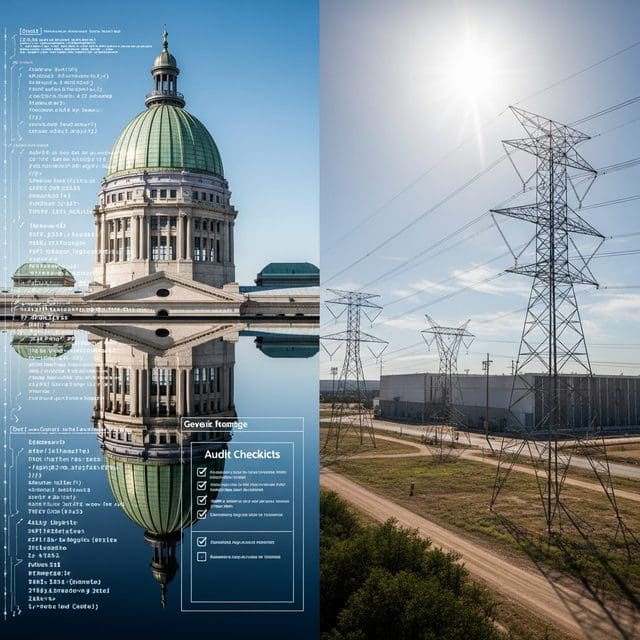
Illinois Governor JB Pritzker prepares to sign the nation’s first mandatory AI safety audit law, while Texas pivots toward aggressive energy-grid reforms to manage the massive power demands of data centers.
As the federal government continues to debate the nuances of artificial intelligence regulation, the “Fifty Laboratories of Democracy” are moving forward with distinct, localized strategies that reflect their unique regional priorities. In Illinois, Governor JB Pritzker is poised to sign SB 315, the Artificial Intelligence Safety Measures Act, which establishes the country’s most rigorous oversight regime for frontier AI models. The bill passed the General Assembly with overwhelming support, including a unanimous 110–0 vote in the House, signaling a bipartisan appetite for state-level tech accountability.
This Illinois experiment represents a significant shift from voluntary industry standards to state-enforced transparency. Under SB 315, companies generating more than $500 million in annual revenue must submit to annual third-party safety audits conducted by experts in frontier AI safety. These requirements, set to begin in earnest by 2028, oblige major labs such as OpenAI and Anthropic to publish catastrophic-risk frameworks and report “critical safety incidents” to the state within 72 hours. In cases involving imminent risk of death or serious physical harm, that reporting window shrinks to just 24 hours. The law also mandates internal whistleblower systems, ensuring that employees who flag safety risks are protected from corporate retaliation.
While tech industry trade groups like NetChoice and the CCIA have urged a veto, calling the audit mandate “unworkable” in the absence of a federal consensus, Illinois proponents view the bill as a necessary template for the nation. The enforcement mechanism is centralized within the Illinois Attorney General’s office, which can levy civil penalties of up to $1 million per violation, climbing to $3 million for repeat offenses. By eschewing a private right of action, the legislature has focused on state-led oversight rather than trial-lawyer litigation, though the law is expected to become a de facto national standard alongside existing frameworks in California and New York.
While Illinois focuses on the software and safety protocols, Texas is tackling the physical infrastructure of the AI revolution through the lens of energy independence. The Electric Reliability Council of Texas (ERCOT) and state regulators recently approved new “batching” rules for large-load interconnection. These rules specifically target the massive energy consumption of AI data centers, which have contributed to an staggering 410 GW queue of requested power. The state is shifting toward a “build the wires, the AI will follow” philosophy, investing in 765 kV extra-high-voltage networks to accommodate the load.
Governor Greg Abbott has further signaled a shift toward local self-reliance, suggesting that new data centers in rural areas should be prohibited unless they provide their own power and reuse their own water. This “bring your own power” expectation highlights the Texas approach to federalism: utilizing its unique, independent power grid to experiment with market-based solutions that ensure the AI boom does not compromise energy reliability for residential consumers. It stands in stark contrast to the regulatory-heavy approach in the Midwest, yet both states are filling a vacuum left by federal inaction.
The Illinois Senate is also advancing a broader eight-bill package targeting AI applications in mental health, school biometrics, and algorithmic rent-setting. This comprehensive architecture suggests that state legislatures are no longer waiting for a slow-moving Congress to define the rules of the digital age. By serving as policy laboratories, these states are testing which frameworks can foster innovation while maintaining local sovereignty and public safety, proving that the Tenth Amendment remains the most effective tool for addressing rapid technological change.

Dylan Brooks serves as the Senior Correspondent for Statehouses and Local Governance at Just Right News, where he brings a principled, constitutionalist lens to the often-overlooked machinery of state-level politics. As the lead voice behind the acclaimed feature series “Fifty Laboratories of Power,” Dylan has dedicated his career to the idea that the most impactful governance happens closest to home. His reporting consistently champions the Tenth Amendment, exploring how individual states can serve as testing grounds for innovative, conservative policy solutions that prioritize personal liberty and fiscal responsibility.
A native of Des Moines, Iowa, Dylan’s journalistic philosophy was forged in the heart of the American Midwest. Growing up in a community where local school board meetings and town halls were the bedrock of civic life, he developed a deep appreciation for the “retail politics” of the heartland. This upbringing instilled in him a fundamental belief that the American experiment is best preserved when power is decentralized. He carries the values of his Iowa roots into every assignment, maintaining a healthy skepticism of federal overreach and a steadfast commitment to the concerns of everyday citizens over the interests of the administrative state.
Now based in Madison, Wisconsin, Dylan operates from one of the nation’s most pivotal political battlegrounds. His location in a state capital known for its rigorous policy debates allows him to provide Just Right News readers with a front-row seat to the legislative process. From Madison, he tracks the ripple effects of statehouse decisions on local municipalities, ensuring that the connection between high-level policy and community impact is never lost. His work often highlights the success of conservative governors and legislatures in fostering economic growth, protecting parental rights, and securing the integrity of local institutions.
As an African American man in the conservative media landscape, Dylan offers a vital perspective on how limited government and free-market principles empower individuals and families. He frequently reports on how deregulation and school choice initiatives provide new avenues for success in underserved communities, challenging the monolithic narratives often presented by legacy media outlets. Dylan’s work is characterized by a commitment to the facts and a refusal to shy away from the complex realities of modern governance.
Throughout his tenure at Just Right News, Dylan has become a trusted authority for readers who value a rigorous, principled approach to the news. Whether he is dissecting a complex state budget or profiling a local grassroots movement, his goal remains the same: to provide the American public with the information they need to hold their local leaders accountable. By focusing on the “Fifty Laboratories of Power,” Dylan Brooks ensures that the vital work being done in statehouses across the country receives the national attention it deserves, always through a lens that respects the traditions and sovereignty of the American people.